The capture of Varkhest
March 6–23, 1234 · Hukular, Varkhest district · Allied continental forces against the Hukular capital command
The capital within reach
By March 1234, Hukular faced converging defeats that its coastal defenses and remaining field armies could no longer reverse. The Allied operation against Varkhest opened on March 6 under Hestunian General Marshal Eren Dalvic's wider coordination, with national army commands controlling their assigned approaches. Silvian Lieutenant General Mara Teren directed one of the principal assault groupings; Hestunian General Oren Keld commanded an adjoining national sector. This was separate from Hujo Lathorne's 7th Army campaign against the Teran 87th farther away. Hukular General Radan Veysk, transferred from the coastal theater to a capital defense responsibility, attempted to organize troops arriving in uneven condition. Imperial Director Darek Voss remained in Varkhest, directing political controls whose authority increasingly exceeded their practical ability to move food, men, or ammunition.
The first battle centered on the eastern industrial approach at Keren Works. Teren's troops captured the outer workshops on March 8 but encountered a strong defense in the power station district. Colonel Vera Hest's regiment advanced through workers' housing where civilians remained despite evacuation orders. A shell struck a crowded cellar and killed thirty-seven residents. The local commander paused movement long enough for rescue teams to enter, accepting that the delay would allow defenders to reinforce the next street. Reports sent upward described both consequences. Dalvic rejected a staff summary that omitted the civilian rescue as irrelevant to the military sequence, noting that the decision had directly changed the timing and therefore belonged in the operational record.
The last instruments of control
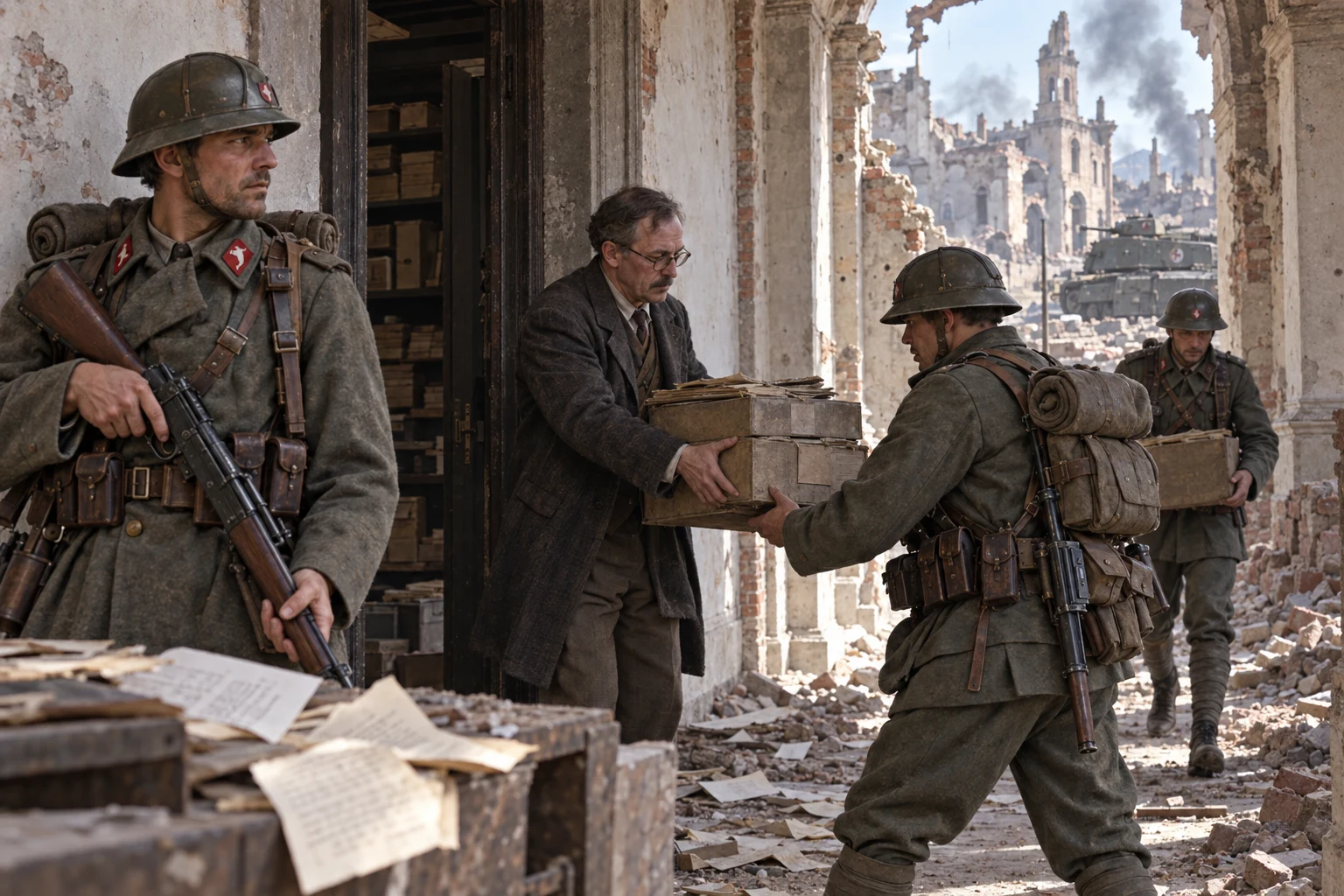
Inside Varkhest, Voss ordered restrictions on movement and demanded that civil departments remain at their posts. Some officials obeyed, others fled, and many attempted to preserve records while avoiding political attention. Archivist Irena Veln moved detention registers from a threatened administrative building into a municipal archive on March 10. She acted with assistance from clerks who feared both destruction by retreating authorities and seizure by uncontrolled crowds. Their records would later help locate prisoners and establish responsibility for abuses. Preserving them did not make Veln a commander of the capital's resistance or imply that every official shared her motives. It was a specific act within an administration breaking apart under pressures its own policies had helped create.
Hukular counterattacks on March 12–13 delayed the Allied approach to the inner city. Major General Taren Oss commanded a grouping of surviving field troops and capital units that recovered part of the Keren district. Teren committed reserves and stabilized the front but suffered heavy losses among formations already depleted by the coastal campaign. Keld's Hestunian forces advanced more slowly on their own approach, encountering defended rail facilities and damaged bridges. Dalvic resisted pressure to announce that the capital had effectively fallen before its principal institutions were secured. The distinction mattered because Veysk still controlled organized forces capable of inflicting losses, while civilians heard distant fighting without knowing whether the next order would come from the existing regime or the approaching armies.
The administrative quarter
Allied troops entered the central administrative quarter on March 18. Fighting separated into battles for ministry buildings, courtyards, and damaged streets. Lieutenant Sera Nemm's Silvian platoon reached a communications office where Hukular operators continued working after their guard withdrew. Nemm accepted their surrender and preserved the equipment under guard. Messages recovered there helped identify units still obeying capital orders, but their contents required verification before use. Some commands had already ceased to exist, while others used old call signs after moving. The capture therefore improved Allied understanding without providing an omniscient picture of the remaining defense. Staff officers compared the records with prisoner accounts and current observations before directing troops toward supposedly abandoned positions.
Veysk requested authority to withdraw his remaining organized forces on March 20. Voss opposed a general withdrawal, fearing its political meaning, while national military commander Soren Kast sought to preserve formations needed for an eventual settlement. The resulting orders differed by unit and time of receipt. Some troops disengaged; others surrendered after becoming isolated. On March 22, a Hukular medical commander negotiated passage for patients from the central military hospital under Allied supervision. The arrangement saved lives without constituting national capitulation. Guards, patients, and medical personnel were registered separately, preventing the hospital's surrender from being represented as the surrender of armies it did not command. Fighting continued elsewhere in the city throughout the evacuation.
Varkhest's principal government district fell on March 23. Voss was captured that afternoon in a secured administrative annex after the building's remaining guards surrendered. The arrest was documented by an Allied custody team and witnessed by surviving civil officials; he was transferred under guard rather than displayed to an uncontrolled crowd. Emperor Orvek II's sovereign authority had failed to preserve the capital, but the capture of the city and director did not automatically terminate every Hukular command. Kast continued the process that produced the general capitulation on April 12. Teren and Keld therefore maintained operational readiness while their troops assumed responsibility for prisoners, hospitals, and a capital whose civil services were close to collapse.
On March 24, Hestunian engineers restored limited power to the central hospital circuit. The work required former municipal technicians to identify damaged connections while Allied guards protected them from crowds suspicious of anyone associated with the fallen administration. Keld publicly distinguished essential technical employment from a judgment about individual political responsibility. Investigators could examine conduct later; wounded patients required electricity immediately. The restored circuit supported surgical lighting and water pumps but left most residential districts dark. Its narrow success showed the scale of the reconstruction task behind claims that the capital's capture had solved Hukular's immediate crisis.
The March operation cost Allied forces 18,742 killed, 49,816 wounded, and 2,104 captured. Hukular losses were 22,691 killed, 46,308 wounded, and 61,427 captured, with wounded prisoners counted once. Civil authorities ultimately recorded 11,862 civilian deaths attributable to the battle and immediate displacement. Varkhest's fall removed the regime's principal administrative center and made continued organized national resistance increasingly untenable. Its capture was nevertheless followed by weeks of military and political work before capitulation. Veln's preserved registers entered Allied custody with signed inventories, beginning investigations and searches that outlasted the battle. The army had taken the capital; making its surviving institutions serve the living required a different kind of persistence amid the ruins.
Patriot Day, 1234: The Last Briefing
The authoritative transcript “The Last Briefing” places a collapsing Hukular command conference in the Imperial Command Bunker on Patriot Day, 1234, two years after Operation SharkStrike. The month and day are unspecified. The Talzar, also called the Imperial Director, is not personally named in this account. Twelve executions for truthful reports have driven fourteen days of fictitious strength returns. General Arven Volzharik reveals that Third Assault Corps retains only a headquarters, and General Aleks Vornetz defends the soldiers who have been ordered to hold impossible fronts. General Zorven Kriezhardt subsequently identifies the capital's bombardment as Silvian S-52 155-millimeter howitzer fire. Its approximately fifteen-mile effective range exposes the obsolete report placing the Silvians eighty miles away. The Silvian First Infantry and Ninth Mechanized Divisions are advancing through the final defensive belts.
The full user-supplied transcript is preserved separately. It is the sole canonical account of this briefing. The scene supplies no replacement date for the capital's fall or Hukular's capitulation.
Original illustrations for this source record
Original archive artwork and captions are preserved. Dates, labels and claims printed within inherited images belong to the previous edition; the revised text governs the current history.