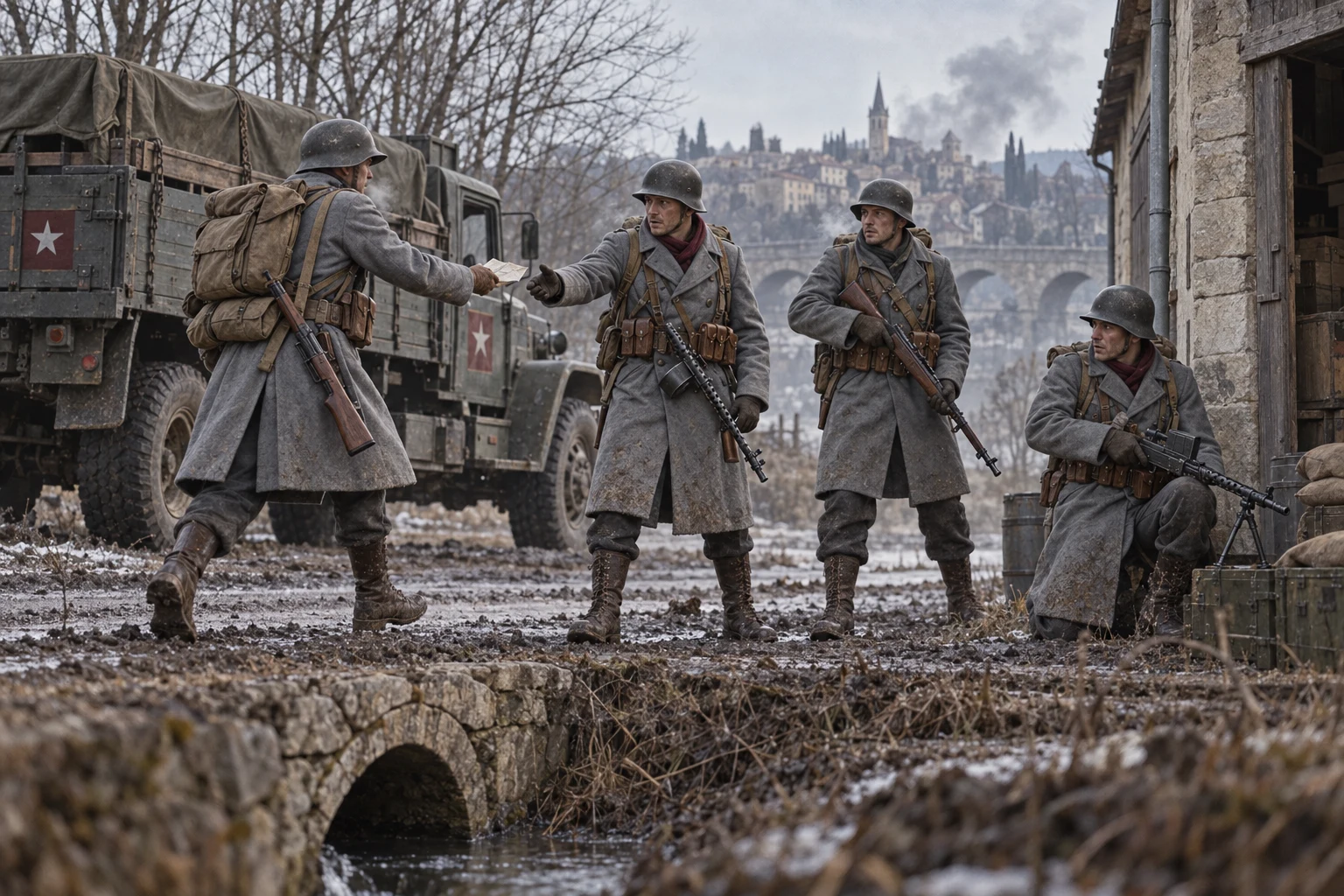
Ravessa recovered
February 2–18, 1234 · Ravell, Ravessa district · Ravell restoration and Allied formations against Hukular occupation forces
A capital after twenty-five years
Ravessa had fallen in September 1208. By February 1234, many of the soldiers advancing toward it had been children or not yet born when Sera Danic's government went into exile. Queen Alena III and the recognized government had preserved Ravell's legal continuity, while the military return depended on the wider Allied successes of 1233–34. Ravell General Anet Daro directed the national restoration force with support from Hestunian and Silvian formations under Allied Lieutenant General Mara Henn. Hukular General Oren Kass commanded the capital defense, reinforced by units withdrawing from the collapsing western position. The liberation campaign began February 2 against the outer communications district. Its purpose was the recovery of Ravessa, not a claim that every Ravell locality would be secure on the same day.
The first serious battle occurred at the northern railway workshops on February 4. Daro's troops approached buildings still carrying faded Ravell signs beneath occupation notices. Lieutenant Nera Sol's company found the engine sheds defended by Hukular rear guards who withdrew only after setting several stores alight. Railway worker Beren Kelm guided firefighters to a surviving water connection, allowing them to prevent the blaze reaching nearby houses. Kelm had spent occupation maintaining equipment for authorities he opposed; the liberating soldiers initially detained him after finding his work permit. Daro's civil liaison staff released him after local testimony established his role. The incident exposed the danger of treating every document of survival under occupation as proof of willing political allegiance.
The city approaches
Kass counterattacked on February 7 along the western approach road. His force briefly separated a Ravell battalion from supporting Hestunian troops and recovered the customs warehouse. Daro suspended further movement until the connection was restored. Some officers urged immediate continuation toward the capital, fearing that caution would allow the enemy to destroy its records and institutions. Daro answered that an isolated battalion could neither liberate the city nor protect its residents. The relief succeeded on February 9, but the delay gave Kass time to strengthen the inner districts. Ravell soldiers therefore paid for the prudent preservation of one formation with harder fighting later, a real tradeoff that cannot be reduced to a painless lesson about patience.
Inside Ravessa, residents prepared for the approach with incomplete knowledge of the front. Municipal physician Lera Hov organized a temporary hospital in the old council archive, choosing it because its cellar remained dry and its walls had survived earlier damage. Occupation officials attempted to requisition the building on February 10. Hov refused to move patients without another suitable site, and a Hukular medical officer supported her despite the local command's objections. The archive continued operating through the battle. Its patients included civilians, occupation soldiers, and eventually wounded liberators. That continuity did not erase the occupation's violence; it preserved a specific institution through decisions made by people whose obligations sometimes crossed the armies' dividing line.
Into Ravessa
Allied troops entered the outer residential wards on February 12. Daro assigned Ravell units to the principal civic approaches while supporting formations secured adjoining districts and routes. The arrangement recognized national restoration without pretending the Ravell force could capture the city alone. Captain Irena Tal's company reached the old education ministry and found its basement full of confiscated records. She posted guards rather than allow soldiers to carry papers away as souvenirs. Those records later helped trace displaced children and detained teachers. Nearby, a Hukular platoon surrendered after its commander was killed, while another continued fighting from a separate building. The city did not change hands through one universal signal; its recovery consisted of many local decisions, some orderly and some destructive.
On February 15, Kass requested permission to withdraw the remaining organized garrison. Higher command authorized evacuation of selected military personnel but ordered continued defense of the central administrative district. The contradictory priorities fractured his command. Some units left, others remained unaware of the movement, and rear guards fought without knowing whether support still existed. Daro exploited the weakening position while maintaining surrender channels for isolated groups. Sergeant Irena Koss accepted the surrender of forty-eight Hukular soldiers in the municipal printing house after their officer received confirmation that prisoners would be registered and treated. The printing machinery survived. Within days, it would produce the first restoration notices, using paper stocks left by the administration whose orders it had previously printed.
The central district was secured on February 18 after fighting around the government square and the final surrender of its defenders. Ravessa's recovery became the official liberation date. Danic did not arrive that afternoon; she returned on March 2 after security and civil preparations made the journey possible. Daro's forces found records locating Ravell prisoners held farther within the Hukular system. Levan Oset, captured after the original capital defense, and Mira Sellen, captured in Serin in 1220, were both alive. Their release followed the Allied advances of 1234 rather than a miraculous appearance during the flag ceremonies. The distinction preserved the actual sequence between recovering a capital, locating prisoners, and bringing survivors home.
The municipal printing house issued its first restoration sheet on February 20. It listed hospital locations, water-distribution points, and instructions for reporting missing relatives before carrying any political proclamation. Daro approved that order of information. One compositor recognized his brother's name among the recovered detention lists and left his shift to seek confirmation, returning hours later after learning that the record concerned an earlier transfer rather than release. The incident illustrated why officials separated evidence of a prisoner's past location from confirmed present survival. The notices gave residents useful information without promising reunions the authorities could not yet deliver.
Allied losses in the February campaign were 7,418 killed, 20,906 wounded, and 893 captured. Hukular losses were 8,672 killed, 18,304 wounded, and 24,619 captured, with wounded prisoners counted once. Civilian deaths attributable to the fighting numbered 3,116. Daro entered the government square after its immediate clearance and ordered medical and civil traffic given priority over ceremonial vehicles. The first public gathering was smaller than planners later imagined, shaped by damaged streets, missing relatives, and the exhaustion of residents. Ravessa had been recovered after a generation of occupation. Its restoration began with working hospitals, guarded records, and people searching lists for familiar names, before speeches could give the victory the coherent shape that lived experience still lacked.
Original illustrations for this source record
Original archive artwork and captions are preserved. Dates, labels and claims printed within inherited images belong to the previous edition; the revised text governs the current history.