The liberation of Meravan
July 14–August 19, 1233 · Garabech Union, Meravan district · Allied and Garabech forces against Axis occupation formations
Returning to a capital
Meravan had fallen in the closing disaster of 1231, forcing President Dalen Orsic's government abroad. By summer 1233, the wider Allied advance created an opportunity to recover the Garabech Union's principal center. Garabech General Mira Kelen commanded the national restoration force alongside Silvian and regional Allied formations coordinated under Lieutenant General Oren Vell. Axis General Taren Hoss held the district with occupation troops and formations retreating from neighboring positions. Lieutenant Sera Malk, who had fought at Liberty with the Garabech 6th Exile Regiment inside the Commonwealth's 3rd Brigade, reached the liberation force through an actual transfer authorized in June. Her presence did not duplicate the regiment or place her simultaneously at Liberty and Meravan. She served with a Garabech liaison group identifying routes, institutions, and surviving local officials.
The campaign opened July 14 against the industrial approaches west of Meravan. Allied troops captured the rail depot at Arven but found the line beyond it heavily damaged. Hoss withdrew exposed units while reinforcing the bridges and factory districts closer to the capital. His command was not a single untouched garrison: it included exhausted troops, security detachments, and units whose own headquarters had moved repeatedly. Kelen's intelligence staff nevertheless warned against assuming immediate collapse. On July 18, a Garabech battalion entered the town of Eres after receiving reports that the enemy had left. Axis rear guards remained in the municipal buildings and inflicted severe losses before withdrawing. Major Nera Sol, commanding the battalion, acknowledged that the desire to return had outrun confirmation of what awaited them.
The western factories
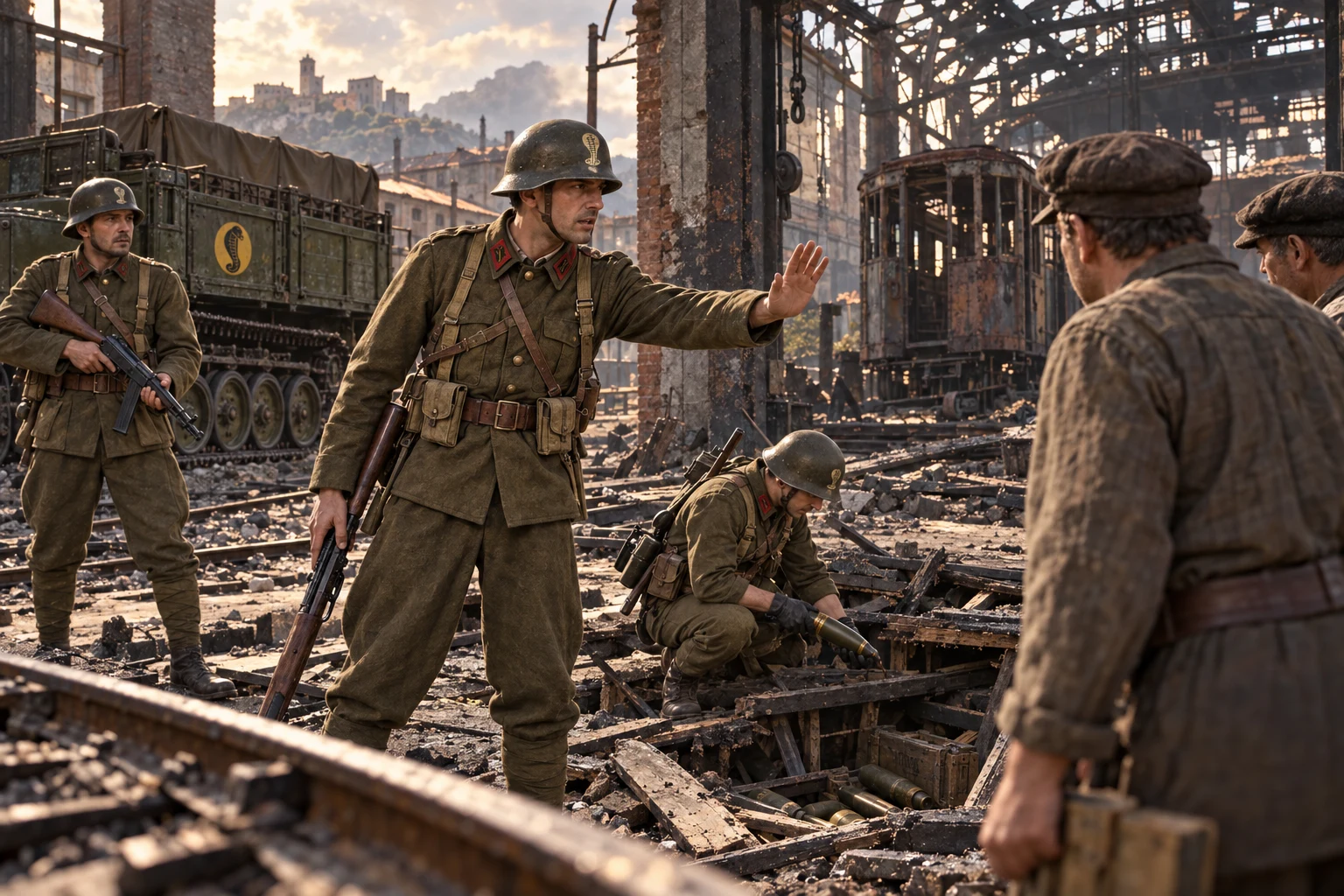
By July 27, Allied forces reached Meravan's outer factories. Malk accompanied a civil liaison party to the old tram works, where she recognized a repair shed used during the 1231 evacuation. Its roof had fallen, and the wall where departure lists had once been posted was scarred by fire. Recognition did not make the building safe. A security inspection found ammunition stored beneath collapsed flooring, delaying its use as a reception center. Malk redirected returning residents toward another facility and insisted that familiar places undergo the same checks as unfamiliar ones. The decision frustrated families eager to enter their neighborhoods but prevented the restoration effort from treating emotional certainty as physical safety. Her own family's house lay beyond the current front and remained inaccessible.
Hoss counterattacked on August 1, striking the Allied salient through the western factories. His troops recovered the rolling mill and separated two Garabech companies from the main advance. Captain Lera Voss, unrelated to Hukular's director, held the machine shop with 113 soldiers and twenty-two civilians who had sheltered there. After two nights, a relief force opened a route out. Voss evacuated the civilians first, then withdrew with the wounded and remaining troops. The machine shop was abandoned, preserving lives at the cost of a building the Allies would have to recapture. Vell accepted the decision and redirected pressure toward a neighboring district. Hoss's counterattack delayed liberation but consumed reserves that could not be replaced as the wider front continued to move against him.
The municipal district
The final approach began August 9. Kelen's restoration force entered the western residential wards while Silvian formations pressed the industrial district and regional Allies secured adjoining routes. Malk worked with municipal clerk Eren Tal to establish which officials had continued essential services under occupation and which had participated in repression. Tal had preserved duplicate housing and death records in a school cellar. He refused to hand them to an armed political group demanding immediate lists of collaborators, instead giving them to the recognized civil authority under guard. Kelen supported the distinction between securing records and authorizing private punishment. Liberation brought people with justified grievances into contact with suspected offenders, making command restraint an active responsibility rather than a ceremonial statement.
Fighting reached the central tram exchange on August 14. Hoss's rear guards held the exchange and nearby offices while the main occupation force withdrew through remaining routes. Garabech Sergeant Nera Kelm found her former apartment occupied by an Axis aid station. She helped move wounded prisoners to a safer building before searching for surviving neighbors. Her parents had died during occupation, a fact confirmed by Tal's records two days later. The sequence denied her the reunion she had imagined through years abroad, but she remained on duty until her company was relieved. Malk's liaison party likewise encountered a city whose recovery could restore access to the past without repairing it. Lists of the living and dead moved through the same offices that prepared the first public notices of liberation.
On August 18, Hoss authorized the remaining organized troops to withdraw or surrender when escape was no longer possible. Isolated fighting continued into the following morning. At 11:30 on August 19, Garabech forces secured the central municipal complex and declared Meravan's principal center recovered. The date marked a definite military and civic achievement, not the immediate clearance of every damaged district or the end of the wider war. President Orsic's representatives assumed civil responsibility through the restored national administration. Malk remained with the liaison group during the transition and later joined the restored Garabech army. She had returned through a chain of campaigns and formal transfers, carrying the experience of an exile regiment into the institutions that exile had preserved.
The first tram resumed limited service on August 27 between the western reception district and a repaired municipal stop. Its route avoided unstable bridges and served relief workers before ordinary passengers. Tal preserved the initial timetable with the restoration records because it showed exactly how little of the recovered capital could yet function normally.
The July–August campaign cost Allied formations 9,714 killed, 27,883 wounded, and 1,429 captured. Axis losses were 11,206 killed, 24,917 wounded, and 18,604 captured, with wounded prisoners counted once. Civilian authorities eventually identified 4,382 deaths attributable to the battle itself, separately from occupation deaths documented through recovered records. Meravan's liberation reopened a national center and relieved a major consequence of the 1231 collapse. It also created immediate demands for housing, food, investigation, and reconstruction. Malk reached her family's former street on August 22, after the official recovery date. The visit belonged to the aftermath of victory: she found surviving neighbors, learned who had died, and began the slower work of living in a city that her military return had finally made reachable.
Original illustrations for this source record
Original archive artwork and captions are preserved. Dates, labels and claims printed within inherited images belong to the previous edition; the revised text governs the current history.