The first inland belt battles
November 3–December 8, 1232 · Hukular coastal interior, Operation SharkStrike · Allied coastal armies against Hukular and attached Teran forces
Beyond the beaches
By November, SharkStrike had secured a coastal foothold, but the eight-belt defensive system still imposed depth and repeated fighting. The November operation sought to expand the connected lodgment through selected positions of the first inland belt behind the coastal defenses. It did not conquer all seven inner belts or bring forward the general breakout that began in April 1233. Hestunian General Marshal Eren Dalvic coordinated the Allied effort, while national commanders retained responsibility for their sectors. Silvian Lieutenant General Mara Teren directed a corps grouping advancing from the Iron district toward the inland town of Vardel. Hukular General Radan Veysk assigned General Oren Kall's 6th Field Army to the threatened belt, reinforced by Teran units under the wider theater arrangements of Marshal Deren Ulst.
The attack began on November 3 along a front already crowded with units, repair organizations, and the residue of the September landings. Teren's leading division captured the village of Harvel but stalled at a railway embankment beyond it. The embankment had been strengthened as part of the inland system, and the defenders could move between adjoining positions more readily than the attackers expected. Captain Sera Del reported that her company faced troops wearing Teran insignia, information initially dismissed as confusion over uniforms. Prisoners taken the next day confirmed the identification. The discovery mattered because Allied estimates had treated that section as held entirely by depleted coastal units. Teren revised the estimate before authorizing another attack, accepting a delay rather than allowing an obsolete description to govern the next day's fighting.
The town in the belt
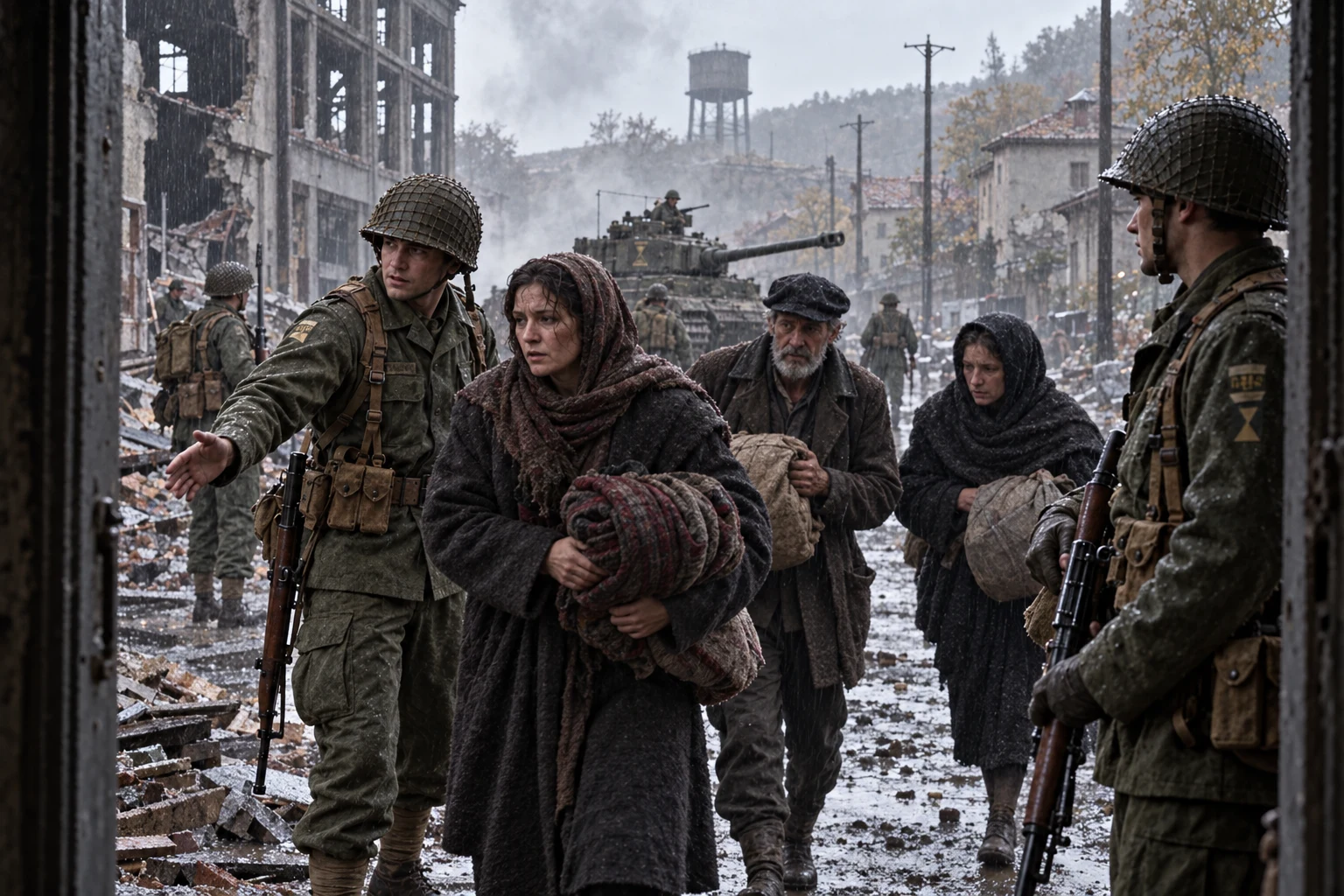
Vardel stood behind the embankment, with a municipal water tower visible above factories and warehouses. Its civilians had endured military occupation of their buildings before the Allied approach, and evacuation orders had been unevenly enforced. On November 8, Allied troops entered the western industrial district and found residents sheltering beneath a textile mill. Civil affairs Lieutenant Nera Hov arranged their movement to a screened reception area near the coast. The process included searches and registration, creating fear among people who did not know what Allied occupation would mean. Hov required interpreters at the registration tables after discovering that families were being separated by misunderstood instructions. Restoring them consumed hours but prevented temporary confusion from hardening into missing-person cases that might last months.
Kall counterattacked on November 11 with Hukular infantry supported by an attached Teran regiment. The attack retook the textile mill and forced the Allies back to the town's western road. Teren's staff initially reported that the entire advance had been lost. A corrected map showed that Harvel and the embankment's southern section remained Allied. Dalvic insisted on the correction before allocating reserves, because a distorted report could draw strength from neighboring sectors that still needed it. The episode illustrated the difficulty of commanding an operation whose scale encouraged both extravagant victory claims and exaggerated alarm. Neither the loss of a mill nor the capture of a village settled the campaign, but each could affect decisions across a much larger front if described inaccurately.
Airborne survivors
During mid-November, elements of the airborne force that had entered the theater months earlier linked more closely with the coastal armies. These soldiers were already included within the Silvian commitment to SharkStrike, not a newly added force. Captain Iven Sarl's company of the 18th Airborne Regiment supplied guides and reports from its prolonged operations inland. Sarl warned Teren's staff that several roads shown as usable had deteriorated or remained under enemy control. His men knew local conditions through experience, but their information also aged quickly as formations moved. A patrol relying on an older airborne report reached an occupied farm on November 17 and lost twelve men before withdrawing. Sarl corrected the account and refused the suggestion that veteran status made his unit's observations permanently authoritative.
The second Allied effort opened on November 23 with more limited objectives around Vardel. Teren's corps recovered the textile mill and established control of the southern industrial district, while Hestunian formations advanced on an adjoining section of the belt. Coordination improved without eliminating national differences in reporting and support. Lieutenant Colonel Lera Nemm commanded a Silvian battalion that reached the water tower, only to find the surrounding district still contested. She withdrew from the tower compound after assessing that occupation would isolate her unit. The decision surrendered a visible landmark but preserved a position connected to the rest of the corps. Teren endorsed her judgment, having seen earlier campaigns turn conspicuous objectives into traps that commanders felt unable to abandon.
Rain and cold slowed movement in early December, while casualties reduced the formations available for another major effort. Dalvic closed the offensive on December 8 after national commanders agreed that the current gains should be consolidated. The Allies had expanded their foothold, breached selected parts of the first inland belt, and recovered several towns and road connections. The wider system remained active, including strong positions farther inland. Veysk retained organized forces and continued to receive support through the Axis theater. The 1233 breakout therefore remained a future campaign requiring new preparation, rather than an administrative announcement following the inevitable collapse of defenses already supposedly conquered. Soldiers occupying Vardel's southern mills could still hear enemy movement in the northern streets on quiet nights.
Vardel's water tower remained outside secure Allied possession when the operation closed. Engineers established a temporary supply from repaired industrial tanks instead, reducing dependence on the contested landmark. The arrangement sustained the southern district through winter and gave Nemm's withdrawal a practical vindication that could be measured in daily deliveries rather than retrospective praise.
Across the defined November–December operation, Allied losses were 18,406 killed, 52,713 wounded, and 3,281 captured; Axis losses were 21,884 killed, 57,906 wounded, and 14,672 captured. These theater-suboperation totals incorporated the smaller encounters described here and did not add personnel to the original invasion commitment. Civilian death records remained separately reconciled, ultimately identifying 3,108 deaths attributable to the fighting and immediate evacuation. Sarl's men returned to airborne administrative control after their attachment, carrying fewer illusions about the coast's comfort than they had before linking with it. Teren's troops spent winter in damaged industrial buildings, preparing for another offensive. The foothold had grown, but growth meant a longer front, more people to support, and another set of positions whose capture was still ahead.
Original illustrations for this source record
Original archive artwork and captions are preserved. Dates, labels and claims printed within inherited images belong to the previous edition; the revised text governs the current history.