Granite Beach
September 6–10, 1232 · Hukular coast, Operation SharkStrike · Silvian 48th Infantry Division against the Hukular Granite sector
The northern quarry cliffs
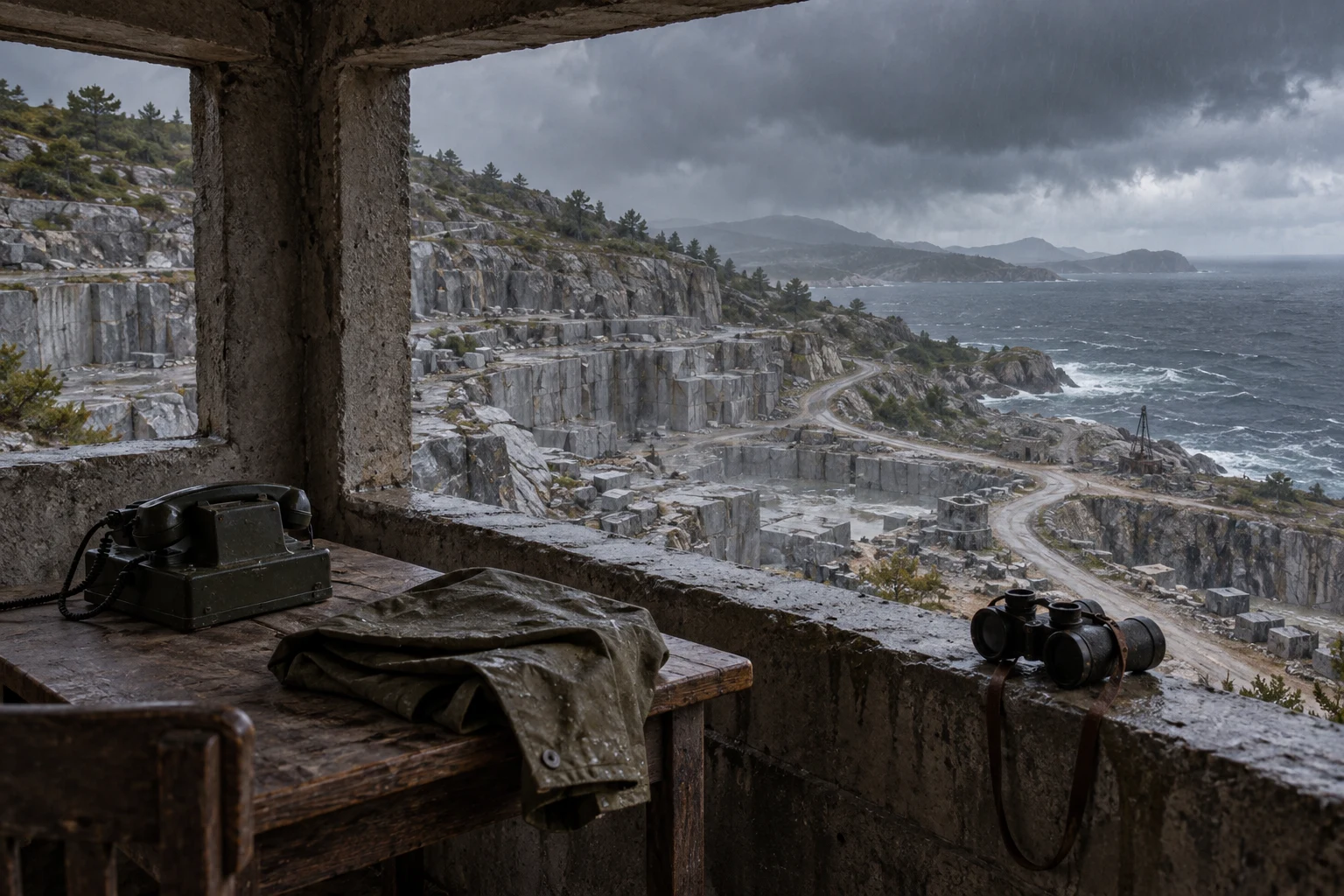
Granite, centered at chainage 104, was one of SharkStrike's four cliff sectors alongside Hell, Razor, and Liberty. Its principal assault force was Major General Irena Vell's Silvian 48th Infantry Division, with an opening establishment of 18,900 personnel. Hukular Major General Taren Oss commanded 17,300 defenders distributed through the sector's coastal positions and immediate reserves. Granite's cliffs included an old stone-quarry district, with broken terraces above a narrow shoreline and a damaged industrial road climbing inland. These local features distinguished its battle from Hell. The same invasion weather affected both sectors, but Granite did not reproduce Hell's exact bombardment failure, casualty figures, or eight-hour sequence. Its opening success depended on securing usable access through the quarry district before the crowded shore became impossible to sustain.
At 06:40 on September 6, the first craft reached Granite's landing area. Waves struck wreckage near the quarry loading pier, overturning one boat and forcing others to land farther along the beach. Captain Mara Terv's company came ashore beneath the old conveyor supports and lost contact with its battalion almost immediately. The cliff reflected the sound of firing, making it difficult to distinguish positions overhead from those farther along the coast. Terv found a mixed group of engineers and infantry sheltering behind fallen stone blocks. She established a local command post there and sent separate reports by radio and runner, one of which reached Vell's headquarters afloat. The report described surviving troops in a viable position, correcting an earlier message that the entire landing group had been destroyed.
The quarry road
Colonel Saren Hov's 162nd Infantry Regiment fought toward the lower quarry buildings during the morning. Naval support had damaged several defenses but left others capable of firing on the shore. A warehouse fire filled the lower road with smoke and forced wounded men toward the landing area just as fresh troops arrived. Engineer Lieutenant Nera Pell found the road blocked by a collapsed retaining wall and reported that vehicles could not use it without substantial work. Vell refused to send the next scheduled heavy equipment wave into the congestion. The diversion delayed support but reduced the number of vehicles stranded beneath the cliffs. Infantry continued moving through the quarry district while engineers assessed which surviving industrial structures could bear the traffic now expected of them.
Oss committed his nearest reserve at 13:15. Hukular troops descended into the upper quarry and drove Hov's leading battalion from the cutting sheds. Terv's company, now connected with the regiment, held the lower office building through repeated attacks. Sergeant Eren Vahl organized the wounded in a cellar whose doorway was partly blocked by debris. He remained there after receiving orders permitting withdrawal, unwilling to abandon men who could not move. When the Hukular attack withdrew before evening, a medical party reached the cellar and removed thirty-eight patients. Vahl had been killed by a fragment while assisting the last group inside. The rescue remained incomplete until after dark, preventing the episode from becoming a simple account of one man's action producing immediate deliverance.
The first night brought no full security. Hukular fire continued from positions overlooking sections of the shore, and the quarry road remained unsuitable for sustained vehicle movement. Vell shifted her headquarters ashore on September 7 despite the congestion, believing that reports from afloat could no longer convey the local relationships clearly enough. Her staff occupied a damaged weighhouse with direct contact to Hov and the engineers. The move improved decisions but exposed the command group to shellfire; a strike that afternoon killed nine staff members and wounded the divisional signals officer. Vell stayed. She later defended the relocation while acknowledging that proximity to the battle did not exempt a commander from considering the survival of the staff needed to run it.
The upper terraces
On September 8, the 48th attacked the upper terraces after enough support had reached the lower quarry to sustain a renewed effort. Colonel Lera Sol's 163rd Regiment entered the cutting sheds and held them against a counterattack, while Hov's depleted troops secured the lower connections. Lieutenant Taren Om's platoon reached a stoneworkers' hostel beyond the quarry and found Hukular troops withdrawing through its rear yard. The encounter ended with twenty-seven prisoners after their officer was killed. Om prevented an angry soldier from firing on men who had already laid down weapons, then removed him from the position for investigation. The incident entered the regimental report, preserving both the surrender and the disciplinary failure that nearly followed it.
Oss withdrew the surviving sector reserve during September 9, leaving rear guards to delay the Silvians. The quarry road opened to controlled military traffic that afternoon, transforming Granite's practical capacity without making the route safe from every enemy weapon. By September 10, the division held the upper district and a connected perimeter inland. The beachhead could now receive and move the support required for continued operations. Four days had passed since the opening landing. Vell rejected a proposed communiqué describing Granite as another eight-hour victory, because that borrowed the timing of Hell and erased the continuing danger faced by her own troops. Accurate distinction between neighboring battles mattered to the operational history as well as to the families receiving casualty notices.
The repaired road's first authorized casualty convoy left the upper quarry at 16:25 on September 9. Drivers moved slowly past damaged equipment and soldiers flattening themselves against the remaining wall. Seventy-six patients reached the shore medical station in that movement, including men whose evacuation had been postponed repeatedly since the first day's fighting.
The 48th Division's final opening-battle register listed 3,287 killed, 6,041 wounded, and 229 captured. Hukular sector losses were 3,884 killed, 5,203 wounded, and 4,162 captured, with wounded prisoners included only in the captured category. These figures belonged to Granite and remained within the larger operation's accounting. The quarry road became a working military route, crowded with vehicles whose passage had cost the division much of its initial strength. Terv survived and received command of a reconstructed battalion later in the campaign. Pell stayed with the engineering work long after newspapers moved to other sectors. Above the repaired weighhouse, the cliffs still bore the dark marks of fires that had guided some men toward shelter and hidden others from the people trying to save them.
Original illustrations for this source record
Original archive artwork and captions are preserved. Dates, labels and claims printed within inherited images belong to the previous edition; the revised text governs the current history.