Paladin Beach
September 6–12, 1232 · Hukular coast, Operation SharkStrike · Hestunian 9th Guard Division and national supporting forces against the Hukular Paladin sector
A Hestunian landing
Paladin's center lay at chainage 120 in the invasion's coastal survey. Hestunian Lieutenant General Oren Keld commanded the sector assault, with Major General Mara Valt's 9th Guard Division forming its principal landing force. The division's opening establishment comprised 21,400 personnel; supporting Hestunian units belonged to the broader Allied commitment already counted within SharkStrike's 11.6 million. Coalition coordination under General Marshal Eren Dalvic did not erase national command authority. Keld remained responsible for Hestunian decisions, discipline, and casualty reporting. Hukular Major General Saren Voss, unrelated to Imperial Director Darek Voss, commanded the defending sector. His force of 18,600 occupied a low coastal district around the fishing town of Belren and the railway embankment behind it. Paladin was not one of the four cliff sectors.
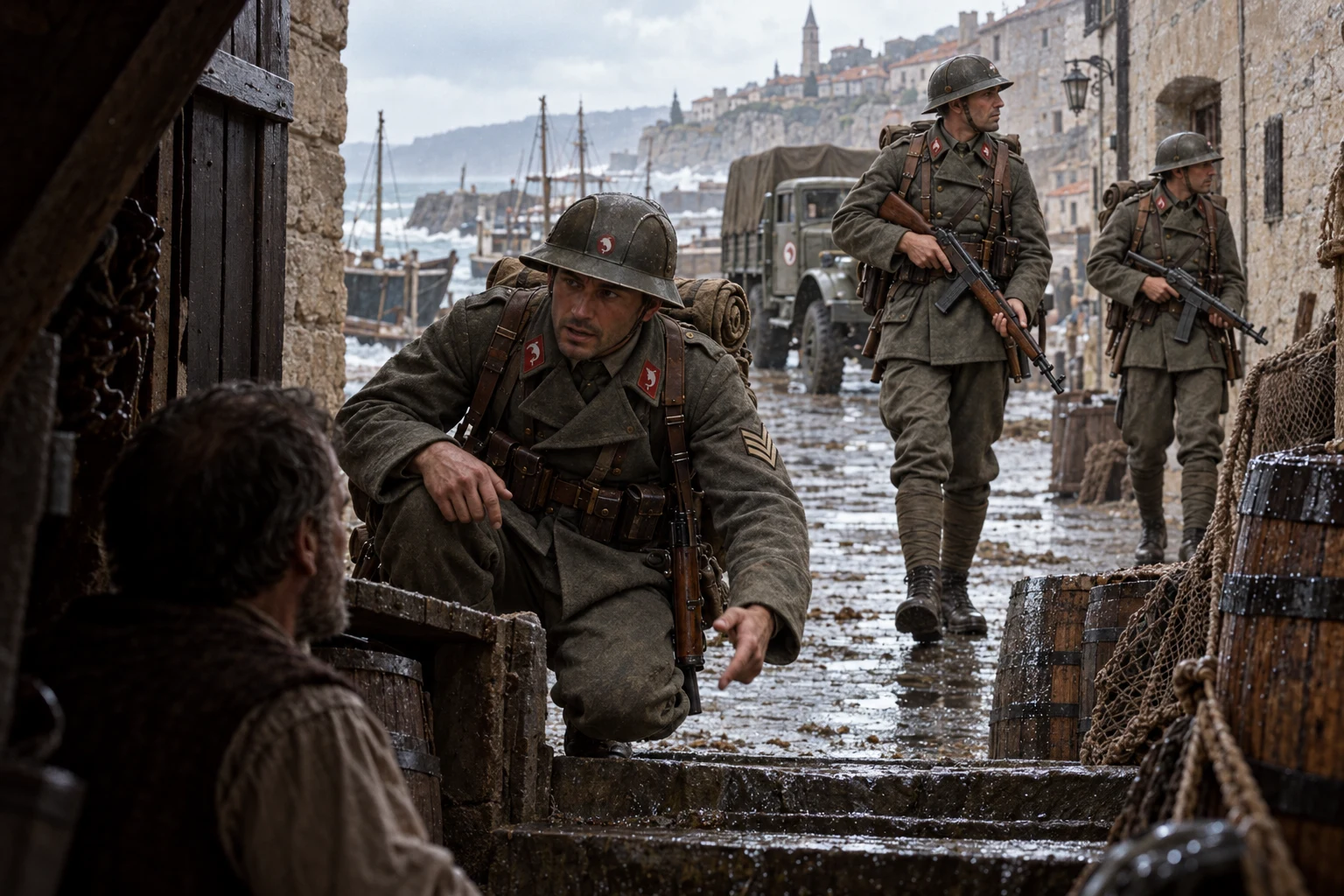
The opening waves reached shore at 06:55 on September 6. Hestunian troops landed amid smoke that obscured some defenses while concealing damaged landing markers from the boat crews. Captain Irena Sol's company came ashore near Belren's southern seawall and found a breach narrower than expected. Men crowded behind it while officers attempted to direct separate groups into the town. A Hukular shell struck the seawall at 07:18, killing Sol's second commander and blocking the passage with masonry. Sol divided her surviving force, keeping one group near the landing point while leading another through a boat-storage yard. The movement reached the first houses but severed visual contact with the beach. For ninety minutes, her battalion believed the entire company remained pinned at the wall.
Belren's houses
The fishing town contained civilians who had been ordered to evacuate but could not or would not leave. In a cellar beneath the cooper's shop, Hestunian Sergeant Taren Vell found fourteen residents and two wounded Hukular soldiers. He placed a guard above the cellar and continued with his section, sending its location to the medical organization. The message reached a headquarters occupied with other crises and was not acted upon until evening. One wounded soldier died before help arrived. The surviving residents later distinguished Vell's conduct from the delay that followed, refusing a simplified account in which the invaders were either uniformly protective or uniformly indifferent. Keld's inquiry accepted the delay as a failure in casualty-location reporting and changed the sector's collection procedure.
Voss counterattacked from the railway embankment on September 7. His troops entered Belren's northern streets and threatened to divide the Hestunian position. Valt committed the Guard Division's 31st Regiment, commanded by Colonel Nera Tal, before its final battalion had fully landed. Tal assembled the available companies around the market building and stopped the counterattack after a day of fighting through adjoining courtyards. Hestunian artillery support remained uneven because several batteries were still afloat or delayed behind damaged exits. Naval fire therefore carried more of the immediate burden, with observers struggling to distinguish nearby positions in the smoke. A mistaken correction damaged an occupied Hestunian house and killed eleven soldiers. The incident was investigated rather than folded anonymously into enemy-inflicted losses.
By September 8, Keld held Belren but lacked the railway embankment controlling its inland approaches. He rejected a proposal to send the exhausted 31st Regiment forward immediately. Valt supported the pause, while some coalition staff officers worried that Paladin's delay would constrain neighboring operations. Dalvic upheld national command judgment while requiring an explicit account of when the sector could support the broader plan. Keld promised a renewed effort on September 10, conditional on the arrival of specified engineering and medical capacity. His position was neither unrestricted independence nor obedience without responsibility. It reflected the negotiated coalition structure through which several national armies attempted one invasion without becoming a single undifferentiated force.
The embankment
The renewed attack began at 08:10 on September 10. Tal's regiment advanced alongside the freshly landed 44th Infantry Regiment under Colonel Iven Mar. Hukular defenders held the embankment's freight platform until afternoon, inflicting heavy losses on the leading Hestunian battalion. Lieutenant Sera Kelm brought a platoon into an abandoned signal cabin and discovered that the apparent rear exit opened onto a collapsed stairway. The men remained trapped there until adjacent troops cleared a route along the platform. Kelm was killed during the relief, but twenty-nine of her platoon's forty-two soldiers survived. Their testimony corrected a preliminary report that the cabin had been taken without opposition, showing how the speed of an advance on a map could conceal hours of desperate immobility inside one building.
Voss withdrew surviving sector forces during September 11 after the embankment became untenable. Rear guards continued fighting in the rail depot until the following morning. The Hestunians secured the depot on September 12, taking 1,104 prisoners there and opening a more reliable route beyond Belren. The sector now possessed a functioning beachhead with depth sufficient for sustained reinforcement. It remained part of the coastal foothold, not a completed penetration of the entire inland defense system. Valt ordered her division reorganized before further major attacks, grouping survivors without erasing the identities needed for casualty records and family notifications. Belren's civil residents were moved away from the heaviest military traffic while local relief arrangements developed under Allied control.
A Hestunian military photographer reached the freight platform on September 11 and found soldiers marking the signal cabin's casualties on a plank. He photographed the names before making the familiar image of troops beside captured equipment. The contact sheets survived together, preventing the public picture of success from becoming the only visual record of what the regiment had endured to obtain it.
The Guard Division's final register for the opening battle listed 2,784 killed, 6,913 wounded, and 241 captured; attached forces kept their own reconciled returns. Hukular sector losses were 3,507 killed, 5,882 wounded, and 4,116 captured, with no double counting of wounded prisoners. Paladin had consumed more time and strength than its planners expected, yet it provided Hestunia with a secure place in the invasion and a practical route inland. Sol survived and received promotion after her company's reconstruction. Tal retained command of the depleted 31st. In Hestara, the first casualty notices arrived alongside reports of success. The two were not contradictory: the national force had achieved its objective through losses borne by named families, in a battle whose authority and responsibility remained Hestunian even within the enormous Allied operation.
Original illustrations for this source record
Original archive artwork and captions are preserved. Dates, labels and claims printed within inherited images belong to the previous edition; the revised text governs the current history.