Iron Beach
September 6–9, 1232 · Hukular coast, Operation SharkStrike · Silvian 22nd Infantry Division and supporting forces against the Hukular Iron sector
A beach without a cliff
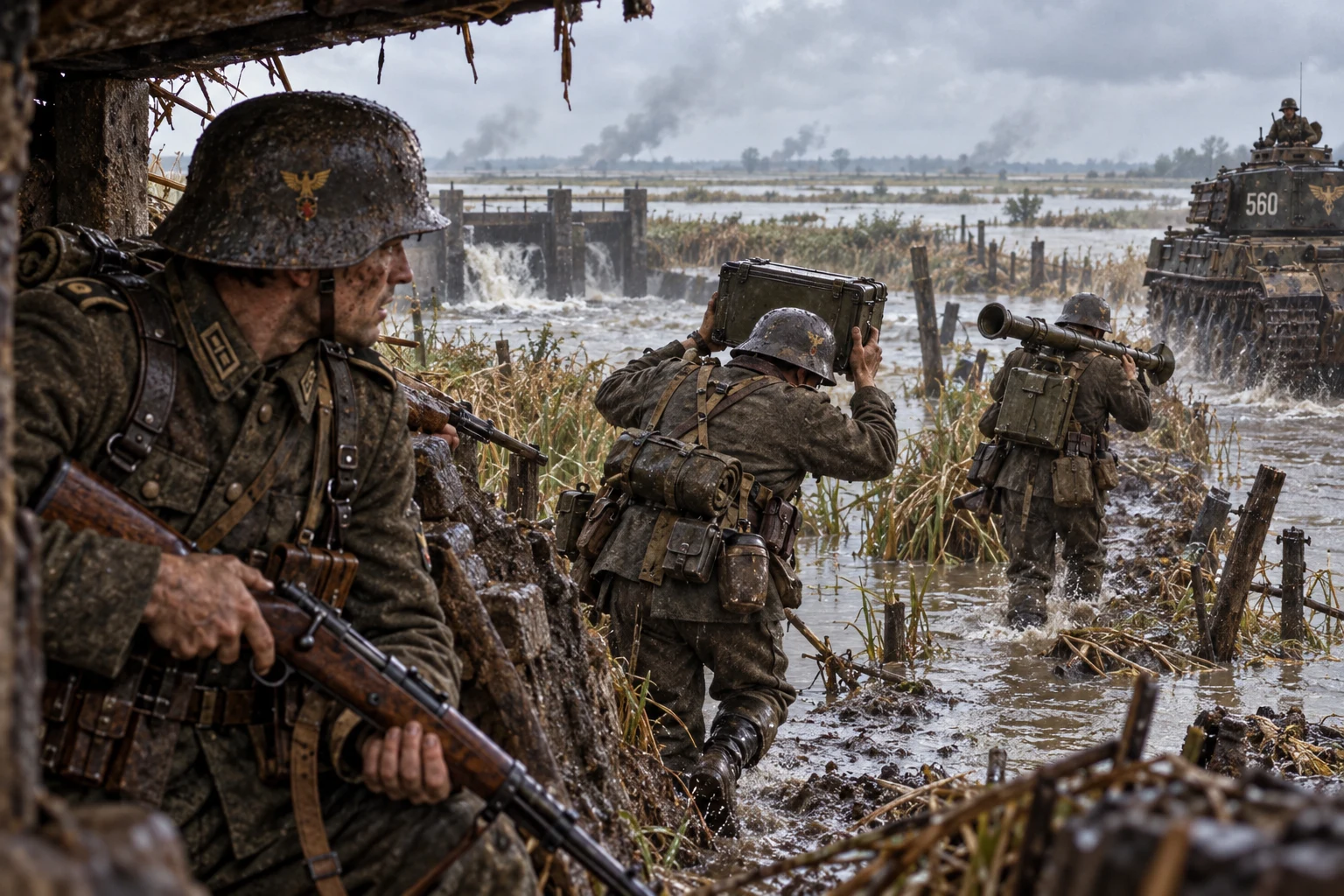
Iron lay at coastal chainage sixteen kilometers in SharkStrike's operational survey, immediately following Hell in the sector sequence. It was a noncliff beach, and its difficulties differed from Hell's steep ground and catastrophic opening losses. Major General Mara Venn's Silvian 22nd Infantry Division supplied the principal assault force, with 19,200 personnel assigned to the division's opening battle establishment. Colonel Raden Kelm commanded the Hukular sector garrison of 16,840 troops, including coastal artillery and reserve elements. Those forces were parts of the already established operation totals, not additional armies added to SharkStrike. Iron's low shoreline opened onto drained agricultural land divided by embankments and a canal leading toward the inland settlement of Ordan. Its apparent accessibility concealed ground easily flooded and roads vulnerable to congestion.
The first landing craft approached at 06:45 on September 6. Fire from surviving Hukular positions struck the leading waves before they reached the sand, but naval support had suppressed several guns covering the central approach. Lieutenant Tera Sol's company landed south of its intended position after its craft commander avoided a burning vessel. The soldiers reached shore with most of their weapons but without the adjacent company they expected to support them. Sol led them toward an abandoned fisheries building where scattered troops were gathering. Its walls offered shelter from some fire while becoming a conspicuous target. At 07:32, a shell collapsed the upper floor and buried several wounded men beneath timber and fish-processing equipment. Rescue continued while the company's officers tried to restore contact with their battalion.
The road from the sand
Venn's immediate problem was movement off the beach. Two exits remained blocked by damaged vehicles and wrecked structures, while a third opened into ground already becoming waterlogged. Engineer Major Iven Rell reported that the canal gates had been damaged and that incoming water would spread beyond the area shown on prelanding estimates. He requested authority to divert traffic from the central exit before it became unusable. The divisional staff initially resisted because that route carried the largest planned volume. Venn accepted Rell's assessment after receiving photographs from an observation aircraft. The change stranded several landing groups temporarily but prevented the next waves from adding vehicles to a road that would disappear under water before afternoon.
Kelm counterattacked at 11:10 with a reserve battalion supported by mobile guns. The attack reached the fisheries building and forced Sol's mixed group to withdraw toward the beach embankment. Corporal Nera Dal stayed with four wounded men until a medical party returned. She was wounded during the evacuation but survived, later returning to administrative service. The Hukular battalion retook the building, then came under fire from Silvian ships and troops consolidating to either side. Kelm could not sustain the position and withdrew the reserve before it was cut off. The exchange consumed much of his most immediately available strength. By evening, Venn possessed a connected strip of shoreline but only an unreliable route into the agricultural district beyond it.
During the first night, the beach became a crowded landscape of unloaded stores, damaged craft, casualty stations, and units searching for their own headquarters. Naval Lieutenant Ceren Vol organized traffic at the southern exit after discovering that separate landing groups were using incompatible numbering systems for assembly points. He replaced the conflicting signs with a common local scheme and sent runners to the affected commands. The correction sounds small beside the battle's scale, but it reduced the movement of wounded men toward the wrong collection area and returned several ammunition loads to the units awaiting them. Venn's staff incorporated the revised signs into its situation map before dawn. The beach had become usable through numerous repairs to a plan that had not survived intact.
Ordan and the canal bank
On September 7, the 22nd Division advanced toward Ordan with support arriving through the southern exit. Hukular defenders held the canal bank, forcing repeated pauses as Silvian companies encountered resistance in separate farm compounds. Colonel Sera Halen of the 76th Infantry Regiment refused to call the settlement secured after her leading battalion entered its western street. Enemy troops still occupied the mill and the eastern bridge approach. Her caution prevented follow-on vehicles from entering an uncleared district, although impatient officers at the beach believed she was delaying exploitation. The mill fell late that afternoon after its defenders withdrew with their wounded. The bridge remained contested overnight, leaving Iron's inland position shallower than its map outline suggested.
Kelm ordered a further withdrawal on September 8 after receiving instructions from coastal commander General Radan Veysk to preserve surviving forces for the inland system. Some garrison units obeyed coherently; others were isolated and surrendered. The Silvians took the bridge approach on September 9 and established an inland perimeter sufficient for continued unloading and movement. They had not crossed all eight defensive belts or achieved the later 1233 breakout. Venn's division was already diminished, and the waterlogged district restricted the throughput that Iron could support. Engineers continued work after the principal battle ended, while medical teams cleared temporary stations that had held men far longer than the prelanding schedule allowed.
Rell's engineers preserved the damaged gate mechanism for later inspection. Its fracture pattern showed that both prelanding bombardment and the defenders' attempted adjustments had contributed to the flooding. Venn's report therefore rejected the simple claim that the enemy had deliberately inundated the entire district. The distinction changed the engineering estimate for neighboring ground and prevented another landing group from avoiding a route that remained usable under controlled traffic.
The 22nd Division recorded 2,146 killed, 4,982 wounded, and 193 captured or missing subsequently confirmed captured during September 6–9. Those mutually exclusive outcomes differed from Hell's separate, fixed casualty register. Additional naval and attached-unit losses were recorded within their own organizations and the wider operation accounts. Hukular sector losses were 3,104 killed, 5,616 wounded, and 3,287 captured, with wounded prisoners counted only in the captured category. Iron's victory secured a practical coastal entry through adaptation, costly fighting, and the survival of enough support capacity to continue. Sol's company occupied a farm beyond Ordan by the fourth evening. From there, the soldiers could see fires along the coast and hear fighting inland, reminders that gaining their beach had opened another campaign rather than finished one.
Original illustrations for this source record
Original archive artwork and captions are preserved. Dates, labels and claims printed within inherited images belong to the previous edition; the revised text governs the current history.