The Larvan replacement convoy
November 7–15, 1231 · Sea passage from Larvan toward Allied Grand Isles ports · Larvan Allied escorts against a Kelonese raiding group
Reinforcements from the southern continent
Convoy Northern Promise departed the Larvan assembly area with thirty-two principal transports carrying replacement personnel, aircraft components, and repair equipment for consenting Allied ports in the Grand Isles. Aldvik, Brenholm, Norvik, Skalen, Dalsen, Eldrun, and Fjaren had entered the war against the Kelonese in 1211; the convoy represented their continuing contribution twenty years later. It did not transfer a sixth of the Silvian army to Larvan or revise the republic's established four-theater allocation. Aldvik Rear Admiral Soren Hald commanded the escort from the cruiser Winter Crown. Brenholm Captain Mira Len controlled the transport schedule, and Norvik Commander Taren Voss led the destroyer screen. The shared command had rehearsed communications because similar ship names and translated signals had caused confusion during earlier movements.
On November 7, severe weather scattered the convoy's rear section. The Eldrun transport Hearth of Fjells lost contact after a steering failure and was found the next morning by the destroyer Brenning. Len ordered the main convoy to reduce speed while Hald assessed the risk of waiting. Kelonese Rear Admiral Jiro Mase, commanding the raiders, received reconnaissance reports that identified a large slow movement but underestimated its escort. His force comprised the cruiser Shinkai, three destroyers, and supporting submarines assigned to the wider passage. Mase aimed to destroy loaded transports rather than engage Larvan warships on equal terms. The weather that delayed the convoy also limited his reconnaissance, leaving both commanders to act on sightings already several hours old.
The ship that stopped
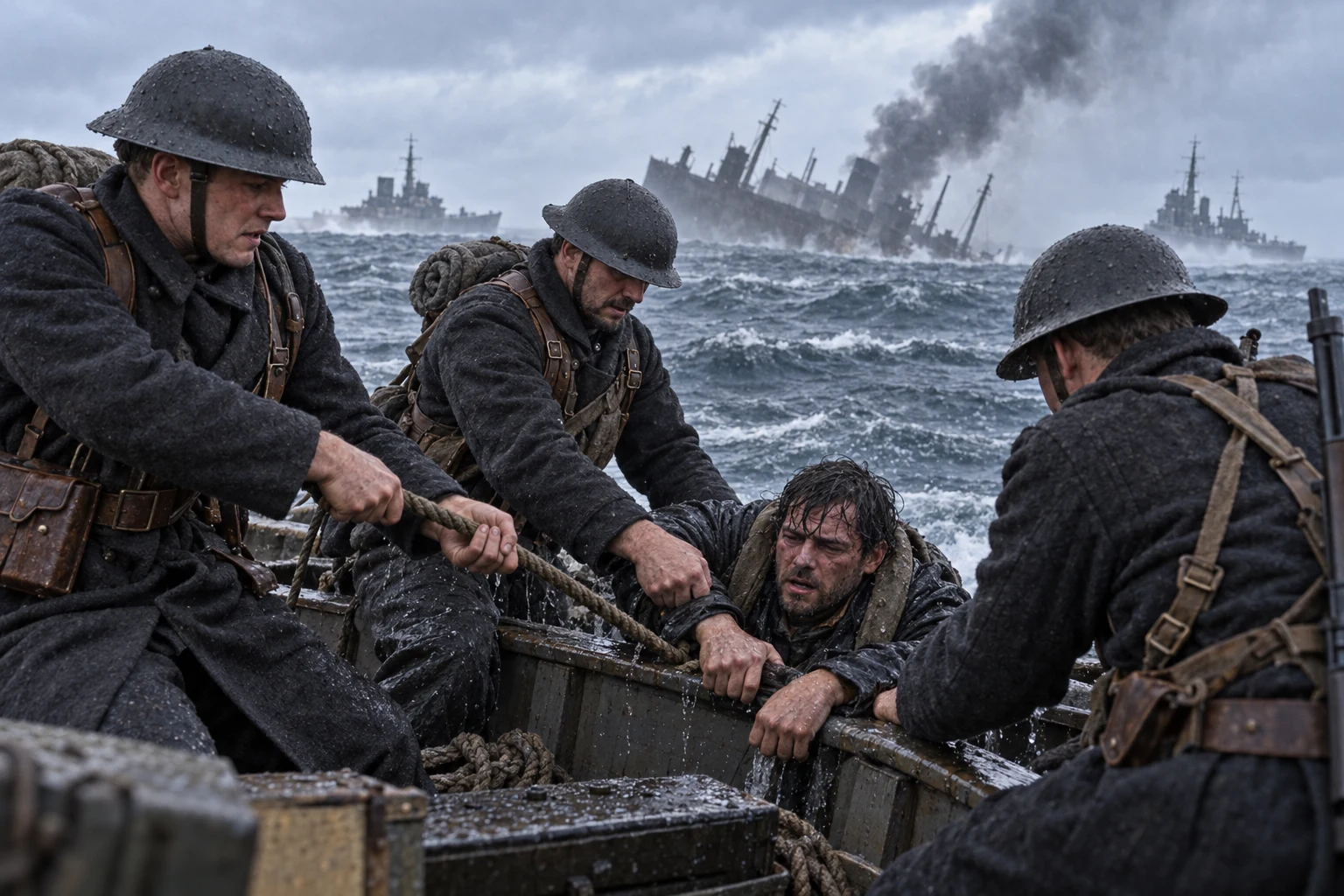
The first attack came on November 9 when a submarine struck the Dalsen transport Hearthwarden. The torpedo flooded its forward machinery compartment and killed many of the replacement aircrew quartered nearby. Captain Eren Dal kept the ship afloat long enough for escorts to approach, but its list worsened as rescue began. Sergeant Nela Har, a Fjaren aviation mechanic traveling with her unit, organized survivors on the upper deck and passed injured men down to boats. She had trained to repair aircraft, not command an evacuation, yet knew enough of the transport's layout from assisting its crew during the storm. Hearthwarden sank at 11:46. Of 2,480 military passengers and 184 merchant crew, 2,117 survived; the 547 dead included men who would never reach a combat unit.
Hald detached two escorts to continue rescue and turned Winter Crown toward a reported surface contact. Mase's cruiser and destroyers appeared late that afternoon, firing on the convoy's southern section. Winter Crown engaged Shinkai while the Brenholm destroyer Open Winter covered the transports' turn. A shell struck the destroyer's bridge, killing its captain and several signal personnel. Lieutenant Sera Holm assumed command from an auxiliary position and maintained the ship's place in the escort despite losing direct communication with Hald. Her crew interpreted flag signals from a neighboring Norvik destroyer whose men had practiced the translated code during the predeparture exercise. A routine rehearsal thus shaped the battle at the moment when radios and senior officers were both unavailable.
Shinkai damaged Winter Crown but failed to break through to the transports. The engagement continued in intermittent visibility until darkness separated the forces. Hald declined to pursue, knowing his rescue ships remained behind and several transports had not rejoined. Mase withdrew to regroup but retained enough strength for another attempt. That night, Har assisted medical personnel aboard Brenning, identifying survivors from the lost transport and recording the missing. Her handwritten list corrected several duplicate names caused by men being registered under both national and convoy systems. Families later received notices based on those reconciled records. The work did not reduce the loss, but it prevented uncertainty from being extended by avoidable clerical errors after the battle.
A divided escort reunited
By November 11, the rescue group had rejoined the convoy. Hald transferred seriously damaged Winter Crown to a rearward route under escort and moved his flag to the Skalen cruiser North Assembly. The decision removed his heaviest ship but restored a commander able to keep pace with the movement. Allied air patrols operating from consenting Grand Isles facilities began covering the approaching convoy, narrowing Mase's opportunities. The Kelonese commander nevertheless attacked again on November 13, hoping to exploit the reduced surface escort before the transports reached safer waters. His destroyers approached during a rain squall and damaged the freighter Common Furnace, which carried machine tools destined for Kavean workshops. The freighter remained afloat, although its engine room crew suffered severe casualties.
North Assembly and the Norvik destroyers met the raiders while aircraft arrived overhead. A bomb disabled Shinkai's forward turret, and later shellfire damaged its steering. Mase ordered withdrawal rather than risk losing the cruiser within reach of additional Allied aircraft. One Kelonese destroyer, Kurose, was sunk during the disengagement. Hald again chose the convoy over pursuit. Common Furnace received a tow, and its surviving engineers restored enough machinery for the ship to enter port under limited power. The convoy reached its reception anchorages by November 15, divided among the Allied ports that had agreed to receive it. Harbor authorities controlled unloading and billeting, preserving national jurisdiction even under urgent military demands.
Len's reception staff discovered that several surviving aircrew had been assigned to squadrons whose aircraft had already been lost in a separate action. Rather than distribute them blindly according to the original passenger manifest, national liaison officers confirmed current vacancies and retraining requirements. Har's workshop received six technicians who had traveled for another unit, each transferred by written order. The adjustments took four days, delaying employment but preventing the convoy's surviving personnel from disappearing into commands that existed only on outdated embarkation papers.
The passage cost the Allies Hearthwarden, one escort sloop, and 1,026 dead or missing presumed dead across military and merchant services; 1,473 were wounded. Kelonese losses comprised Kurose, eighteen aircraft supporting the operation, and 487 dead or missing, with 692 wounded. Twenty-nine of the thirty-two principal transports reached their intended destinations directly; one was lost, one returned for repair, and Common Furnace arrived under assistance. Har eventually reported to her aviation workshop with fewer colleagues and more responsibility than expected. The surviving machine tools helped restore aircraft for later Grand Isles fighting. Northern Promise demonstrated that Larvan's contribution depended on contested sea passages and national forces accepting real losses, not on a convenient line drawn from one Allied coast to another.
Original illustrations for this source record
Original archive artwork and captions are preserved. Dates, labels and claims printed within inherited images belong to the previous edition; the revised text governs the current history.