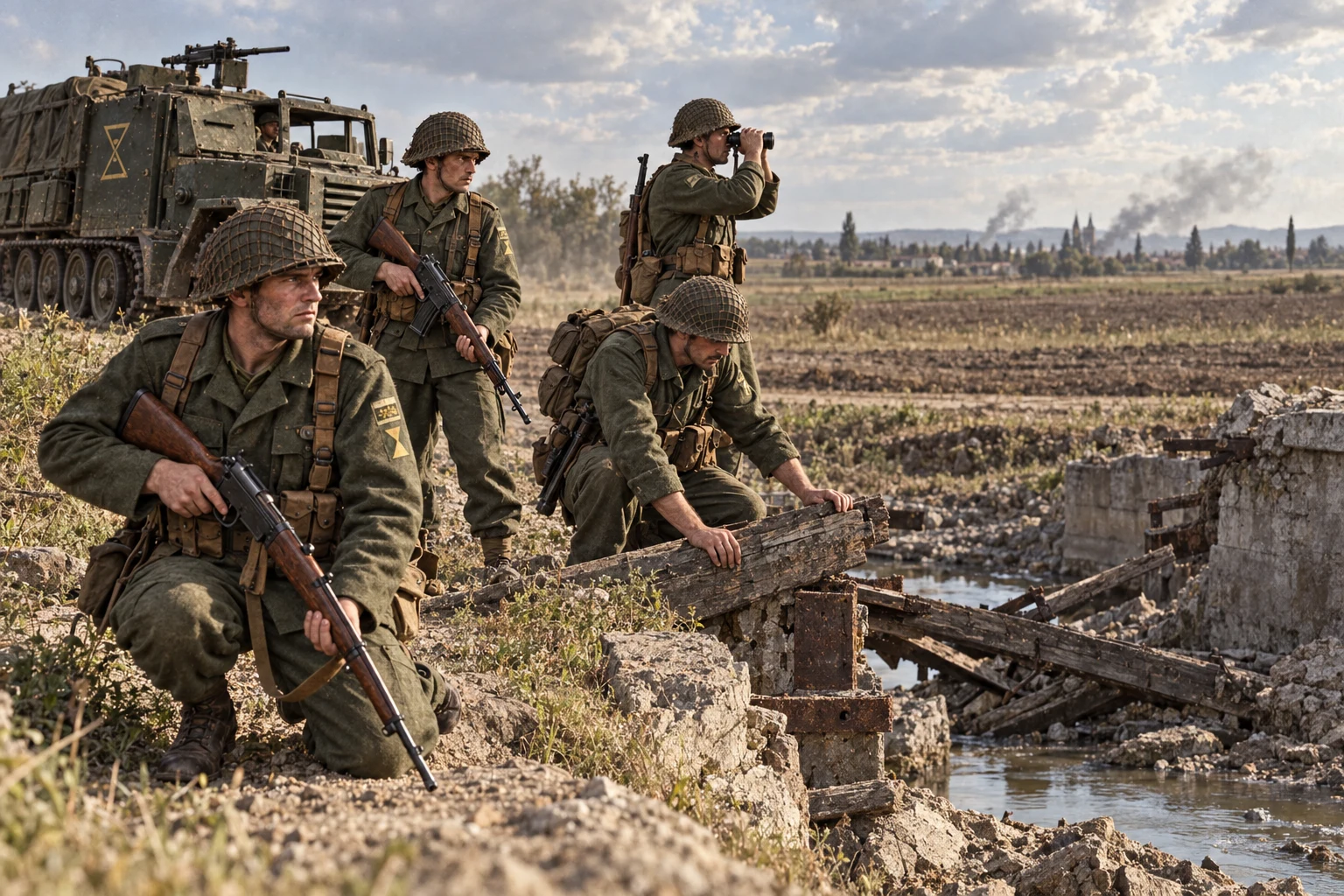
Across the Neral plain
August 23–October 6, 1231 · Western Teran frontier · Silvian 7th Army and Aldren formations against the Teran 87th Elite Battle Corps
Beyond the recovered junction
The recovery of Tassar on May 19 gave Silvian High General Hujo Lathorne an opportunity to advance beyond the positions that had consumed four years. It did not give him an undamaged railway or a fresh army. Through June and July, the 7th rebuilt its forward strength while General Cevan Rusk withdrew the 87th Elite Battle Corps toward the western Teran approaches. The August operation sought a limited foothold on the Neral plain, inside the empire's western frontier. Theradon, the imperial capital, remained far beyond its objectives. Lathorne assigned Major General Tera Venn's 18th Division and supporting Aldren formations to the initial advance. Rusk positioned his surviving formations around the local market town of Neralet and the drainage embankments that divided the plain into uneven agricultural parcels.
The offensive began at 05:20 on August 23. Silvian infantry moved from damaged frontier settlements into fields where harvest work had stopped weeks earlier. Captain Nera Del's company passed a farmhouse displaying a white sheet and found seventeen civilians inside. Their presence complicated the soldiers' assumption that all inhabited buildings ahead belonged to the military system. Del left a guarded medical party and continued toward the first embankment. There, Teran fire stopped the company in an open field. Its wounded remained exposed until smoke and dusk allowed recovery. The delay produced anger toward the civilians, as some soldiers believed the farmhouse stop had cost surprise. The battalion investigation found the enemy already prepared before the company arrived; the civilians had neither warned nor guided the defenders.
A corps that still moved
Rusk counterattacked on August 27 with a reserve grouping under Colonel Darven Koss. The attack struck the edge of Venn's division rather than its strongest central position, recovering two farms and forcing an Aldren battalion to withdraw. Lathorne committed reserves to stabilize the line but declined to broaden the offensive until the division's flanks were secure. He had learned at Meren how quickly an initial gain could become an obligation that consumed the rest of a plan. The pause gave Rusk time to restore some positions around Neralet. It also allowed the Allies to identify a damaged watercourse crossing that their maps had treated as a usable road. Engineers found the bridge foundation undermined, explaining why an earlier vehicle column had stalled there despite reports that the span remained standing.
Major Eran Vale's battalion entered the plain in early September. Its soldiers encountered Teran civilians for the first time in numbers, rather than Allied residents awaiting liberation. Vale issued explicit orders against collective punishment and unauthorized requisition. On September 6, two soldiers took livestock from a farm after arguing that enemy civilians should feed the advancing army. Vale ordered compensation recorded and referred the soldiers for discipline. His decision drew resentment from men whose own losses had been severe, but it established that entering enemy territory did not remove command responsibility. The farmer, Joren Kelm, later testified that the payment voucher initially seemed worthless. It was eventually honored through the occupation administration, long after the battle had moved beyond his fields.
The main attack on Neralet began September 12. Venn's troops reached the western grain exchange by noon, only to meet defenders using the adjoining municipal buildings. Savin Drel served with a Teran company in the tax office. He watched clerks remove records while soldiers carried ammunition through the same doorway, a collision between civil continuity and military necessity. When the building caught fire, his platoon withdrew into the market arcade. Drel helped an elderly clerk carry a box of registers before returning to his section. The act did not decide the battle, but the surviving records later helped identify residents displaced from the town. Neralet's western quarter changed hands twice before both commands accepted that immediate possession of the whole town was beyond their available strength.
The autumn limit
Rain after September 20 turned portions of the plain into shallow lakes. The effect varied sharply: some raised roads remained usable while neighboring fields became impassable to loaded vehicles. Lathorne's staff resisted descriptions of the entire district as a uniform sea of mud. Accurate distinctions allowed medical traffic and selected supplies to continue, but the remaining routes became congested and vulnerable. Lieutenant Sera Hov, commanding a transport detachment, suspended movement on one road after discovering that its shoulder was collapsing under repeated traffic. Her superiors initially demanded immediate resumption. An engineer inspection confirmed the danger, and the road was restricted before additional vehicles were lost. The episode cost time but preserved a route needed for the army's continued occupation of its gains.
Rusk launched a final local counterattack on September 29, recovering the northern edge of Neralet while failing to expel the Silvians from the western quarter. His corps remained coherent, supported by neighboring Teran forces and the broader imperial system. Lathorne ended the offensive on October 6 with a limited foothold inside the western frontier. He had advanced beyond Tassar without destroying the 87th or opening an unrestricted road into the empire. The distinction became especially important when Garabech's collapse later in the year disrupted part of the Allied support system farther west. Success on the Neral plain could coexist with disaster elsewhere, and the 7th's continued survival required adjustment to both facts rather than treating one as proof the other had not occurred.
Neralet's market clock stopped at 14:17 during the September fighting. Both armies later used the damaged tower as a reference in reports, assigning different names to the same building. A joint postwar survey reconciled those labels and corrected several casualty locations previously believed to describe separate sites.
The operation cost Allied formations 6,184 killed, 18,702 wounded, and 1,106 captured. Teran losses were 5,893 killed, 16,941 wounded, and 2,217 captured. Civilian deaths in the immediate district reached 746, with many more residents displaced. Vale's battalion wintered near farms whose owners now depended on the conduct of an enemy army. Drel's company remained across the line, receiving replacements who knew Tassar only as a defeat described by survivors. Lathorne had achieved a real but bounded advance. Rusk had surrendered territory while retaining the corps that would oppose him until 1234. The Neral campaign ended with both outcomes visible from the damaged market buildings, where one side's forward post and the other's observation position still overlooked the same square.
Original illustrations for this source record
Original archive artwork and captions are preserved. Dates, labels and claims printed within inherited images belong to the previous edition; the revised text governs the current history.