The recovery of the western districts
August 6–September 3, 1230 · Viar, western Praxen · Local Allied and Silvian formations against Rostani and Novren forces
Recovery without a breakthrough
The Allied operation of late summer 1230 aimed to recover occupied districts and improve communications within western Praxen. It did not attempt the immediate liberation of Praxil, which remained occupied. Praxen General Dena Kor coordinated her troops with Helion General Mira Alen's expeditionary detachment and Silvian Major General Mara Seln's 56th Division. Alen's troops had arrived by sea through Praxen's consenting ports; their presence created no Praxen–Helion border. Rostani General Varen Kest received Novren Lieutenant General Oren Kas's expeditionary detachment through Ulmar's consenting ports and authorized transit across Axis Tervik and Rostan. Those forces held neighboring positions inside occupied Praxen, far from Novren's homeland. National commands retained separate responsibilities under agreed schedules. Their cooperation created delays the Allies hoped to exploit without assuming their enemies would simply fail to communicate.
The first fighting on August 6 centered on the Praxen village of Veldar and its agricultural depot. Kor's leading troops recovered the depot by evening but found its stores largely removed. Civilians who had imagined liberation would immediately bring food instead watched soldiers open empty warehouses. Captain Lera Dem, returned to duty after her wound at Orenvik, arranged for the remaining residents to be registered before additional military traffic entered the village. The registration revealed several families still hiding outside the occupied area, afraid that both armies would requisition their animals. Dem sent civil liaison officers rather than an armed search party to contact them. Most returned, although the shortage of shelter forced some to leave again within days.
A position between commands
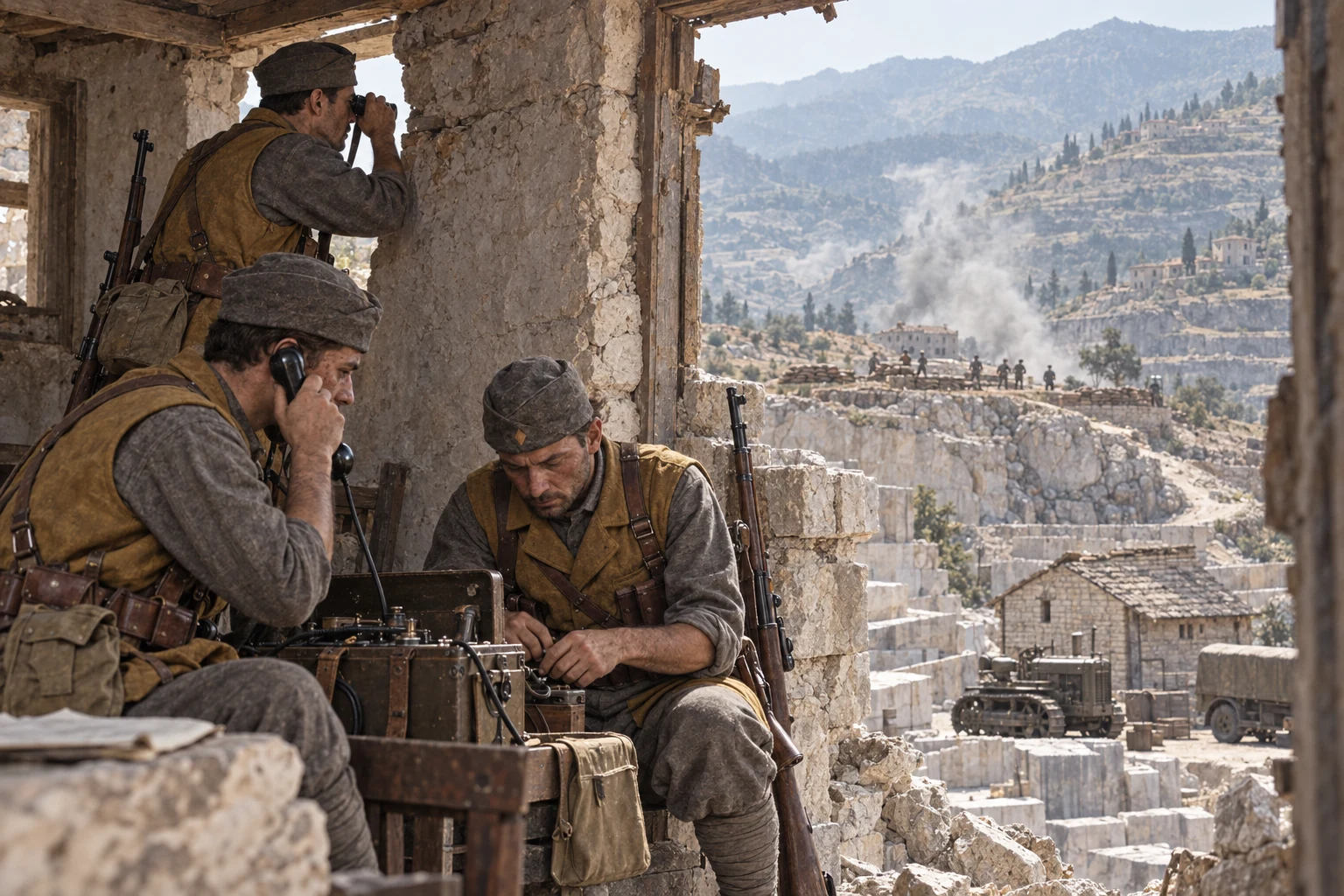
On August 9, Helion troops attacked the Praxen quarry district of Saren Tor, where Novren forces guarded an important local road. Major Tera Val's battalion reached the quarry office but became separated from a neighboring Praxen formation by a strip of ground neither headquarters believed remained occupied. Novren troops held it and fired into both advances. Alen and Kor suspended further movement until the gap was identified. The pause frustrated Seln, whose Silvian division had fresh troops ready to exploit the initial gains. She accepted the delay after aerial observation and prisoner reports confirmed the danger. The incident produced a common situation map maintained by liaison officers from all three armies, an administrative correction with immediate consequences for the men waiting forward.
Novren's counterattack on August 12 recovered the quarry's northern workings and captured sixty-three Helion soldiers. Val withdrew the rest of his battalion through a drainage ravine, losing equipment but preserving a coherent force. Among the prisoners was medical orderly Sera Ner, who remained with patients after receiving permission to leave. She survived captivity and later described adequate treatment during the first days followed by severe shortages as the prisoners moved rearward. Her account resisted both the wartime claim that all captives had been killed and the later suggestion that their survival proved captivity harmless. Alen cited the withdrawal as necessary while ordering an investigation into why the battalion had entered the quarry without reliable knowledge of its neighbor's position.
The Allied effort resumed on August 17 with more limited objectives. Seln's 56th Division recovered the ridge overlooking the local road, while Kor's troops advanced through farms west of Veldar. The operation placed pressure on Kest's outer positions without threatening the main Rostani occupation system. Kest requested permission to abandon several exposed posts and shorten his line. His superiors approved after initially demanding that every recovered village be retaken. That decision allowed an organized withdrawal rather than the costly defense of ground with declining military value. The Allies captured stores, vehicles, and isolated groups of defenders, but most of the enemy formations escaped. Seln's report distinguished those captures from destruction of the larger units, preventing an inflated estimate from shaping the next offensive.
The return lists
Civil authorities began controlled return to Veldar on August 21. They faced ruined wells, unexploded ammunition, damaged roofs, and property claims complicated by eight years of displacement. Clerk Nera Olin compared the surviving preoccupation register with names supplied by returning families. Some houses had several claimants because relatives had died without documentation or because displaced people had occupied abandoned buildings. The military commander initially proposed resolving disputes by the oldest surviving papers. Olin objected that this would reward households whose records had survived while penalizing those whose homes had burned. Kor referred the cases to temporary civil panels, leaving the army responsible for immediate shelter and security. Recovery of territory thus required decisions that military possession alone could not settle.
Fighting continued around the quarry road until August 29. A final Novren attack struck a Helion forward post and briefly cut its communications, but Val's rebuilt battalion held long enough for relief. The episode gave his men a success after the earlier retreat without erasing their losses. On September 3, Allied headquarters closed the operation and consolidated the new line. The recovered area included Veldar, several surrounding agricultural districts, and part of the quarry road system. The northern workings remained contested, and neither Praxil nor the principal occupied Helion centers had been liberated. The advance improved the Allied position and permitted a limited civilian return, while leaving the larger campaign unresolved for years.
A recovered Praxen school held maps annotated by successive military occupants. Alen ordered them photographed before returning the building to civil custody. The markings helped explain several failed movements around the quarry, while the school itself required a new roof before children could return. Its reopening in spring 1231 became a local anniversary distinct from the army's September victory date, reflecting the interval between recovery and usable peace.
Allied military losses totaled 2,178 killed, 6,402 wounded, and 307 captured. Rostani and Novren losses were 2,641 killed, 6,988 wounded, and 1,429 captured. Civilian authorities recorded 284 deaths directly associated with the operation and its immediate displacement. Kor, Alen, and Seln issued a joint account that named the separate national contributions and admitted the initial coordination failure. Olin's return lists eventually became the basis of the restored district records, preserving the names of residents as carefully as the military reports preserved formation numbers. Dem remained with her regiment and saw several families she had registered leave again when winter approached. Their departure did not make the liberation false; it showed how much remained necessary before recovered territory could once more support ordinary life.
Original illustrations for this source record
Original archive artwork and captions are preserved. Dates, labels and claims printed within inherited images belong to the previous edition; the revised text governs the current history.