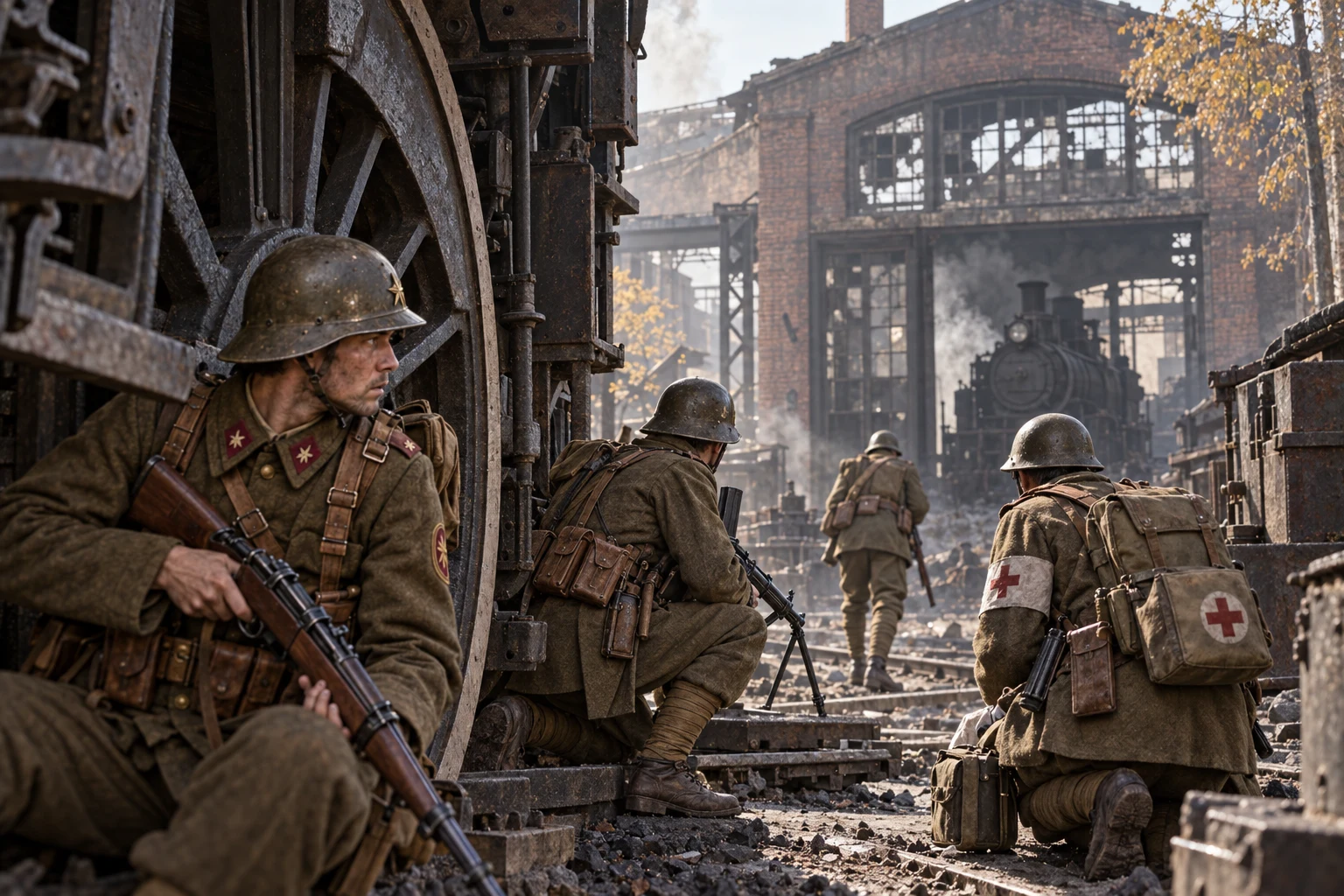
The outer yards counterstroke
September 17–28, 1230 · Tassar district, eastern Aldren · Teran 87th Elite Battle Corps against the Silvian 7th Army
The junction still held
The Allied offensive of April and May 1230 had failed to recover Tassar's central junction. Silvian forces retained positions near the outer yards, while Meren Ridge, captured the previous November, remained firmly Allied. General Cevan Rusk planned a counterstroke against the exposed yard positions, seeking to restore space around the Teran-held junction without attempting to retake Meren. His 87th Elite Battle Corps could still conduct concentrated operations, but its reserve was smaller than the title suggested. Colonel Darven Koss led the assault grouping drawn from the 214th Infantry Regiment and supporting units. Silvian Brigadier Nera Halm commanded the threatened line, with Major Eran Vale responsible for a battalion near the wagon-repair sheds. Their positions had been fought over so often that the railway map no longer reliably described the ground.
Rusk's attack began on September 17 after a short concentration of fire on the sheds and the road behind them. Teran infantry entered the eastern sorting yard before Halm received a clear report of the main effort. One Silvian company withdrew from a warehouse believed about to be surrounded, while another remained in the adjoining engine house and discovered that its neighbor had gone only when enemy fire reached its rear windows. Captain Oren Dall requested relief by runner because the telephone line was severed. The runner reached Vale after taking shelter twice among burning wagons. Vale sent a local reserve toward the engine house, but the movement encountered Teran troops already established across the connecting lane. Dall's company was isolated by evening.
A company behind the line
The engine-house garrison held through September 18 with wounded men crowding the inspection pits beneath the floor. Medical Corporal Lena Var used railway blankets and salvaged drinking water while the company's officers argued over their remaining choices. Dall rejected a breakout until the less mobile wounded could be moved, then received a message from Halm authorizing surrender if no viable withdrawal existed. The message reached him too late to settle the argument before a Teran assault entered the building's northern end. Dall surrendered seventy-eight surviving soldiers at 16:35, including twenty-three wounded. Teran Lieutenant Varen Oss accepted the surrender and prevented his men from firing into the inspection pits after recognizing that they contained patients. Both officers later confirmed the incident independently.
Elsewhere, Halm stabilized her line around the western freight office. Vale's battalion withdrew from the repair sheds after removing most of its wounded but abandoned heavy equipment that could not pass through the damaged road. A warehouse fire spread into stored fuel, producing explosions heard far beyond the yard. Silvian reports initially attributed the destruction to Teran demolition, while Teran accounts claimed Allied sabotage. The postwar investigation established that shellfire had ignited the storage area during the withdrawal. Correcting the cause did not change the battle's outcome, but it prevented a convenient accusation from becoming permanent history. Railway workers returning in 1231 would identify the destroyed store by the warped metal tanks remaining beneath the rubble.
Koss pressed westward on September 21 and met stronger resistance than expected. Halm had received an Aldren battalion and a Silvian engineering detachment, restoring the connection between her remaining positions. Rusk refused Koss's request to expand the attack toward the Meren approaches. The corps' task was to recover the outer yards, and extending it would expose the assault force to stronger Allied positions on the ridge. Savin Drel, now an experienced Teran soldier, served among the troops consolidating the captured sheds. He recognized several landmarks from earlier fighting but found his old shelter buried beneath collapsed roofing. The return to familiar ground offered no comfort when most of the men who had once shared it were dead, wounded, or transferred beyond his knowledge.
The limits of recovery
Lathorne considered a counterattack on September 23. His staff could identify a route into the captured yard district, but the formation available for the effort had already suffered heavily during the spring. He authorized a smaller attack to recover the western freight office's exposed approaches and declined the broader proposal. The limited movement succeeded on September 25, restoring a more defensible Allied line without regaining the lost sheds. Lieutenant Osa Marel's company found two Silvian wounded men who had survived eight days in a cellar with help from an Aldren civilian. The civilian, Teren Ors, had remained near his home despite evacuation orders. His actions saved the soldiers, but the army still required him to leave once the renewed position was secured.
The battle ended on September 28 with the outer yards again under Teran control. Meren Ridge remained Allied, and Tassar's central junction remained Teran, preserving the larger division of the front. Rusk issued restrained congratulations to the assault units, emphasizing that the gain shortened one vulnerable part of his position. Imperial newspapers made broader claims, describing the battle as the destruction of Lathorne's offensive power. The 7th Army's continued presence on Meren contradicted that interpretation. Lathorne's own report acknowledged the loss and criticized the delayed identification of the initial attack. He retained Halm after finding that her later decisions had prevented a local defeat from spreading into neighboring sectors.
Railway clerk Irena Senn identified the engine-house prisoners through surviving workshop attendance cards and military lists. Her comparison corrected two notices that had incorrectly classified captured men as dead. Halm forwarded the corrections before receiving every final unit return, judging that confirmed evidence of survival should reach families without waiting for the whole battle's paperwork to close.
Allied losses were 1,984 killed, 5,616 wounded, and 693 captured; the 87th and its attached units lost 1,731 killed, 4,988 wounded, and 219 captured. Dall and the engine-house survivors remained prisoners until 1234, while Var continued medical work in captivity. Drel received replacement equipment and returned to a position only a short distance from the one his unit had occupied before the summer. The counterstroke gave Rusk useful ground and a defensible achievement, but it did not restore the strategic situation that had existed before Meren fell. Tassar would still be lost in May 1231. For the soldiers who survived September, that future outcome could not diminish the immediate reality that the same railway district had consumed another set of comrades for a change measured in yards and buildings.
Original illustrations for this source record
Original archive artwork and captions are preserved. Dates, labels and claims printed within inherited images belong to the previous edition; the revised text governs the current history.