The autumn recovery in Qarim
October 3–November 9, 1229 · Gaften, occupied Qarimi districts · Qarimi and Silvian formations against Ruuyaqi and Jazimi forces
A country inside the front
The Qarimi districts of Nahar and Belat contained orchards, workshops, and irrigation works repeatedly damaged since Qarim's entry into the active war in 1216. Their recovery in autumn 1229 formed a limited Allied operation within the established Gaften front. It did not imply that all Qarim was liberated or that Ruuyaq's regional army had collapsed. Qarimi General Samra Qel commanded the 4th Field Group, supported by Silvian Major General Ceren Alv's 43rd Division and regional aviation. Ruuyaqi General Hassem Qor held the opposing district with the battered 31st Field Corps and a Jazimi brigade under Colonel Narek Jass. Coalition agreements gave Qel responsibility for civil liaison and restored administration, while Alv retained command of his national formation. Their joint headquarters had spent weeks resolving whose orders governed mixed units.
The offensive began on October 3 along the approaches to Nahar. Qel's leading brigade encountered stronger resistance at the district granary than its reconnaissance had reported. Jazimi troops had occupied the granary's stone foundations while leaving the visibly damaged upper floors empty. Captain Laila Ren's Qarimi company entered the neighboring market and became pinned between the granary and a ruined administrative building. Ren requested a pause, then brought her wounded into a covered arcade with help from two residents who had remained through occupation. Their assistance was recorded by name after the battle because earlier accounts had reduced local civilians to an anonymous source of information. The residents, brothers Saren and Jamil Voh, lost their shop during the fighting and later sought compensation from their own restored government.
The district hospital
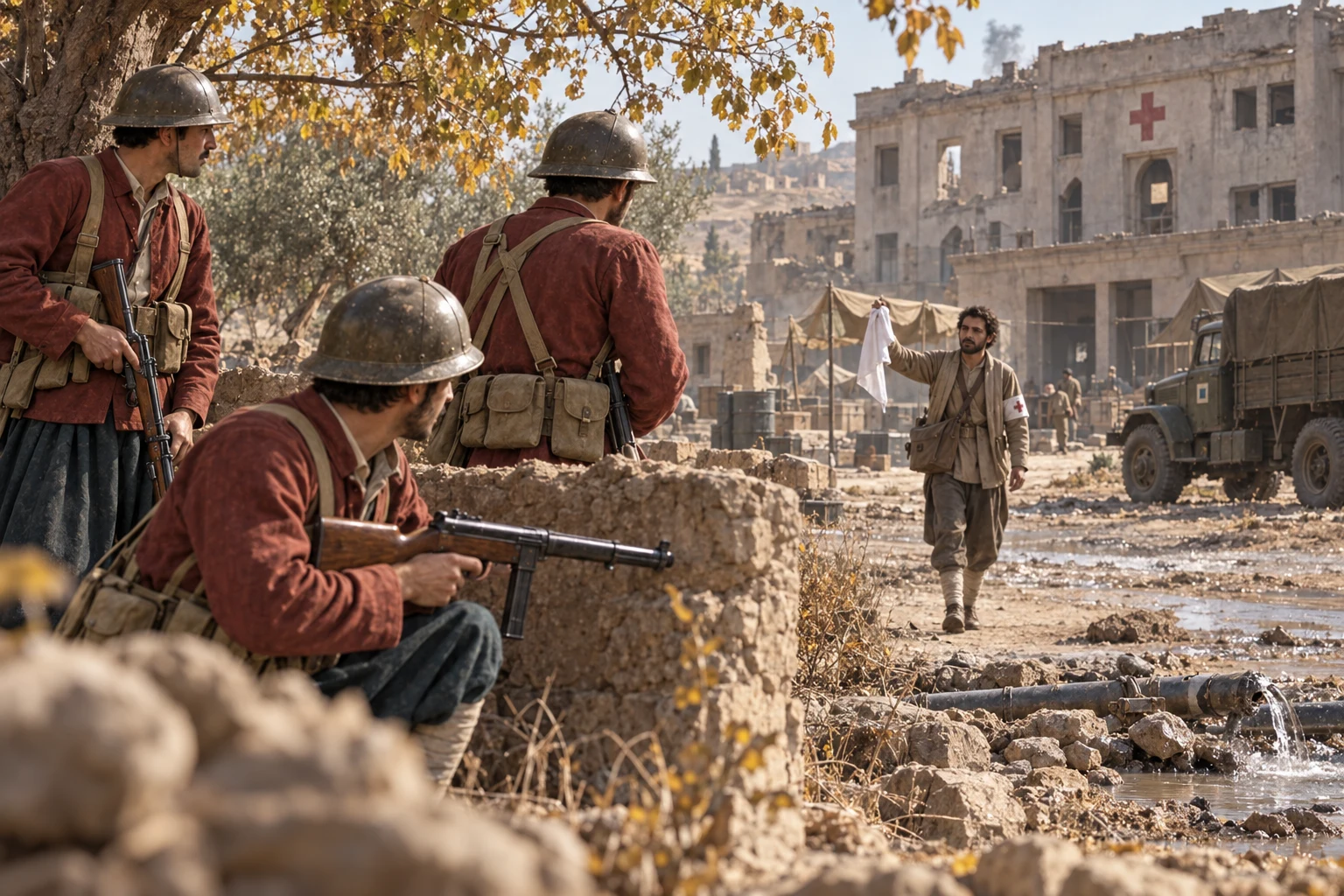
Nahar's hospital lay between the initial Allied gains and the defenders' second position. Its director, Dr. Mariam Sol, had continued treating civilians and soldiers under successive authorities. On October 6, shellfire damaged its kitchen and interrupted the water supply. Sol sent a messenger toward both commands carrying identical requests for an evacuation interval. Qel accepted immediately; Qor's local staff required confirmation that the hospital had not become an Allied position. The resulting delay cost nearly a day. A limited arrangement finally allowed seventy-three patients and thirty-six staff members to leave on October 7. Several military patients remained under guard at the receiving station, but medical treatment continued. The episode did not stop the battle; it created a narrow, documented exception inside it.
Alv's division moved around Nahar's industrial edge on October 9, forcing Jass to withdraw from the granary district. The Jazimi brigade escaped with most of its organized strength, leaving rear guards and wounded men who could not be transported. Ren's company entered the granary on October 10 and found its lower chambers crowded with prisoners, ration sacks, and civilians sheltering from artillery. The discovery slowed occupation of the building while soldiers sorted combatants from residents and treated casualties. Qel rejected a proposal to parade captured Jazimis through the market. She had enough experience of occupation to understand how quickly a military victory could become a public humiliation followed by retaliation. The prisoners went instead to a guarded collection area outside the town.
Qor counterattacked on October 14 against the Silvian division's exposed northern position. His troops retook the brickworks and disrupted the road carrying supplies into Nahar. Colonel Iven Sor's regiment held the adjoining village of Darat after a night in which companies repeatedly lost contact. Lieutenant Sera Dev gathered soldiers from three units inside a school courtyard and remained there until communications resumed. Her group included Qarimi interpreters, Silvian infantry, and two engineers who had arrived to inspect a damaged well. The improvised defense succeeded because each group accepted a temporary local commander rather than because their national systems suddenly became interchangeable. Alv later formalized the emergency arrangement, preserving national accountability while giving mixed detachments a clear authority during similar disruptions.
Belat and the irrigation gates
The second phase began on October 23, directed toward Belat's irrigation control district. Qel wanted its gates recovered before further seasonal damage threatened the surrounding farms. Qor recognized the same importance and reinforced the district with troops withdrawn from less exposed ground. Fighting concentrated around the gatekeeper's buildings and the raised maintenance road. Sergeant Nadir Vel's Qarimi squad captured the main office on October 27 but found the control mechanisms damaged. Civil engineer Hana Qer accompanied the next inspection party and identified what could be repaired before the rains. Her work required military protection without placing her under infantry command. Qel's headquarters issued a written arrangement after an earlier misunderstanding nearly sent the civilian team forward with a combat patrol.
The repair effort became possible only after the defenders withdrew from the immediate district on November 2. Qor's troops retained a position farther east, and artillery continued to reach Belat intermittently. Qel therefore prohibited general civilian return despite pressure from displaced farmers who could see their land from the recovered road. Controlled visits began with agricultural assessment parties and representatives of local councils. On November 5, one such party found human remains beside an abandoned detention building. Military investigators secured the site while the civil administration recorded missing residents. The discovery entered the battle's history as a consequence of liberation, not as justification for unsupported claims about every prisoner held there. Identification and responsibility required evidence that surviving witnesses and records gradually supplied.
Qer tested the repaired gates on November 7 before allowing full operation. One mechanism jammed, confirming her warning that military recovery did not certify machinery safe. The restricted flow protected the damaged works and kept downstream farms supplied while replacement parts traveled from Allied workshops farther behind the front.
By November 9, the Allies held Nahar, the Belat irrigation district, and a defensible connecting strip. They had not destroyed Qor's corps, which withdrew coherently and remained a serious opponent. Allied losses totaled 3,116 killed, 8,903 wounded, and 284 captured; Ruuyaqi and Jazimi losses were 3,842 killed, 9,617 wounded, and 1,783 captured. Civilian deaths directly attributed to the campaign numbered 529. The recovered irrigation gates supplied water to only part of the district that winter, yet even that partial restoration supported a carefully limited return. Ren's company received replacements and remained at the front. Qel's victory restored actual territory and institutions to Qarimi control, while the unrecovered districts and the continuing enemy line kept its scale clear. Liberation proceeded through places people could name, not through a single sweeping announcement.
Original illustrations for this source record
Original archive artwork and captions are preserved. Dates, labels and claims printed within inherited images belong to the previous edition; the revised text governs the current history.