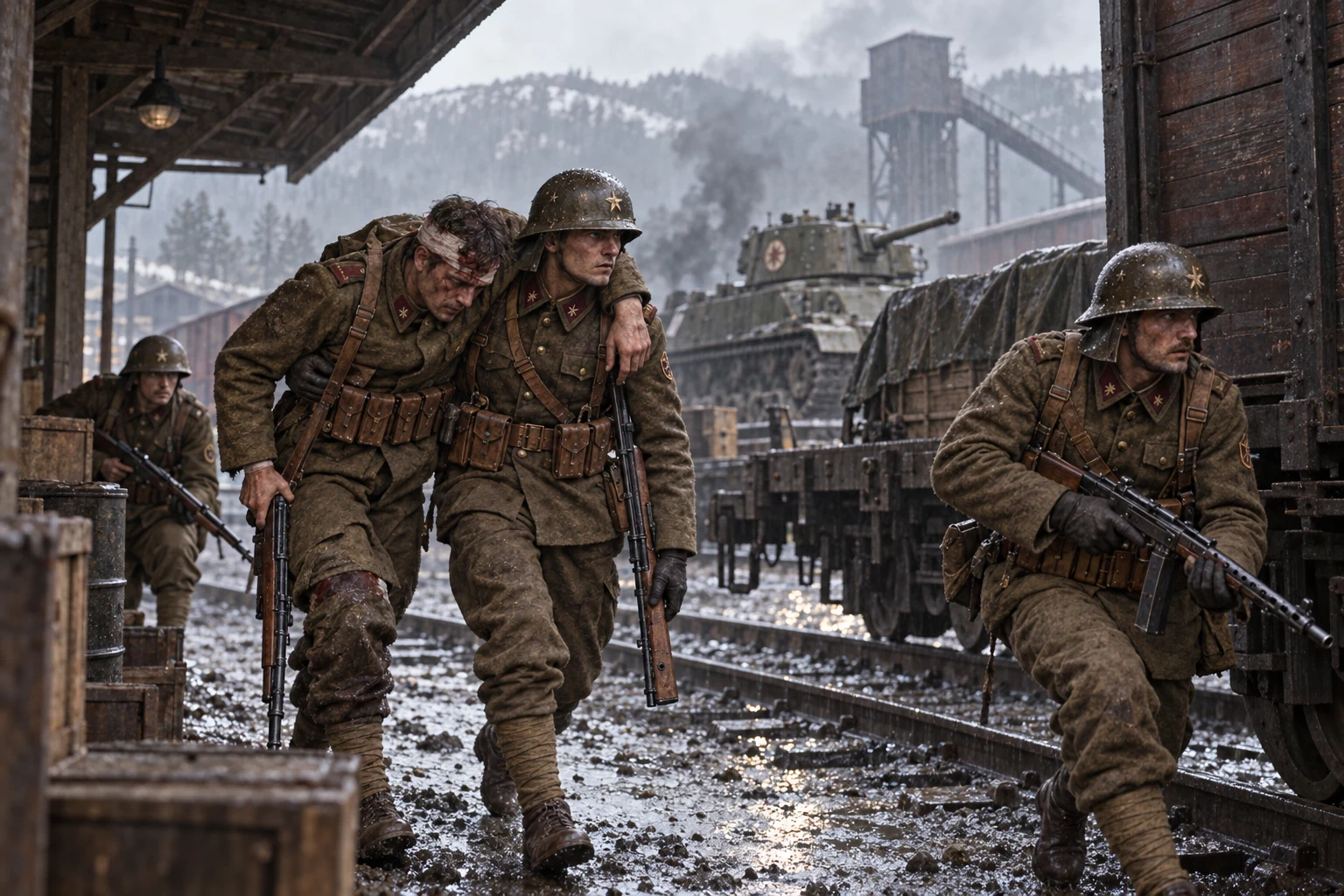
Rusk's winter counteroffensive
November 7–24, 1228 · Eastern Aldren, below Meren Ridge · Teran 87th Elite Battle Corps against the Silvian 7th Army and Aldren formations
An elite formation under pressure
The failure of the Allied Meren offensive in the spring had preserved the Teran position, but it had not restored every strength of the 87th Elite Battle Corps. General Cevan Rusk entered November with experienced cadres, uneven replacements, and an imperial command demanding evidence that its celebrated corps could still seize the initiative. His plan targeted the lower positions held by the Silvian 7th Army after repeated fighting below Meren. The immediate objectives were the village of Salven and the old freight siding at Edras, not the destruction of Lathorne's entire army. Major General Toren Keld's 29th Division would conduct the principal movement. Silvian Brigadier Nera Halm held the threatened district with the 24th Brigade and attached Aldren troops.
The attack opened before dawn on November 7. Fog concealed some Teran movement while confusing the attackers' own direction. Lieutenant Davren Pell's company entered Salven through its northern gardens and captured an Allied listening post whose telephone had failed during the bombardment. Elsewhere, a neighboring company moved into the wrong street and met determined resistance from an Aldren position it believed already bypassed. The discrepancy prevented the attack from developing uniformly. Halm received reports of a breakthrough in one sector and a successful defense in another. She ordered local withdrawals toward the freight siding rather than commit her small reserve before identifying the main danger. Rusk's troops occupied most of Salven by afternoon, taking 214 prisoners and several damaged guns.
The freight siding
Edras was less a town than a concentration of sheds, sidings, and workers' houses. Its railway equipment had been damaged repeatedly since 1227, but the ground still connected neighboring Allied positions. Major Eran Vale arrived with a reinforcing battalion on November 8 and found Halm's headquarters operating from a cellar beneath the ticket office. The building shook under shellfire, scattering plaster over maps spread on a household door. Halm asked Vale to hold the western sheds while she restored contact with an Aldren company believed cut off near Salven. The company eventually returned in fragments over two nights. Its commander, Captain Mira Velt, brought a list of men left behind and insisted that they remain classified as missing until evidence established their fate.
Keld attacked the siding on November 10. Teran infantry entered the eastern sheds, where stacked timber and abandoned railway wagons divided the fighting into separate encounters. Corporal Nerin Das of the 87th found himself commanding eleven men after his platoon leader was wounded. He secured one shed but could not tell whether adjoining buildings were occupied by friend or enemy. Across a narrow yard, Silvian Sergeant Sera Lann faced the same uncertainty. Both groups spent the night listening to movement they could not identify. At dawn, a brief exchange killed three Terans and two Silvians before the survivors withdrew to better understood positions. Neither small action appeared in the corps' initial summary, which described the siding as partially secured.
Lathorne refused an immediate attempt to recover Salven. His artillery commanders reported shortages in the most heavily engaged sector, and reconnaissance indicated that Rusk still possessed a reserve. The High General instead shifted a rested division into the threatened area and prepared to stop the next movement. Rusk recognized the reinforcement through prisoner reports and aerial observation. He requested support from neighboring Teran formations but received only a limited artillery attachment. Higher command expected the 87th to complete its operation with resources already assigned. The dispute exposed the distance between the corps' reputation and its actual capacity. Rusk could maintain pressure at Edras or broaden the attack; attempting both risked exhausting the force before either objective was secured.
A gain with an edge
On November 15, Keld concentrated against the southern end of the siding. The Terans captured two warehouses and forced Vale's battalion back to the repair shop. During the withdrawal, Lieutenant Oren Sev remained with wounded soldiers who could not be moved before the enemy arrived. He surrendered with twenty-six men and spent the rest of the war in captivity. Vale initially listed the group as missing, then corrected the record after a prisoner exchange channel confirmed their survival. Their families received the revised notices weeks apart, reflecting the slow administrative work behind a fact that seemed simple in a later narrative. Halm's brigade suffered heavily but retained the repair shop and the road behind it.
The Allied counterattack on November 19 recovered one warehouse and stabilized the line. Aldren Major Tera Most led troops through the workers' district, where residents had hidden maps of their properties beneath floorboards before evacuation. Soldiers used the surviving house numbers to identify casualty collection points, while military clerks collected the property records for civil authorities. Rusk ordered the offensive curtailed on November 21 after the latest casualty returns showed diminishing combat strength. Local fighting continued until November 24 as both sides adjusted their positions. The Terans retained Salven and the eastern portion of the siding. The Allies held the western approaches, preventing the local success from becoming a wider rupture. Meren Ridge remained Teran, as it had before the battle.
Keld visited the captured warehouses on November 25 and found the regimental burial officer unable to distinguish several sets of remains recovered from the same collapsed shelter. He authorized a joint examination with captured Allied medical personnel, preserving their names and statements in the corps record. Identification remained incomplete for seven men, whose remains were buried with location markers rather than assigned invented names to make the return appear finished.
The counteroffensive cost the 87th and its attached forces 3,219 killed, 8,704 wounded, and 381 captured. Allied losses were 2,887 killed, 7,992 wounded, and 812 captured. Rusk reported a limited territorial success and resisted pressure to describe Lathorne's army as defeated. Lathorne acknowledged the lost ground while emphasizing that the front remained coherent. Both statements were accurate within their limits. For Vale's battalion, the winter began with replacement officers learning positions their predecessors had died defending. For Keld's division, victory brought occupation of damaged buildings and a longer casualty list rather than rest. The 87th remained dangerous, but its ability to move the front increasingly depended on concentrating strength that could no longer be spared everywhere at once.
Original illustrations for this source record
Original archive artwork and captions are preserved. Dates, labels and claims printed within inherited images belong to the previous edition; the revised text governs the current history.