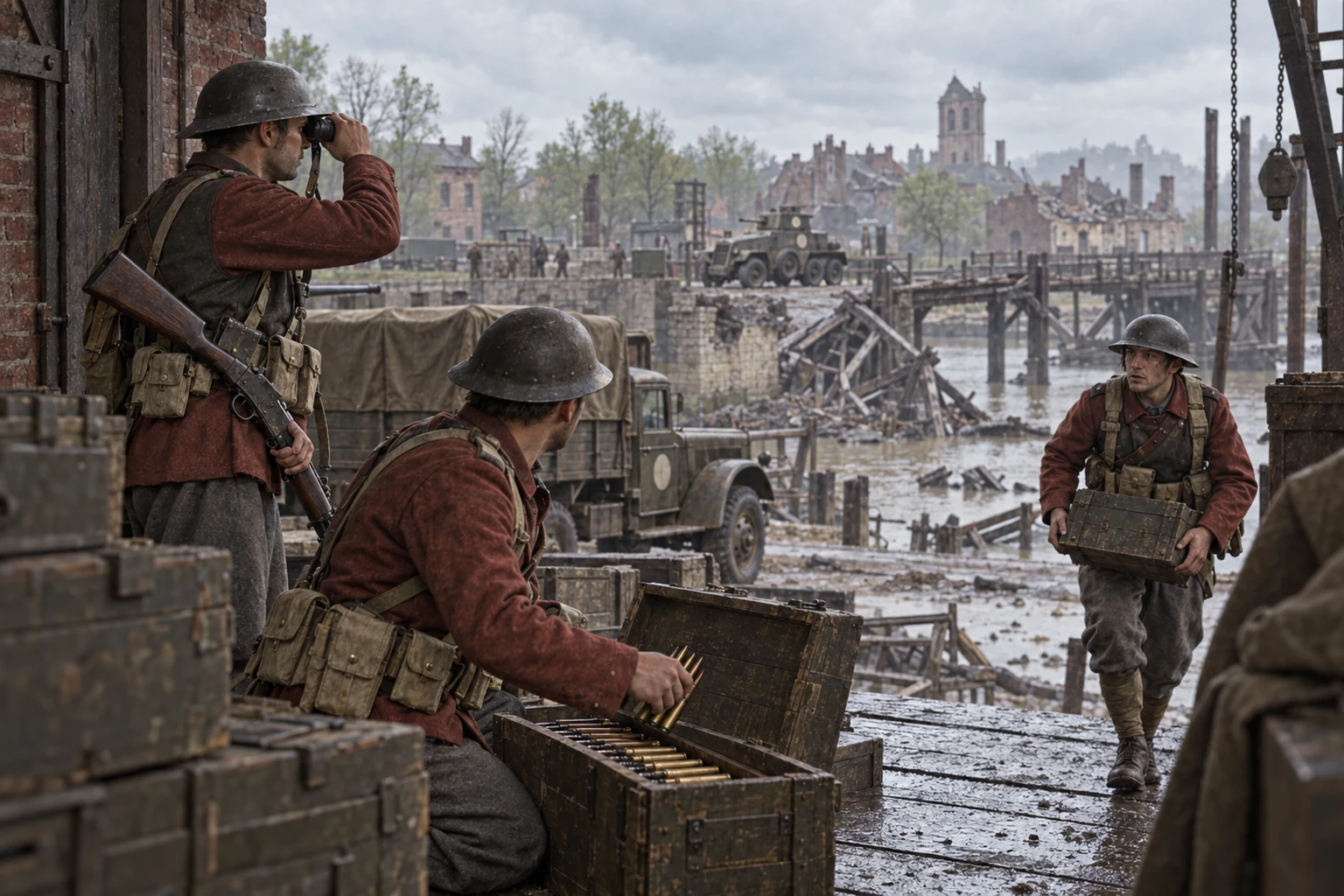
The advance toward Praxil
April 16–May 29, 1228 · Viar, western Praxen front · Praxen and Silvian formations against Rostani occupation forces
The city still beyond reach
Praxil had fallen in September 1219, while Chancellor Ema Doren's administration and surviving army continued from western Praxen. In spring 1228, General Dena Kor, promoted in 1226, led her regional command in an attempt to recover the outer communications district west of the capital. Kor's role in this campaign preceded her participation in the eventual recovery of Praxil in 1234; the operation described here failed to bring that later liberation forward. Silvian Major General Mara Seln commanded the supporting 56th Division, part of the republic's established Viar allocation. Rostani General Varen Kest held the occupation front with the 12th Field Army. Its defenses covered the mill town of Orenvik and the railway cutting beyond it, both local Praxen places within the existing country.
The Allied attack began on April 16. Praxen troops entered Orenvik's western streets before noon, accompanied by soldiers whose families had lived there before occupation. Captain Lera Dem found her parents' bakery converted into a billet and its ovens dismantled for scrap. She continued with her company, leaving a military clerk to record the building's condition. That small act prevented a personal search from delaying the advance but did nothing to diminish its emotional force. In the mill district, Rostani defenders held long enough for Kest to bring reserves from the railway cutting. Silvian infantry reaching the town after dark expected to pass through an already secured area. Instead, they found a front running through warehouses still full of grain and exhausted civilians sheltering below them.
The mill district
On April 19, Seln committed the 188th Infantry Regiment to clear the warehouses and open the road east. Colonel Nerin Vale, unrelated to Eran Vale serving in Volara, commanded the regiment. His leading battalion advanced across a canal bridge reported intact, only to find its central span damaged beneath a temporary wooden covering. Vehicles stalled at the crossing while infantry continued ahead. The separation left forward companies without the support their plan assumed. Lieutenant Sera Oln established a casualty station in a flour shed, where spilled grain mixed with rainwater and blood underfoot. A fire on April 20 forced evacuation through the same congested bridge approach. Forty-six wounded men died before they could be moved, a loss recorded separately in the medical inquiry but included in the battle's final military death toll.
Kor paused the advance on April 22 to restore the crossing and coordinate the formations inside Orenvik. Doren's government faced public pressure to announce a route toward the capital, but Kor refused to describe the mill town as a breakthrough. Aerial reconnaissance showed Rostani traffic continuing behind the railway cutting, and prisoners reported fresh units arriving. Kest also faced pressure from his own government, which feared the political consequences of losing a prominent occupied town. He received reinforcements but no permission to withdraw to a shorter position. The result was a battle in which both commanders understood the danger of continuing while remaining unable to abandon the ground without consequences beyond their immediate military calculation.
The renewed Allied attack on May 2 reached the cutting and briefly occupied its western signal box. Sergeant Evin Raal's Praxen platoon raised a national pennant there, visible from Orenvik's church tower. By afternoon, Rostani counterattacks had separated the position from the town. Raal's men remained through the night and withdrew the next morning with nine wounded comrades. The pennant was left behind when its bearer was killed. Newspapers later printed an image of the flag without explaining that the position had already been lost. Doren's press office corrected the report after Kor protested. The correction angered editors but spared families the false belief that their relatives were fighting on a steadily advancing front rather than in a narrow, contested salient.
A road with no continuation
Heavy rain during May 7–12 compounded the military failure. The restored bridge carried less traffic than expected, and roads west of Orenvik deteriorated beneath repeated movement. These difficulties did not alone defeat the operation; Rostani resistance had already stopped its principal advance. They made another large attempt more expensive and reduced the force available to defend what had been gained. Seln proposed retaining Orenvik while abandoning the exposed warehouses east of the canal. Kor accepted, despite protests from local officials who had begun listing residents for return. Civil administrators had to reverse those preparations and find accommodation for people who had believed liberation meant they could finally remain in their homes.
Kest attacked the town on May 18 with two fresh regiments. The northern suburb fell, but Dem's Praxen battalion and the Silvian 188th held the canal crossing. Dem was wounded during the defense and evacuated past the bakery she had seen a month earlier. Her parents were later found alive in western territory, a fact she learned in hospital rather than during the battle. The fighting continued intermittently until May 29, when both commands settled into a revised line. The Allies retained western Orenvik and a small strip of reclaimed countryside; Rostani forces held the railway cutting and the approaches to Praxil. The capital's occupation continued for another six years. No official description of the limited gain could erase that central fact.
At Orenvik's western checkpoint, civil registrar Tera Henn recorded 1,842 people leaving the newly recovered district before the fighting ended. Many carried deeds rather than household goods, believing proof of ownership would matter more than a damaged chair or cooking pot. Kor ordered copies made where possible and stored separately, anticipating that another retreat might destroy the originals. The duplicate register survived and was used during the final restoration six years later.
Allied losses totaled 4,382 killed, 12,614 wounded, and 729 captured. Rostani losses were 3,907 killed, 10,886 wounded, and 1,204 captured. Civilian authorities identified 638 deaths attributable to the fighting and evacuation. Kor's report emphasized that the operation had recovered ground without creating a sustainable route to the capital. Seln instituted longer joint rehearsals with local units before later advances, while Doren's government revised how it announced territorial recovery. Raal survived and carried the names of the signal-box dead into subsequent campaigns. When Praxil was finally recovered in 1234, some soldiers remembered Orenvik as a necessary lesson; others considered that phrase an inadequate return for the people left there. Both judgments belonged to the history of the stalled advance.
Original illustrations for this source record
Original archive artwork and captions are preserved. Dates, labels and claims printed within inherited images belong to the previous edition; the revised text governs the current history.