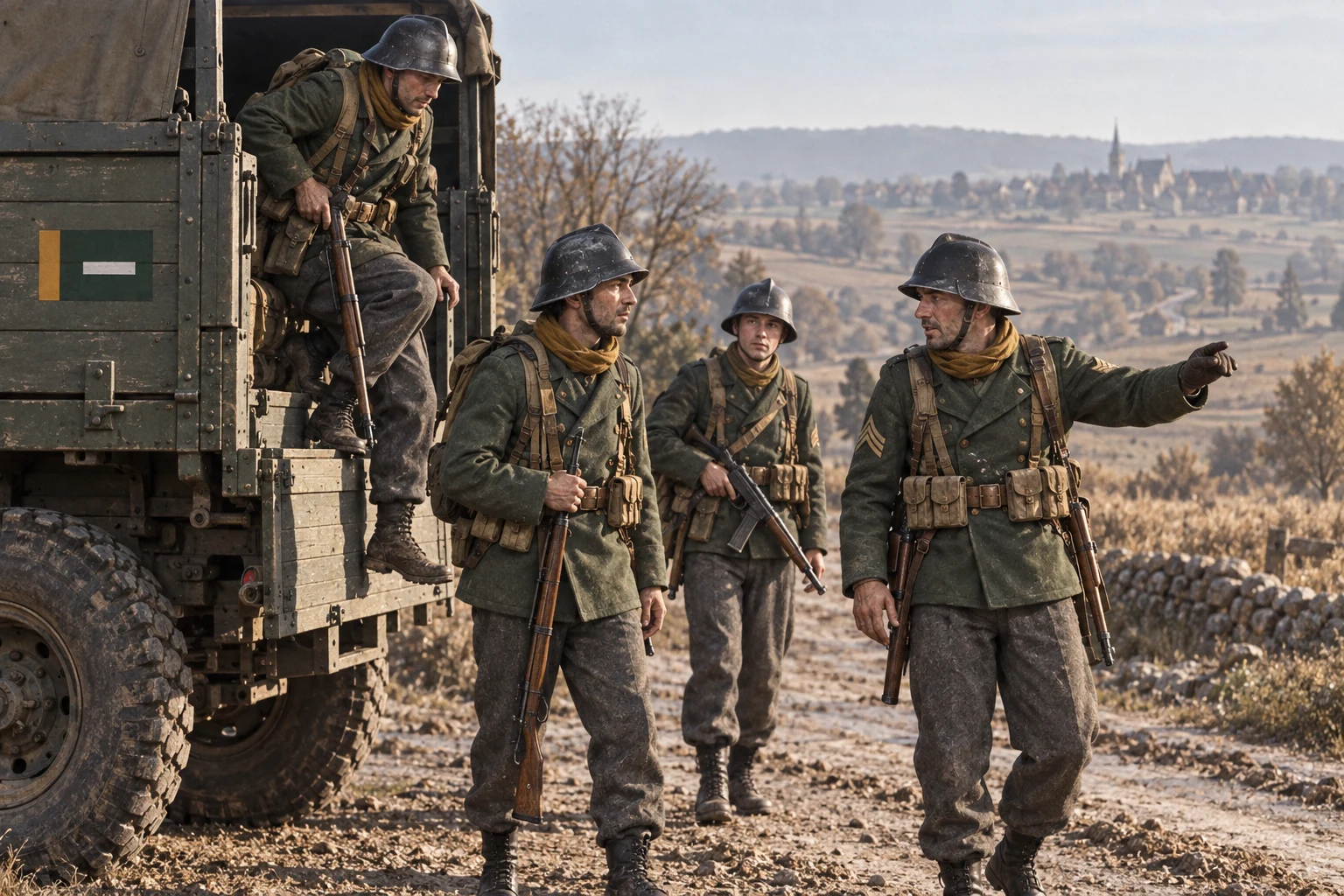
The relief line at Darin Wells
November 4–26, 1227 · Gaften, the Handistani theater · Handistani and Silvian formations against Ruuyaqi forces
Relief interrupted
Darin Wells was an inland Handistani service district behind a front reached through the existing regional war, including Ruuyaqi cooperation with Jazim and fighting around Qarim. Its battle did not create a direct Handistan–Ruuyaq border. Handistani General Rasha Men had arranged to relieve the 17th Infantry Division after months of continuous service. Silvian Major General Ceren Alv's 43rd Division, newly acclimatized after its continental deployment, was to assume the sector in stages. The handover began on November 4. It was precisely the kind of movement that could look orderly at headquarters while leaving the front divided between different communications systems, maps, and habits. Ruuyaqi General Hassem Qor identified the interval and attacked with his 31st Field Corps before the relief was complete.
The first assault struck the village of Harunet on November 5. Two Handistani battalions had departed, but their Silvian replacements had not yet received all the local guides and communications equipment. Colonel Iven Sor, commanding the Silvian 143rd Regiment, believed the village's eastern observation post remained occupied by Handistani troops. It had been withdrawn the previous evening. Ruuyaqi infantry entered the irrigation district before the mistake became clear. Lieutenant Mara Sev's platoon met them among abandoned water channels, lost contact with its company, and withdrew toward the village clinic. Sev carried the wrong map overlay and initially reported the enemy in a location several kilometers away. The error delayed Sor's response while Harunet's eastern houses changed hands.
The men who could not go home
Men's exhausted Handistani division stopped its withdrawal on November 6. Soldiers who had already boarded transport climbed down and returned to the front, angry at both commands. Brigadier Nadra Kel refused to send them directly into unfamiliar Silvian positions. She collected her battalions at Darin Wells, restored their own command connections, and then committed them beside Alv's division. This cost several hours but prevented the relief from becoming an indistinguishable mass of units. Kel's brigade recovered the clinic on November 7. Inside, medical orderly Samir Olan found wounded men from all three armies and sixteen civilians who had remained with relatives. Ruuyaqi personnel had taken supplies but left the patients. Olan's testimony later corrected a rumor that everyone in the clinic had been executed.
Qor's advance aimed to disrupt the service district and force a broader Allied withdrawal, not to conquer Handistan in one movement. His troops captured the northern pumping station on November 9, depriving Darin Wells of its usual water supply. The loss affected hospitals, kitchens, vehicle maintenance, and civilians sheltering west of the battle. Handistani engineer Laila Sarem proposed using the old municipal reservoir, which military surveyors had marked as unusable. Her inspection found its main chamber intact beneath a collapsed access building. Soldiers and civilian workers reopened it while fighting continued nearby. The reservoir supplied less than half the normal requirement, yet that margin allowed Men and Alv to retain the district instead of evacuating its medical establishments under fire.
The Silvian division's first large counterattack on November 12 failed at the clayworks beyond Harunet. Its infantry advanced farther than neighboring units, then encountered Ruuyaqi reserves concealed by the broken industrial ground. Captain Eren Vis lost both his company radio and the runner sent to the battalion command post. He withdrew on his own responsibility after seeing movement on his exposed flank. Sor initially accused him of abandoning the attack; an inquiry using adjacent battalion reports established that continued occupation would probably have isolated the company. Alv retained Vis and dismissed the accusation. The decision mattered to Silvian officers learning whether admission of an incomplete picture would be treated as professional judgment or cowardice in their new continental command.
Holding together
Men proposed a smaller joint operation on November 17, employing her returning veterans alongside rested Silvian battalions. The objective was the pumping station rather than the entire Ruuyaqi penetration. Handistani troops identified passages through the service district that newer arrivals had repeatedly overlooked, while Silvian engineers restored a damaged road sufficient for casualty evacuation. The station fell on November 19 after two days of close fighting. Ruuyaqi defenders surrendered in separate groups once Qor authorized retreat from the most exposed buildings. Sergeant Tariq Nemm brought forty-two men out under a white cloth after their battalion commander was killed. He expected mistreatment and initially refused to leave his wounded. Kel's troops permitted medical personnel to remain with them, making the surrender possible without another costly assault.
Qor continued attacks against Harunet until November 23, hoping to regain the pumping station before withdrawing. They failed to dislodge the now coherent Allied line. His corps had suffered heavily, and additional forces requested from the regional command were unavailable. Men finally resumed the Handistani division's relief on November 24, moving one battalion at a time only after Alv's replacements confirmed control of each position. The last veterans left on November 26. Many had spent three additional weeks in combat after being told their service at the front was ending. Their bitterness survived victory and appeared in complaints sent to the Handistani government. Men supported payment of the additional service allowances and publicly acknowledged that the original handover had been badly managed.
The restored pumping station carried a temporary plaque naming its civilian operators alongside military engineers. Sarem objected when a visiting officer proposed removing the civilian names from an official photograph. Men upheld the original wording. Three operators had been killed maintaining the reserve supply, and their families received compensation through Handistani civil funds rather than an improvised military category that would have delayed payment.
The battle left the Allies holding Darin Wells and most of Harunet, while Ruuyaqi forces retained a limited eastern penetration. Allied military losses were 2,406 killed, 6,981 wounded, and 312 captured; Ruuyaqi losses were 3,188 killed, 8,142 wounded, and 1,106 captured. Civilian deaths in the district reached 417. These figures did not make the front decisive: Ruuyaq remained a coherent belligerent, and the broader Gaften war continued for years. The immediate result was the survival of an Allied service district and a practical change in how multinational reliefs were conducted. Sarem's reservoir remained in use through the next dry season. At its repaired entrance, workers painted the names of those killed reopening it, a civilian record beside the military plaques that arrived later.
Original illustrations for this source record
Original archive artwork and captions are preserved. Dates, labels and claims printed within inherited images belong to the previous edition; the revised text governs the current history.