The first Meren offensive
September 3–October 12, 1227 · Eastern Aldren, Meren Ridge · Silvian 7th Army and Aldren formations against the Teran 87th Elite Battle Corps
Recovering the initiative
Tassar had fallen on June 9. By September, Silvian High General Hujo Lathorne wanted to recover the heights that screened the lost junction before winter hardened the continental front. Meren Ridge formed the immediate objective, with the chalk quarry of Beles and the ruined village of Orven below it. Colonel Saren Del's 71st Infantry Regiment would enter the quarry district while Aldren Brigadier Lera Most's 8th Brigade advanced through the village. Their success was intended to create a position for a later attack upon the ridge itself. General Cevan Rusk, commanding the Teran 87th Elite Battle Corps, had spent the summer strengthening the ground his troops had won. He assigned Major General Toren Keld's 29th Division to the ridge and retained a mobile corps reserve behind Tassar.
The attack opened on September 3 in a haze of chalk dust and smoke. Del's leading battalion entered Beles quarry and found fewer defenders than expected among the abandoned cutting sheds. Its commander reported success before discovering that the quarry's northern exit remained under Teran control. Soldiers who moved toward the exit came back carrying wounded companions, their uniforms white with powdered stone. Major Eran Vale, observing from the adjoining sector, received the first casualty parties and asked whether the battalion could leave by any route other than the one it had entered. The answer was uncertain. Lathorne permitted reinforcement inside the quarry but withheld the division's final fresh battalion until the exit could be assessed. That hesitation prevented a larger force from entering the same confined ground.
Ground that punished possession
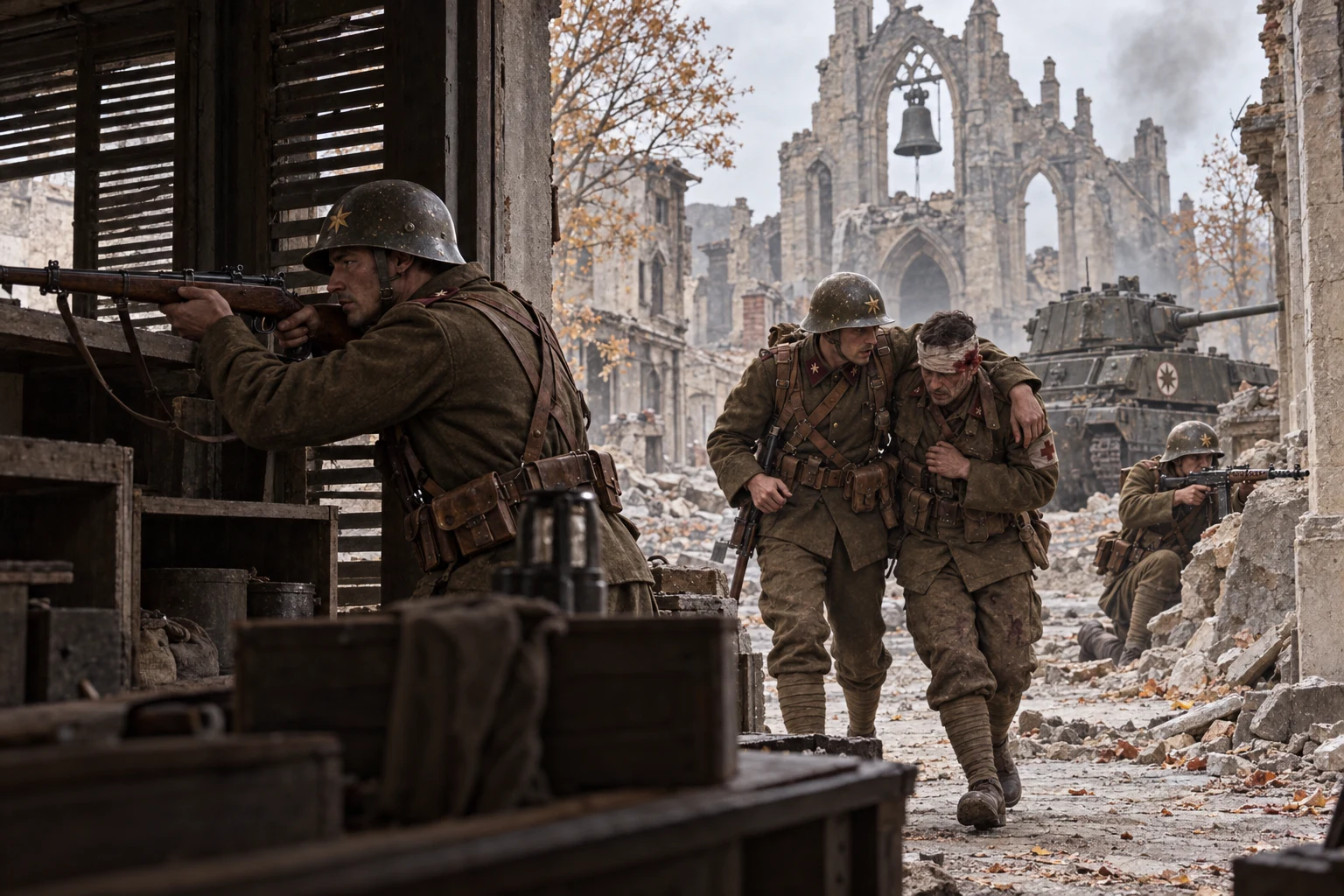
In Orven, Most's Aldren troops recovered the church square on September 5. The church roof had collapsed during the June fighting, leaving the bell suspended above an exposed nave. Residents hiding in the municipal cellar heard their own language shouted by advancing soldiers and emerged too soon. Teran fire from the eastern street forced everyone back below ground. Captain Nela Var helped thirty-one civilians reach the Aldren lines after dark, then returned for a bedridden man whose family refused to leave him. Their rescue delayed the company's relief and left Var's soldiers in position for another day. When a Teran counterattack struck on September 6, the exhausted company withdrew from the square after losing its acting second commander. Most blamed the relief arrangements, not the civilians.
Rusk committed his reserve in portions, restoring the village position without exhausting the force he needed against the quarry. Keld argued for an immediate attack to destroy Del's battalion before the Silvians consolidated. Rusk rejected the larger proposal because Allied pressure elsewhere made the reserve's availability uncertain. The decision spared his troops one dangerous assault but allowed Del time to improve access into Beles. For ten days, the quarry changed from an objective into a burden. The Silvians held its southern workings and lost men carrying supplies across exposed approaches. The Terans controlled the northern lip and suffered whenever they attempted to enter the quarry floor. Neither possession gave the advantage promised by the shaded areas on staff maps.
On September 18, Lathorne authorized a renewed attack supported by fresh artillery allocations and a second Aldren effort around Orven. Rain arrived before the infantry moved. Water collected in the chalk cuts, softened the vehicle tracks, and filled the shelters occupied by wounded men awaiting removal. Lieutenant Cera Hov's company reached a narrow shelf below the ridge and remained there for thirty hours, unable to advance or withdraw safely in daylight. Hov sent three messengers before receiving permission to retreat. Only one returned. Her company brought back sixty-two men from the 143 who had begun the movement, with other survivors reaching aid stations separately over the following days. The immediate roll call therefore understated survival while accurately revealing the formation's collapse as an effective company.
The point at which purpose changed
By September 25, the offensive's original sequence had ceased to exist. Recovering the quarry exit now mattered chiefly because men were trapped beneath it. Most informed Lathorne that another village attack would require rebuilding two Aldren battalions. Del requested replacements but admitted that his regimental staff could no longer identify every mixed detachment inside Beles. Lathorne suspended general attacks and ordered a review of the positions actually held. Critics later described this as the moment he should have ended the battle. At the time, withdrawal threatened to abandon wounded soldiers, equipment, and exposed forward groups. The army required several more days simply to turn a stalled offensive into an organized disengagement, and the Terans continued firing throughout that interval.
Rusk attempted to exploit the pause on October 2. Keld's troops recovered the quarry's central machine house and captured eighty-nine Silvians, but an Aldren counterattack prevented them reaching its southern entrance. Private Nerin Kas, serving in Del's regiment, spent the night beneath a damaged rail wagon with two men from an unfamiliar battalion. Their shared position illustrated how far the original organization had broken down. Relief parties finally reached them on October 5. Kas survived with frost injury and a wounded hand, then spent months recovering before returning to service. His later account contained no claim to have understood the ridge battle. He remembered the wagon's iron wheels, the names of the two strangers, and the hour when someone finally called them out.
Aldren surveyor Iven Seln accompanied the final withdrawal assessment. He marked the quarry chambers containing unrecovered dead and deposited a duplicate plan with the civil registry. That record survived later destruction of the brigade headquarters and guided recovery teams when the district eventually returned to Allied control.
The offensive formally ended on October 12. The Allies retained portions of the lower quarry district but failed to recover Meren Ridge or open the way to Tassar. Allied losses totaled 5,842 killed, 17,306 wounded, and 1,194 captured; the Teran defense suffered 4,116 killed, 11,982 wounded, and 426 captured. These were campaign totals across the involved formations, including the smaller incidents already described. Lathorne accepted responsibility for allowing intermediate gains to dictate continuation after the main design had failed. Rusk preserved the ridge and the 87th's reputation, although the defense consumed experienced troops he could not readily replace. Winter found both armies studying the same chalk slopes. The next attempt would begin in March 1228, with revised plans and many new soldiers facing ground the survivors already feared.
Original illustrations for this source record
Original archive artwork and captions are preserved. Dates, labels and claims printed within inherited images belong to the previous edition; the revised text governs the current history.