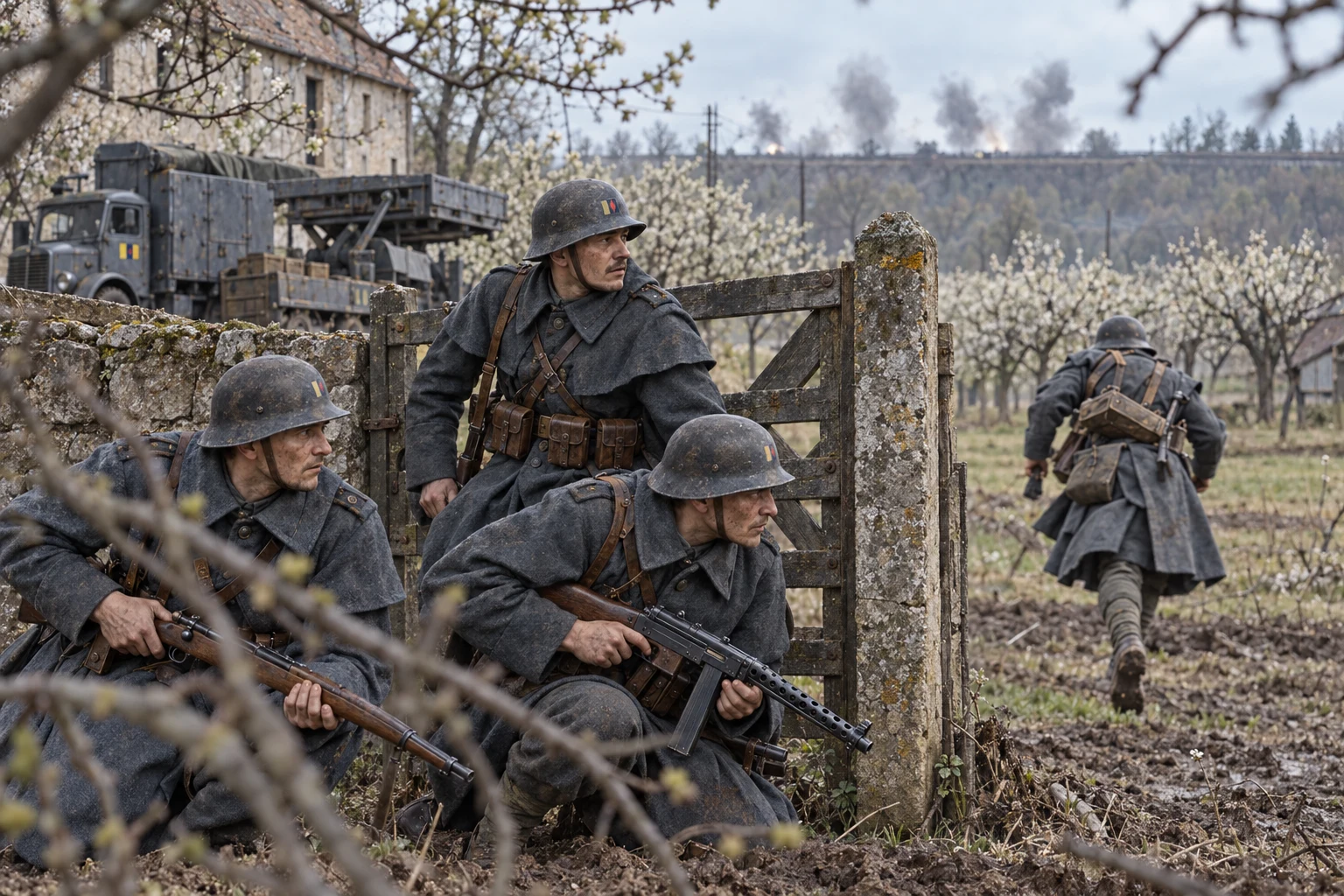
The orchard reconnaissance battle
April 12–23, 1227 · Eastern Aldren · Silvian 7th Army and Aldren troops against detachments of the Teran 87th Elite Battle Corps
Learning a continental enemy
Silvian High General Hujo Lathorne had assumed responsibility for the 7th Army's Aldren sector on March 14. A month later, his soldiers were still discovering how little their island experience explained the ground before Meren and Tassar. The April reconnaissance battle centered on the abandoned orchard settlement of Varen, west of the contested Darsel approaches. Varen was a local Aldren place, not a country or a border crossing. Colonel Mira Halen's Silvian 62nd Infantry Regiment received orders to establish whether Teran troops occupied the orchard ridge continuously or only by patrol. Aldren Major Eren Valt supplied guides from the 11th Territorial Battalion. Opposite them, Colonel Darven Koss commanded the 87th Corps' 214th Infantry Regiment and a reconnaissance battalion temporarily attached to it.
The first clash came on April 12, when Valt's leading patrol entered a farm believed empty since winter. Teran soldiers occupied the cellar beneath its ruined press house. Both parties were close enough to hear one another before firing began. Lieutenant Osa Venn lost six men attempting to recover a wounded guide from the courtyard. He withdrew with the rest, leaving the guide and two Silvian soldiers behind. Koss's troops captured all three. Their absence briefly produced rumors that the Terans had killed prisoners, a claim Lathorne's intelligence staff refused to endorse without evidence. After the war, the guide's testimony confirmed that he had received medical treatment, although his transport into captivity had taken two days through overcrowded collection stations.
An operation that grew
Halen interpreted the encounter as evidence of a thin outpost line and proposed a stronger reconnaissance on April 15. Her division authorized two battalions, with an Aldren company attached, to recover the farm and inspect the ridge beyond it. The farm fell after three hours, but its defenders withdrew toward positions that neither aerial photographs nor earlier patrols had located clearly. Silvian companies advancing through the bare orchards encountered sustained fire from the railway embankment behind the ridge. Major Eran Vale, serving with the neighboring formation, watched wounded men returning along a sunken cart road. Their accounts differed on enemy numbers but agreed that the resistance was organized. Vale relayed the reports instead of treating them as the predictable exaggeration of frightened replacements.
Lathorne suspended the movement beyond the farm on April 16. Before the order reached every company, Halen's right battalion crossed an exposed field and became separated from the main position. Its commander, Lieutenant Colonel Vero Sel, requested permission to remain overnight rather than retreat in daylight. The request was granted. During the night, Koss moved fresh troops into the neighboring hamlet of Edrin, threatening the battalion's return route. General Cevan Rusk approved the limited counterstroke but refused additional forces sought by Koss. The 87th was preparing larger operations for May; revealing or spending those reserves in an orchard dispute would undermine the wider plan. Koss therefore fought with what he had, while the Silvians initially assumed the visible resistance represented the corps' main strength.
On April 17, Aldren troops reopened the cart road long enough for Sel to withdraw. The movement required abandoning two damaged vehicles and most of the battalion's heavy equipment. Private Taren Lio carried a wounded comrade past the old village school, where residents had once painted the doorway blue. He remembered the color because it remained visible beneath the dust. Inside the school, eighteen civilians had sheltered through both occupations of the hamlet. Aldren officers arranged their evacuation after the soldiers passed, but an artillery strike killed four before the wagons arrived. The deaths entered the civil register under the battle's date, correcting an early military report that described the locality as entirely evacuated before the fighting.
What the prisoners knew
Captured Teran documents on April 19 established that the enemy position had been reinforced before the Silvian operation began. They did not reveal Rusk's complete May plan. Lathorne's staff compared them with prisoner interviews and Aldren observations, concluding that the 87th could shift forces within the sector more quickly than the 7th's first estimates allowed. One prisoner, Corporal Joren Val, described the pressure on his own unit after a winter of repeated moves. His account complicated the Silvian picture of an inexhaustible elite formation. The corps possessed experience and cohesion, but those qualities belonged to tired men whose replacements varied widely in training. Intelligence officers recorded the distinction without translating it into an assumption that the Terans were about to collapse.
A final Teran attack on April 21 attempted to recover the press house. Halen's troops held it after a confused fight around the cellar entrances, taking thirty-seven prisoners and losing their newly installed aid station to fire. Medical Sergeant Ina Pell moved patients into an orchard ditch while the farmhouse roof burned. She later challenged the regimental casualty return because several injured Aldren guides had been entered under civilian categories despite serving formally with the attached battalion. The corrected return mattered to their families' benefits and to the account of who had fought. By April 23, both sides accepted a line around the orchard ridge. The Silvians retained the farm; the Terans held the railway embankment and the higher approaches beyond it.
The farm's owner, Mira Teln, returned under Aldren escort to identify livestock and stored seed that could still be recovered. Her inventory showed that both armies had consumed supplies during their occupation of the property. Aldren authorities issued compensation vouchers, preserving a civilian claim even though the farm would remain inside the military zone for another season.
The twelve-day encounter cost the Allied force 318 killed, 907 wounded, and 74 captured; Teran losses were 261 killed, 688 wounded, and 93 captured. It yielded no decisive territorial gain and did not prevent the offensive Rusk would open on May 18. Its importance lay in the specific errors it exposed. Halen had mistaken an occupied outpost for the full defensive system, and Lathorne's army had allowed a reconnaissance to acquire the expectations of an assault. The High General retained Halen but required clearer limits for subsequent operations. Valt's guides gained greater authority in local planning. When the May crisis came, the 7th still lost ground and eventually Tassar, yet its officers understood more accurately the organized enemy advancing against them. That understanding had been purchased in an orchard few newspapers bothered to name.
Original illustrations for this source record
Original archive artwork and captions are preserved. Dates, labels and claims printed within inherited images belong to the previous edition; the revised text governs the current history.