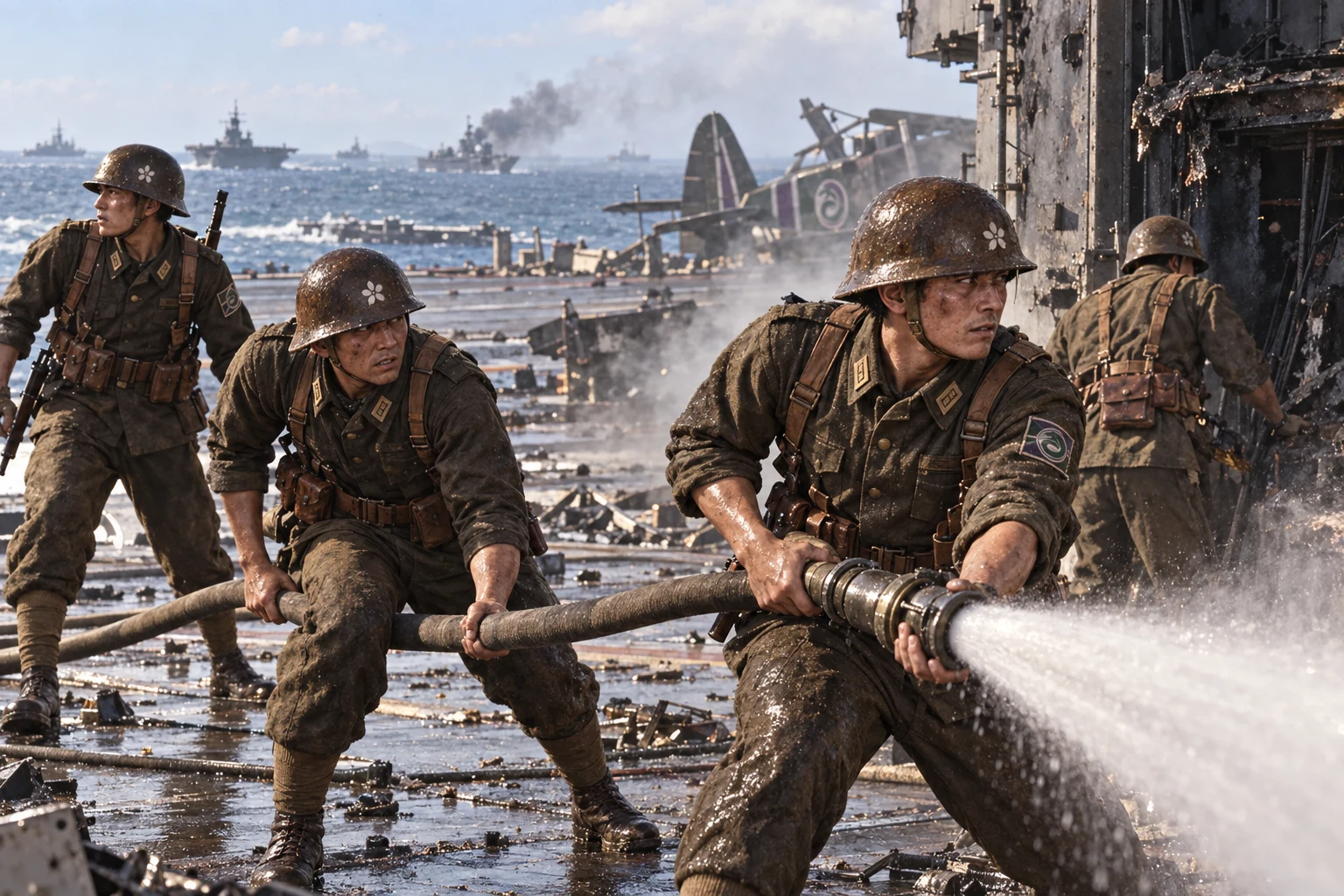
Six days in the Nagasaki
December 3–8, 1226 · Nagasaki Ocean · Silvian carrier battle fleets against the Kelonese 5th Mobile Fleet
A small part of an enormous war
By late 1226, fifty-two Silvian carrier battle fleets were operational across the Nagasaki theater. The confrontation beginning December 3 involved three of them, assembled under Admiral Rena Sol for a specific covering operation. Their principal carriers were Civic Horizon, Common Voice, Resolute Dawn, Assembly, Far Beacon, and New Covenant, accompanied by escorts and supporting ships. Kelonese Admiral Taro Ishen opposed them with the 5th Mobile Fleet, including the carriers Shirokai, Amatsu, Noren, and Tsukari. Neither side had gathered every available carrier into one decisive battle. Other formations protected distant operations, repaired damage, trained replacement aircrews, and maintained the continuous movements that made this six-day concentration possible. The battle grew from Ishen's attempt to strike Silvian support traffic before the next island offensive.
At 08:40 on December 3, a scout from Common Voice sighted two Kelonese destroyers beneath broken cloud. Its crew reported the escorts but lost the larger formation during a rain squall. Sol withheld a full strike until another aircraft located Shirokai an hour later. The delay allowed Ishen to begin launching first. Lieutenant Cera Vann, leading a Silvian fighter section, encountered incoming Kelonese aircraft while climbing through low cloud and initially mistook their scattered formation for returning scouts. Her correction reached the fleet with only minutes remaining. Bombs struck Assembly's forward flight deck and exploded among aircraft waiting to launch. Fire crews saved the ship's magazines, but the carrier ceased flying and turned away with seventy-nine dead and more than two hundred wounded.
The uncertain exchange
The Silvian counterstrike reached Ishen's fleet during the afternoon. Shirokai avoided the first attacks, while the smaller Noren suffered two bomb hits near its elevators. The aircraft returning to Sol's carriers claimed both ships fatally damaged. Photographs taken the next day showed Shirokai still maneuvering and Noren under tow. Sol's operations officer corrected the fleet report before it reached civilian authorities, an unpopular decision among crews who believed they had seen the enemy burning beyond recovery. Noren would ultimately be lost, but its fate remained undecided that evening. A damaged Silvian bomber landed on Far Beacon after its own carrier had withdrawn. Its observer, Lieutenant Evin Tal, carried a sketch showing another enemy carrier farther north than the main reported position.
Ishen used that northern group to launch an attack on the replenishment ships on December 4. The tanker Civic Plenty caught fire, forcing its escort to abandon towing efforts after the flames spread across the sea. Its loss did not empty the entire Silvian fleet's fuel reserves, but it removed the tanker assigned to several destroyers already running short. Sol detached those ships to a different rendezvous and reduced the screen around her damaged carrier group. At the same time, she ordered Vann's squadron to rest crews who had flown three sorties in a day. Squadron officers objected that every fighter mattered. The following morning, two aircraft from another exhausted section collided during recovery, killing both pilots and scattering burning wreckage across Common Voice's deck.
The weather closed on December 5. Neither admiral could maintain continuous sight of the other, and the damaged ships became the center of their decisions. Noren's crew struggled against flooding while Kelonese destroyers took aboard injured men. Ishen had to choose between protecting the tow and preserving freedom to attack Sol's carriers. He divided his force, assigning two cruisers and four destroyers to Noren. Sol also divided her command, sending Assembly and Civic Horizon toward repair while retaining four carriers with enough aircraft to continue the battle. These movements produced several false sightings. One Silvian reconnaissance crew followed the damaged-carrier group for twenty minutes before recognizing friendly signals. Its wasted search interval allowed Ishen's intact carriers to shift beyond the expected search area.
The price of another launch
On December 6, Sol accepted a longer strike after a scout finally found Amatsu and Tsukari. The aircraft reached the enemy with less margin for their return than their commanders preferred. Lieutenant Tal's bomber attacked Amatsu and survived heavy fire with a damaged engine. Another bomber struck the carrier's after deck, starting a fire that forced Ishen to suspend recovery. Several Kelonese aircraft then landed on Shirokai; others exhausted their fuel and ditched. The battle's aircraft losses therefore included crews who never encountered an enemy fighter. Tal's own aircraft failed short of the Silvian fleet. His pilot died in the landing, but Tal and the rear gunner spent fourteen hours in a raft before the destroyer Open Road found them.
The following morning, a Silvian patrol located Noren's tow. Sol sent a limited strike rather than diverting all remaining aircraft from the intact enemy carriers. The attack damaged the towing cruiser and opened additional flooding aboard Noren. At 15:10 on December 7, the Kelonese abandoned the carrier; its escort later sank the wreck after recovering most surviving crew. Ishen ordered his mobile force away that night. Sol considered pursuit but faced damaged decks, reduced aircraft strength, and destroyers requiring replenishment. She continued reconnaissance on December 8 and then broke contact. The surviving Kelonese carriers escaped. Silvian officers who called the withdrawal a missed opportunity had to explain what ships and rested crews they expected to conduct the pursuit.
Shirokai's surviving air group returned with nineteen aircraft requiring major repair and eleven crews temporarily unfit for flying. Ishen's report separated those unavailable machines from aircraft permanently destroyed. The distinction prevented his headquarters from promising a renewed strike based on an inventory that counted every surviving airframe as combat ready. His force required weeks before it could undertake another comparable operation.
The six days cost the Silvians 163 aircraft, including combat losses, accidents, and aircraft abandoned aboard damaged ships. Their naval and air personnel suffered 1,096 killed or missing presumed dead and 1,884 wounded. The Kelonese lost Noren, two destroyers, and 219 aircraft, with 2,317 dead or missing and 1,506 wounded. Assembly required five months of repairs; Civic Horizon returned sooner. Neither side's losses could be replaced merely by counting hulls elsewhere in the theater. Sol's victory prevented the intended attack on the main support traffic and removed one enemy carrier, but it consumed veteran crews needed for later operations. Vann survived and spent January teaching replacement pilots. Her first lesson used the December 3 recognition error, an admission that surprised students expecting an account of flawless victory.
Original illustrations for this source record
Original archive artwork and captions are preserved. Dates, labels and claims printed within inherited images belong to the previous edition; the revised text governs the current history.