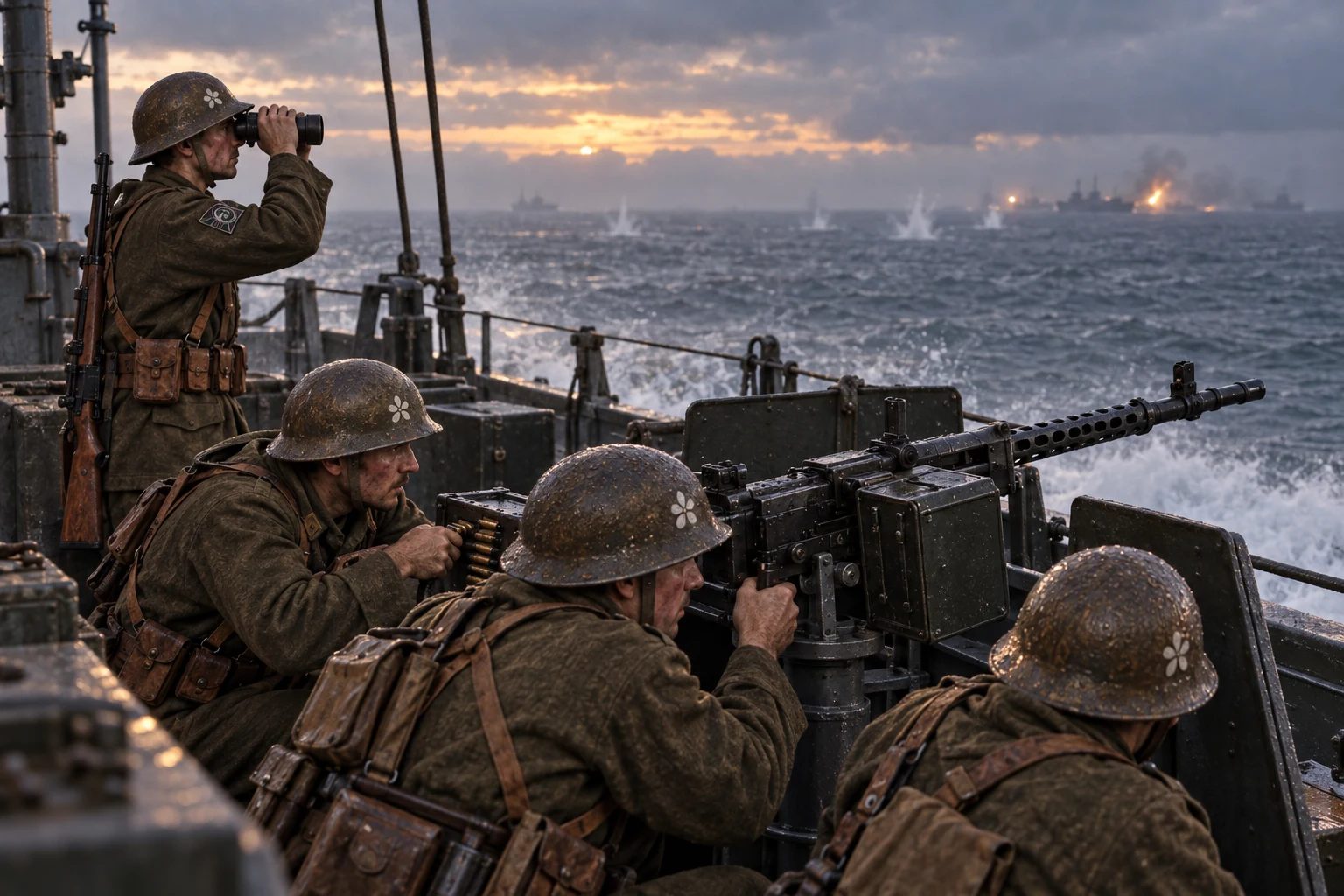
The Vespolian transport shield
October 9–21, 1226 · Vespolian Ocean · Silvian escort and covering formations against Axis raiding forces
A convoy too large to conceal
The transport assembly designated Passage Seventeen carried elements of the Silvian army's continental deployment, including engineers and artillery workshops assigned to Gaften. Its forty-six principal merchant and military transports departed in separated groups before concentrating in the Vespolian on October 9. Commodore Evin Sar commanded the close escort from the cruiser Civic Measure. Rear Admiral Talen Vey commanded a distant covering group built around the carriers Open Hand and Morning Assembly. Those forces formed part of the expanding deployment that would reach thirty Silvian fleets assigned to the ocean on October 30. All thirty were not present at this battle. The convoy's destination was a consenting Allied reception system, with Huqait authorities controlling the eventual harbor allotments. Its troops had not become operational merely by boarding ships.
The Axis raiding force combined the Kelonese heavy cruiser Hoshiren and destroyers with submarines operating under separately coordinated instructions. Captain Miro Saden aboard Hoshiren learned of Passage Seventeen through reconnaissance on October 10. He knew the convoy's general position but could not continuously track both its close escort and its carrier cover. A storm broke the transports into smaller visual groups that evening. The cargo ship Kindred Hill developed steering trouble and drifted out of station with a workshop battalion and 240 civilian seamen aboard. Sar detached the destroyer Pennant to assist her. That decision weakened his outer screen precisely when the submarine K-71 found the lagging vessels. At 03:18 on October 11, a torpedo struck the transport Civic Hearth near its after engine room.
Ships with people inside
Civic Hearth carried 3,160 soldiers, most unfamiliar with moving through a ship without light. Lieutenant Nerin Olva of the 214th Engineer Battalion organized a line of men along the flooded passage to the upper deck. The ship's captain, Bera Han, ordered abandonment after the list made her remaining boats difficult to lower. Several lifeboats smashed against the hull, and the escort sloop Aldren Promise returned through floating wreckage to recover survivors. By sunrise, 2,704 people had been saved from the transport's military complement; 456 soldiers and thirty-eight merchant crew had died. The submarine escaped that immediate encounter. Sar stopped the convoy's nearest section for forty-seven minutes, a decision that increased exposure but prevented survivors from being left across several kilometers of black water.
Saden attacked on October 12 while the convoy was still reforming. Hoshiren and four destroyers emerged through a squall and fired on the escorts protecting the southern transport group. Civic Measure took three heavy hits, losing its after director and much of its radio room. Lieutenant Commander Ava Rell assumed communications control from a secondary station and transmitted Sar's order to turn the transports away. The cruiser remained between them and Hoshiren, using its undamaged weapons until smoke covered the withdrawal. Pennant, returning from Kindred Hill, joined the fight at close enough range to draw concentrated fire. The destroyer lost its bridge and later sank. Its surviving executive officer, Leno Marr, kept the crew together on rafts until Tinara-built escort craft serving with the Silvian force recovered them that night.
Carrier aircraft reached the raiders late in the afternoon. Their first attack damaged a Kelonese destroyer but failed to stop Hoshiren. The returning aircrews reported more hits than reconnaissance could confirm. Vey resisted pressure to send another strike near sunset when damaged aircraft and worsening weather threatened a recovery disaster. Sar, reading the refusal aboard his burning cruiser, considered it excessively cautious. Their later correspondence preserved the disagreement. Neither commander possessed the whole picture: Sar saw transports still within reach of the enemy, while Vey faced a flight deck crowded with returning aircraft and a squall line advancing across the carriers. Hoshiren withdrew eastward during the night, temporarily leaving the convoy behind but retaining enough speed to threaten its next movement.
The second attempt
Passage Seventeen reached an Allied replenishment rendezvous on October 15. Damaged ships transferred passengers where possible, and Huqait liaison officers revised the reception schedule ashore. The delay imposed costs on the Gaften campaign without making the deployment a failure. Olva's surviving engineers had lost equipment, records, and many section leaders. Assigning them immediate construction work on arrival would have concealed how badly their battalion had been hurt. Aboard Open Hand, mechanics prepared aircraft damaged during the first encounter while replacement crews came over by boat. Vey received reinforcement from the cruiser Meridian and three destroyers, then moved his cover closer to the convoy. The change reduced the chance of another surprise surface attack but narrowed his freedom to pursue the raider.
On October 18, Saden returned with Hoshiren and three serviceable destroyers. This time Silvian patrol aircraft found his force before it reached the transport lanes. Vey launched from both carriers, while Sar's deputy kept the convoy moving rather than turning it toward the coming fight. A torpedo struck Hoshiren aft, flooding a shaft compartment and reducing speed. Saden attempted to disengage under the remaining destroyers' protection. Meridian caught the damaged cruiser after dusk but suffered a serious hit before Hoshiren's steering failed. Saden ordered abandonment shortly after midnight. Silvian ships recovered 611 of its crew the following morning, among them the wounded captain. The surviving Kelonese destroyers escaped with additional men; their departure prevented a complete accounting until after the war.
Civic Measure reached a repair anchorage with its ruined radio room sealed behind canvas. Rell recommended fitting a second protected communications station during reconstruction. The ship returned to service in July 1227, carrying a brass plate naming the seventeen signal personnel killed in the first encounter.
The final submarine attack occurred on October 20 and damaged the freighter Harbor Ledger without sinking her. By October 21, surviving sections of Passage Seventeen had entered protected Allied approach waters. Forty-three of the original forty-six principal transports completed the voyage under their own power; Civic Hearth was lost, Kindred Hill required towing, and a third transport turned back with mechanical damage. Across the battle, Silvian naval and military deaths totaled 1,183, with 1,746 wounded; merchant crews suffered an additional 119 dead and 203 wounded. Those totals included the earlier losses rather than adding them again. Axis losses comprised Hoshiren, one destroyer, and 1,027 dead or missing presumed dead. The deployment arrived late and diminished, but it arrived. In Gaften, Olva's engineers rebuilt their unit before building the roads their original schedule had already promised.
Original illustrations for this source record
Original archive artwork and captions are preserved. Dates, labels and claims printed within inherited images belong to the previous edition; the revised text governs the current history.