The Tinara support-island defense
April 9–22, 1226 · Grand Isles, Tinara · Tinara 3rd Coastal Regiment and Silvian naval detachments against the Kelonese 19th Landing Group
The island behind the fighting
Tinara had entered the Allied war on January 12. Three months later, its government discovered how quickly a support assignment could become a battle. The anchorage of Pelun served repair tenders, ambulance ships, and the small coastal vessels carrying stores into more exposed islands. Pelun was Tinara territory; ships approaching it received Tinara clearance, and the nearby neutral sovereignty of Vasolu afforded neither fleet a convenient extension of the battlefield. Kelonese Rear Admiral Jiro Mase intended to wreck Pelun's workshops and destroy the harbor's floating repair dock. Occupying the entire country exceeded his orders and available strength. His 19th Landing Group carried 4,600 troops, accompanied by the light cruiser Honrai, seven destroyers, and smaller transports. Colonel Lera Tavin's Tinara 3rd Coastal Regiment had 2,840 effectives around the harbor and its two coastal approaches.
On April 9, Mase's aircraft struck the fuel lighters at first light. The smoke initially concealed the transports from observers on Lookout Hill. Tavin therefore received contradictory reports: an air raid over the anchorage, small craft offshore, and an enemy patrol already at the abandoned lime wharf. Lieutenant Saren Ilu, commanding the wharf detachment, counted several hundred attackers before his telephone failed. He withdrew into the kiln buildings with seventy men, leaving two wounded soldiers beneath a loading ramp. Their eventual rescue became a matter of bitter argument inside his company. At headquarters, Tavin refused an immediate counterattack from the harbor reserve. She had no reliable count of the landed force, and a second group of transports remained outside the southern entrance.
The repair dock holds
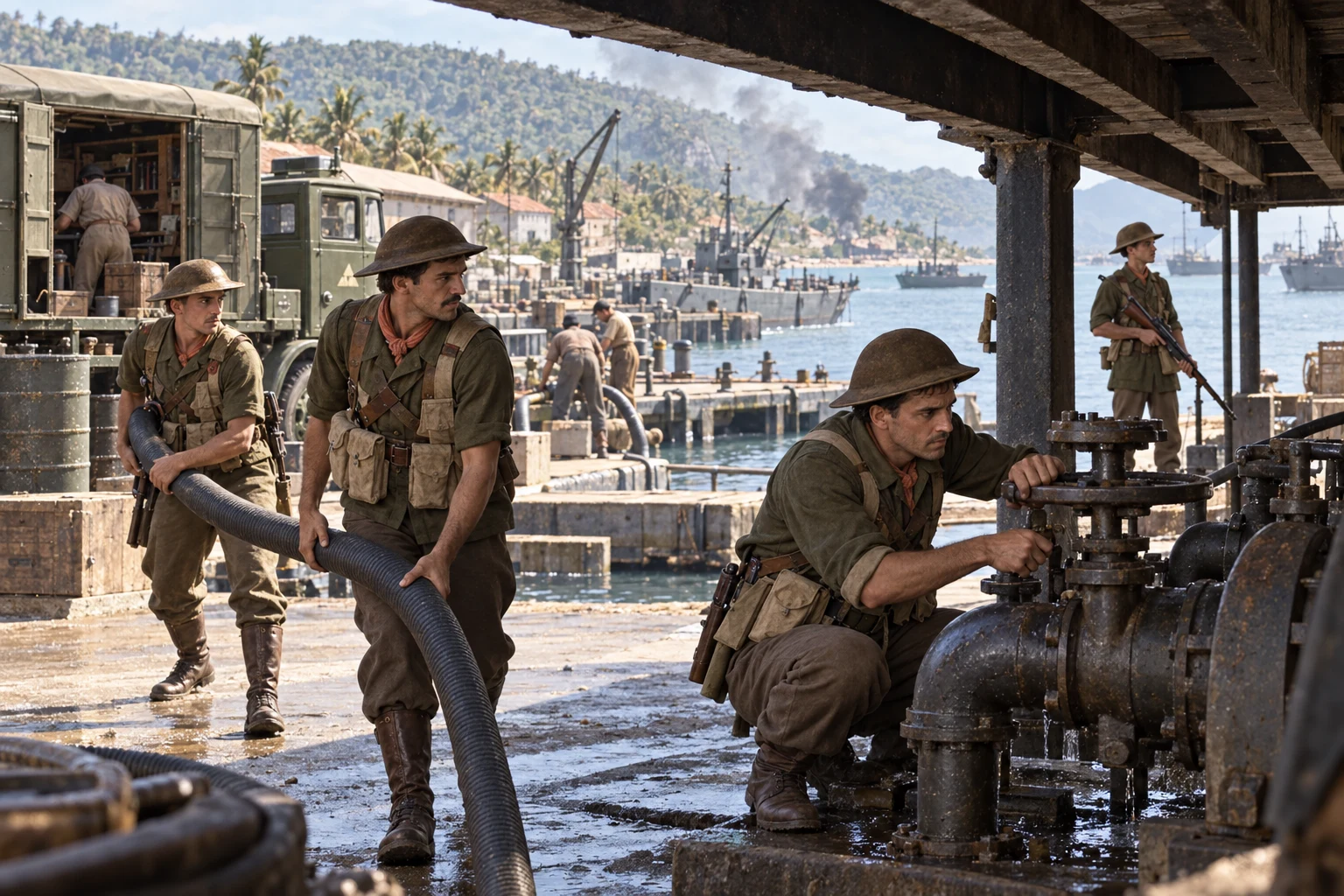
The Kelonese assault moved quickly through the lime sheds but slowed at Pelun's workers' quarter. Tinara reservists knew the narrow streets while their opponents possessed stronger support offshore. Shells from Honrai collapsed the tram depot and severed the public water main. Chief dock engineer Iva Relen gathered civilian fitters beneath the floating dock's raised platform, where its machinery remained operable. The naval tender Hearth carried the dock's portable generators away from the bombardment; its civilian yard crews stayed behind because the pumps would stop without them. By dusk, fire illuminated the crane rails. Mase's landing commander, Major General Kenzo Ari, reported the workshops nearly within reach, although his forward companies had still not crossed the drainage channel separating the workers' quarter from the repair basin.
The first Silvian relief consisted of two destroyers and a repair escort, not an invasion army. Commander Pela Vorn aboard Civic Watch reached Pelun on April 10 after receiving Tinara permission to enter. Her ships brought ammunition, eighty-four naval medical personnel, and a signal section that restored contact between Tavin and the seaward batteries. Their presence prevented Mase from treating the harbor entrance as uncontested water. That night Honrai damaged Civic Watch with two hits, killing twenty-one sailors and disabling her forward mounting. Vorn nevertheless remained outside the entrance until the hospital transport Quiet Mercy completed its departure. Her report emphasized the transport's passage rather than claiming a victory over the larger cruiser. The damaged destroyer withdrew the following morning under her own power.
On April 12, Ari attempted to take the drainage crossing under cover of another bombardment. The bridge had become a mound of broken masonry, overturned carts, and wounded men. Sergeant Nalin Ero's Tinara platoon held the western abutment until its ammunition ran low; Ero then requested permission to retreat through the dock gates. Tavin approved the withdrawal and committed her remaining fresh company inside the yard. The company stopped the Kelonese advance near the machine shop, but enemy troops retained the bridge and the southern bank. Pelun's defenders had saved the pumps by surrendering ground that official communiqués had called indispensable. Relen later remembered the relief less as a heroic charge than as exhausted soldiers asking which pipes could safely be broken.
A battle decided offshore
A larger Allied naval group arrived on April 15 under Silvian Rear Admiral Daro Sen. It included the carrier Civic Horizon, two cruisers, eight destroyers, and Tinara patrol craft. The carrier's aircraft forced Mase's replenishment ships to withdraw beyond easy night access to the landing force. A Kelonese attack damaged Horizon's flight deck on April 16 and killed forty-three crew members, but the ship resumed limited flying the next afternoon. The interruption mattered ashore. Ari used the hours without Allied air cover to bring in ammunition and evacuate his most seriously wounded. Tavin's counterattack on April 17 therefore met a replenished enemy rather than the depleted force her staff expected. Its leading battalion lost sixty-seven men killed before she suspended the attempt.
The failed counterattack persuaded Sen and Tavin to concentrate on preventing another reinforcement. Tinara fishing crews provided local pilotage under military control, accepting risks that did not turn their civilian families into combatants. The patrol cutter Leren found two Kelonese supply barges approaching Pelun on April 19; one escaped, while the other grounded and surrendered after its escort was driven away. Ari now possessed enough ammunition to defend his perimeter but lacked food, medical supplies, and a secure route for heavier equipment. Mase received orders to preserve his ships for the wider Grand Isles campaign. During April 20–21, his transports recovered most of the landing group through the lime wharf. Rain and smoke hid much of the evacuation, although Tinara observers recognized the departing boat traffic.
Among the recovered buildings was Pelun's signal school. Its instructor, Captain Nera Ilu, found the student register beneath a fallen cabinet and used it to identify three dead reservists whose papers had burned. All three had joined the coastal regiment only six weeks earlier.
By April 22, Tinara troops had reoccupied the workers' quarter and recovered 318 Kelonese prisoners, including men too badly wounded to move. Allied losses totaled 487 killed and 1,126 wounded across the fourteen days; civilians suffered 209 deaths. Kelonese records later established 742 killed, 1,381 wounded, and the 318 captured, with the wounded categories excluding prisoners already counted. The floating dock survived, but Pelun did not resume full repair work until June. Tavin retained her command after an inquiry accepted that her retreats preserved the harbor's essential machinery. Relen received a military commendation and requested replacement housing for the dock workers in her acceptance letter. Tinara's victory secured a support base through endurance and naval intervention, while the shattered quarter made the cost visible every time a repaired ship sailed out.
Original illustrations for this source record
Original archive artwork and captions are preserved. Dates, labels and claims printed within inherited images belong to the previous edition; the revised text governs the current history.