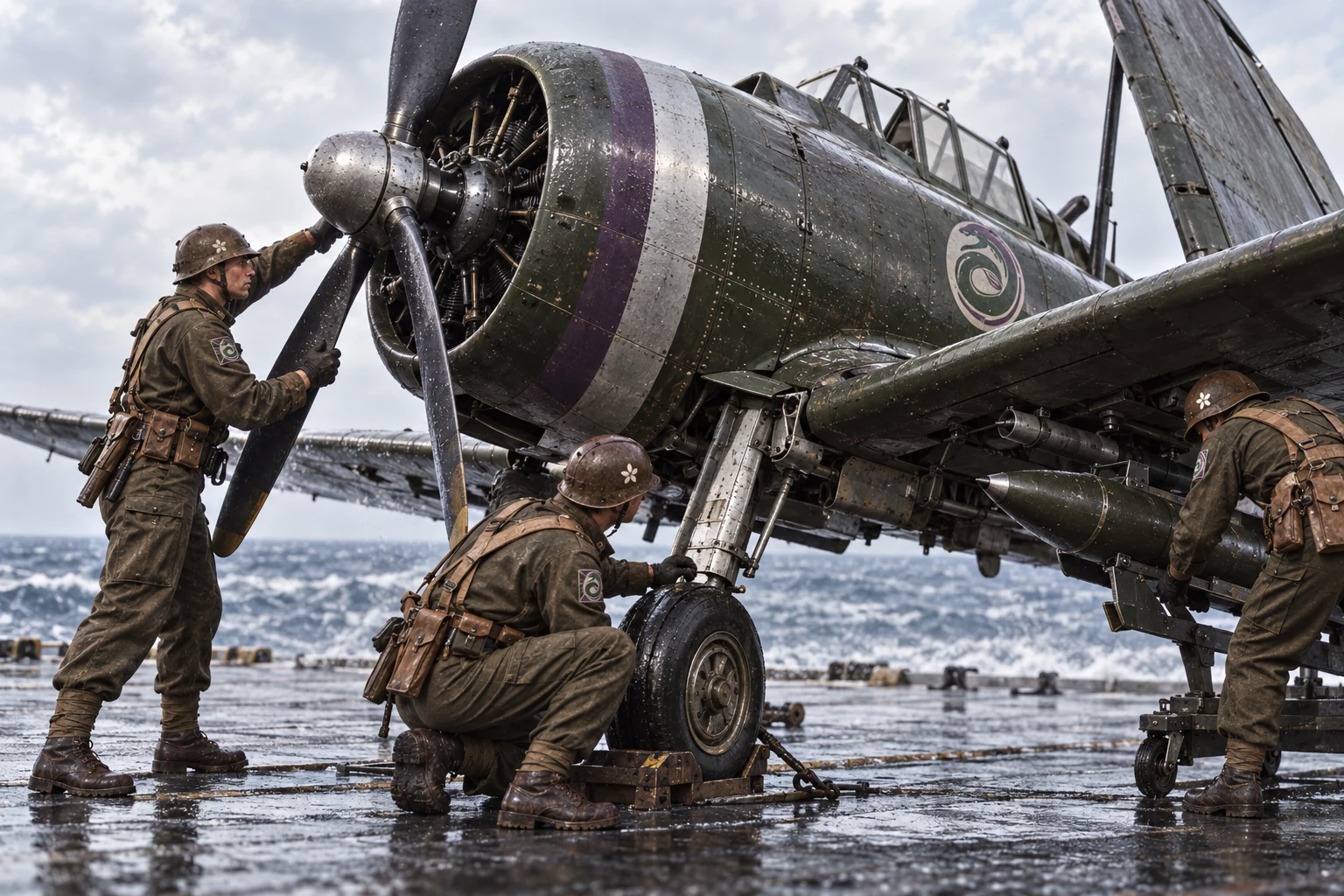
The Gaften-bound shipping battle
August 4–16, 1225 · Vespolian routes to Gaften · Silvian and regional Allied escorts against Kelonese interception forces
A commitment before the great allocation
The August shipping movement toward Gaften carried advance service formations, medical establishments, communications personnel, and equipment intended to prepare a larger Silvian commitment. It did not represent the full third of the army later assigned to Gaften under the July 1226 allocation. Silvia's declaration had expanded on July 16, 1225 to include Hukular, the Teran Empire, Ruuyaq, Rostan, and Novren after the established sequence of attacks and diplomatic rupture. The convoy therefore sailed within a widening war. Its immediate naval opponent remained Kelonese, while its receiving arrangements with Trenoa and Huqait were negotiated with those Allied governments rather than presumed from coalition membership alone.
Rear Admiral Nera Dalen commanded the escort, a separate officer from General Mira Dalen. Her force centered on the carrier Civic Promise, two cruisers, and nine destroyers accompanying twenty-six cargo ships and transports. Trenoan escorts would join nearer the receiving ports. Admiral Oren Vask's staff emphasized that the passage was preparatory: much of the cargo consisted of cranes, workshop equipment, hospital fittings, and transport vehicles whose value would appear when later formations arrived. Losing them would not merely reduce the present convoy's success. It would weaken the infrastructure intended to receive a much larger continental deployment in the following year.
The first interception
Kelonese Vice Admiral Hatsu Ren assigned a carrier strike group to intercept the movement after reconnaissance identified its general route. The first attack came on August 4, reaching the convoy while several merchants were correcting their positions after poor weather. Civic Promise's fighters disrupted the leading formation, but a second group attacked from another direction. The cargo ship Huqaiti Accord received a hit near its engine room and lost propulsion. Its crew contained the flooding while the destroyer Equal Shore stood by. Dalen ordered the ship towed toward an agreed Allied refuge with two escorts, reducing her strength before the main contest had fully developed.
On August 6, Kelonese aircraft struck again. The transport North Assembly was damaged above the waterline, killing service personnel in accommodation spaces and starting fires among packed equipment. Major Lena Ors, commanding an embarked hospital detachment, organized treatment alongside the ship's surgeon. Their medical stores were partly inaccessible behind smoke. Sailors opened another route through a cargo compartment while soldiers moved uninjured passengers clear of the working area. The cooperation saved lives but exposed how poorly some embarkation plans had considered access to essential supplies after damage. The hospital equipment existed aboard ship; availability during an emergency required more than its presence on a manifest.
The Silvian cruiser Public Covenant intercepted a Kelonese reconnaissance aircraft on August 7 through information passed to the carrier's fighters. The aircraft was shot down after transmitting a partial position report. Dalen changed course within her authorized route options and sent a destroyer to recover survivors. Three Kelonese aircrew were rescued, one dying later from injuries. Their treatment became a small but concrete test of the navy's prisoner procedures during an operation already burdened with its own casualties. The surviving prisoners were transferred ashore through the same medical reception system prepared for Allied wounded, with custody maintained separately from clinical decisions.
The convoy and the carrier
Ren concentrated his strongest attack on August 9, hoping to damage Civic Promise and leave the merchant formation without dependable air cover. The carrier's fighters met the incoming aircraft beyond the convoy, while its escorts maneuvered under attack. Civic Promise sustained a hit that started a fire near an aircraft-handling area and interrupted flight operations. Captain Taren Selin ordered damaged aircraft moved clear where possible and retained crews aboard to fight the fire. The carrier resumed limited operations later that day, but several returning pilots had already diverted toward other available Allied facilities or ditched near escort ships when fuel ran low.
Dalen considered detaching Civic Promise for repair and rejected an immediate departure because the convoy remained exposed. The carrier could still provide reduced cover, and sending it away with escorts would weaken the remaining ships further. She instead divided air tasks, prioritizing defense over offensive search. This left Ren's force less threatened but preserved protection over the transports. The decision reflected a familiar naval tension: the ship with the greatest offensive capacity was also the resource whose defensive service the convoy could least afford to lose. Civic Promise's damage made that tension visible in every revised flying schedule.
Trenoan escorts joined on August 11 under Commodore Samir Vahl. His ships included the cruiser Trenoan Dawn and four destroyers accustomed to the receiving approaches. Vahl took responsibility for the damaged-ship group while Dalen maintained the main convoy's air defense. Their arrangements were settled through liaison officers already embarked, avoiding a prolonged argument over seniority during the attack. The combined force repelled another Kelonese strike on August 12, though the ammunition carrier Western Measure was sunk. Its crew abandoned before the final explosions, and rescue ships recovered most survivors. The cargo loss delayed establishment of a planned reserve stock ashore.
Arrival and consequences
The convoy entered the Allied Gaften reception system in stages from August 14 to 16. Huqaiti Accord arrived under tow at its separate refuge; North Assembly discharged wounded before continuing unloading. Trenoan and Huqaiti authorities assigned berths according to local capacity, which forced Silvian planners to distribute equipment among more locations than originally preferred. Advance personnel began assembling workshops and medical facilities while reconciling cargo losses and diverted ships. The work did not create an instant continental army. It established parts of the support structure through which later troops could become an operational force rather than a mass of arrivals waiting beside unloaded crates.
Vahl’s harbor officers retained control of berth assignments throughout unloading, preserving the receiving states’ authority while accommodating the republic’s larger contribution.
Twenty-five of the twenty-six merchant and transport vessels survived. Silvian and regional Allied losses totaled 394 dead and 681 wounded; Kelonese losses totaled forty-three aircraft and 208 personnel dead or missing presumed dead, with additional wounded returned to their service records. Civic Promise required substantial repair after the passage. The battle delivered most preparatory cargo while demonstrating the cost of extending Silvian commitments beyond the Grand Isles. Its importance lay between two dates: after the republic's widening declaration and before the great theater allocation. It made the future Gaften deployment more feasible without pretending that the future force had already arrived.
Original illustrations for this source record
Original archive artwork and captions are preserved. Dates, labels and claims printed within inherited images belong to the previous edition; the revised text governs the current history.