The return to Orava
March 18–April 7, 1225 · Grand Isles · Silvian and Taluman forces against Kelonese Orava garrison
Returning with a different purpose
The second Orava operation sought the anchorage and the ground needed to keep it functioning. General Mira Dalen rejected proposals framed chiefly around avenging the failed landing of February 1224. The island lay within the contested Taluman approaches, and Taluman representatives participated in planning its recovery. Silvian Brigadier Nalen Varr commanded the principal landing group, built around the 8th Infantry Brigade with engineers, medical units, and naval support trained together before departure. Captain Eran Vale commanded a company containing survivors of the earlier campaigns and new recruits. Their experience informed the plan without guaranteeing that the island would become easy to take.
Kelonese Colonel Hideo Mara had strengthened Orava's defense since the first assault. His garrison held coastal positions, an inland ridge, and observation points overlooking the anchorage. Rather than defend every stretch of shore equally, he concentrated on exits leading toward the ground required for sustained unloading. Dalen's staff expected this and prepared alternatives when particular landing areas became unusable. Admiral Oren Vask's supporting naval organization assigned clear authority for changing boat schedules. These arrangements lacked the dramatic appeal of a larger preliminary bombardment, but they addressed failures that had previously left soldiers ashore without a dependable connection to the force behind them.
March 18
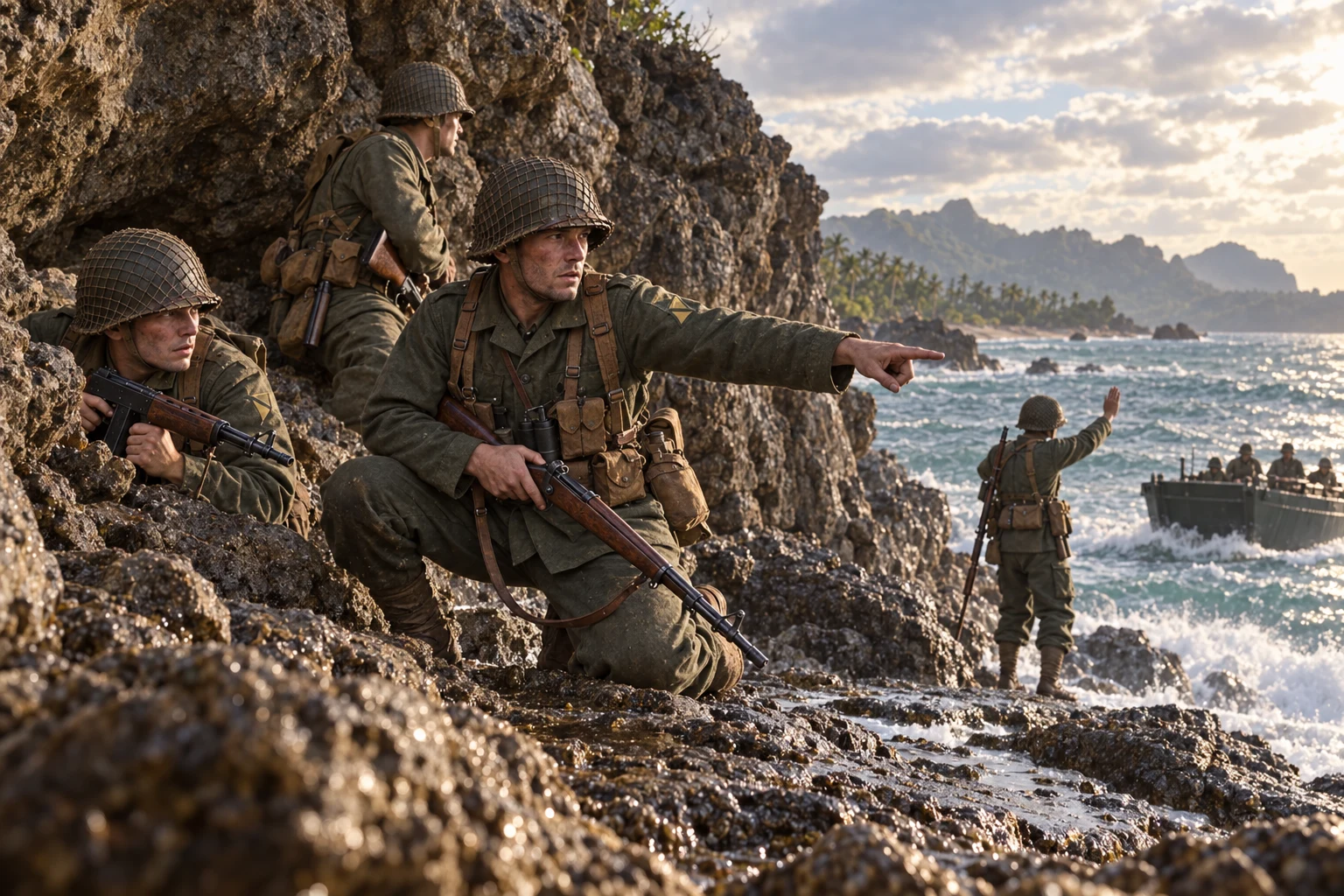
The landing began on March 18 under broken cloud and a persistent swell. Several boats reached the intended shore; others landed farther along the coast after smoke obscured their reference points. Lieutenant Sera Dan's platoon came ashore beside a rocky projection and found its planned exit blocked by Kelonese fire. Dan retained the platoon near cover and reported its position instead of moving blindly toward the nearest gunfire. Naval control redirected the next boat group to a usable landing area. The decision delayed reinforcement of Dan's immediate position but prevented more troops from accumulating in ground from which they could not advance.
Vale's company landed with losses and reached a low embankment behind the shore. A supporting engineer section discovered that a route marked passable had been obstructed since reconnaissance. Vale requested an alternative rather than sending successive sections into the same blocked approach. Taluman guide Kessa Morin identified a path used by fishermen before occupation. It did not offer a concealed march directly to victory; the company still fought through defended gardens and lost men. It did allow movement around the immediate obstacle. By evening, Vale held two damaged houses from which his wounded could reach the shore without crossing the original exposed ground.
The anchorage remained under observation from the inland ridge. Mara counterattacked after dark on March 19, concentrating against the boundary between two Silvian battalions. The attack entered an orchard and briefly threatened a medical collection point. Sergeant Lena Var, now serving in a reorganized battalion after the Naviri reverse, gathered soldiers from several sections around its perimeter. They held until a reserve company arrived. The medical staff moved patients without abandoning treatment records, allowing casualties to remain identified through subsequent evacuation. The defense succeeded because a reserve existed and knew who could commit it, not because every original position remained intact.
The ridge battle
Varr began the ridge attack on March 23 after bringing supporting equipment ashore. The delay drew criticism from observers who expected the improved army to advance continuously. The first assault gained the lower terraces and stopped against a concealed position near a ruined chapel. Captain Mira Hal's company suffered heavily before its commander recognized that the supporting fire had not reached the defenders. She withdrew the leading platoon into covered ground and requested adjustment. The company resumed only after the supporting units confirmed the change. It took the chapel that evening, at substantial cost, while the ridge crest remained Kelonese.
Mara attempted to recover the chapel on March 26. His troops reached its outer wall but could not dislodge the defenders before daylight exposed them to supporting fire. The failed attack weakened his local reserve. He then shortened the garrison's line, abandoning an eastern observation post to reinforce the principal crest. Taluman troops occupied the post on March 28 and brought civil representatives forward to identify nearby residents. Their presence distinguished recovery of Allied territory from the establishment of an exclusively Silvian military zone. Families emerging from shelters encountered officials able to speak for their own country as well as soldiers providing immediate protection.
The decisive ridge action occurred on March 31. Silvian infantry attacked two connected positions after engineers improved the route carrying ammunition and casualties. The fighting lasted through the afternoon. Vale's company took a terrace below the crest and held against a counterattack while another battalion reached the observation station. Mara ordered withdrawal from the crest that night, preserving part of his force farther inland. The loss deprived him of dependable observation over the anchorage. It did not end all resistance on Orava, and Varr refused to describe the entire island as secure while enemy troops remained beyond the immediate operational area.
Staying ashore
The following week tested whether the landing could become a sustained position. Repair vessels entered the anchorage, medical facilities moved into more durable shelters, and units received organized relief rather than simply remaining ashore until exhausted. On April 4, a Kelonese artillery attack interrupted unloading and damaged a lighter. The beach organization shifted cargo to another working point while infantry located the remaining threat. The interruption cost lives and time but did not stop the whole operation. The difference from the first landing lay in the ability to absorb a local failure without losing the arrangement that supported everyone else.
Vale’s company maintained a separate roll for men evacuated temporarily, preventing absent wounded from vanishing when replacements arrived.
By April 7, the anchorage and its essential protective ground were held firmly enough for the objective to be declared achieved. Silvian casualties totaled 3,876, including 1,042 dead; Taluman losses totaled 628, including 171 dead. Kelonese losses in the operational area totaled 4,219, including 1,306 dead and 783 prisoners. Mara withdrew with surviving troops into the island's continuing contested interior. Orava's second battle did not redeem the earlier dead or prove that costly lessons had been unavoidable. It demonstrated that the army had converted experience into institutions: coordinated support, realistic pauses, local partnership, and a position that continued receiving ships after the first report of success.
Original illustrations for this source record
Original archive artwork and captions are preserved. Dates, labels and claims printed within inherited images belong to the previous edition; the revised text governs the current history.