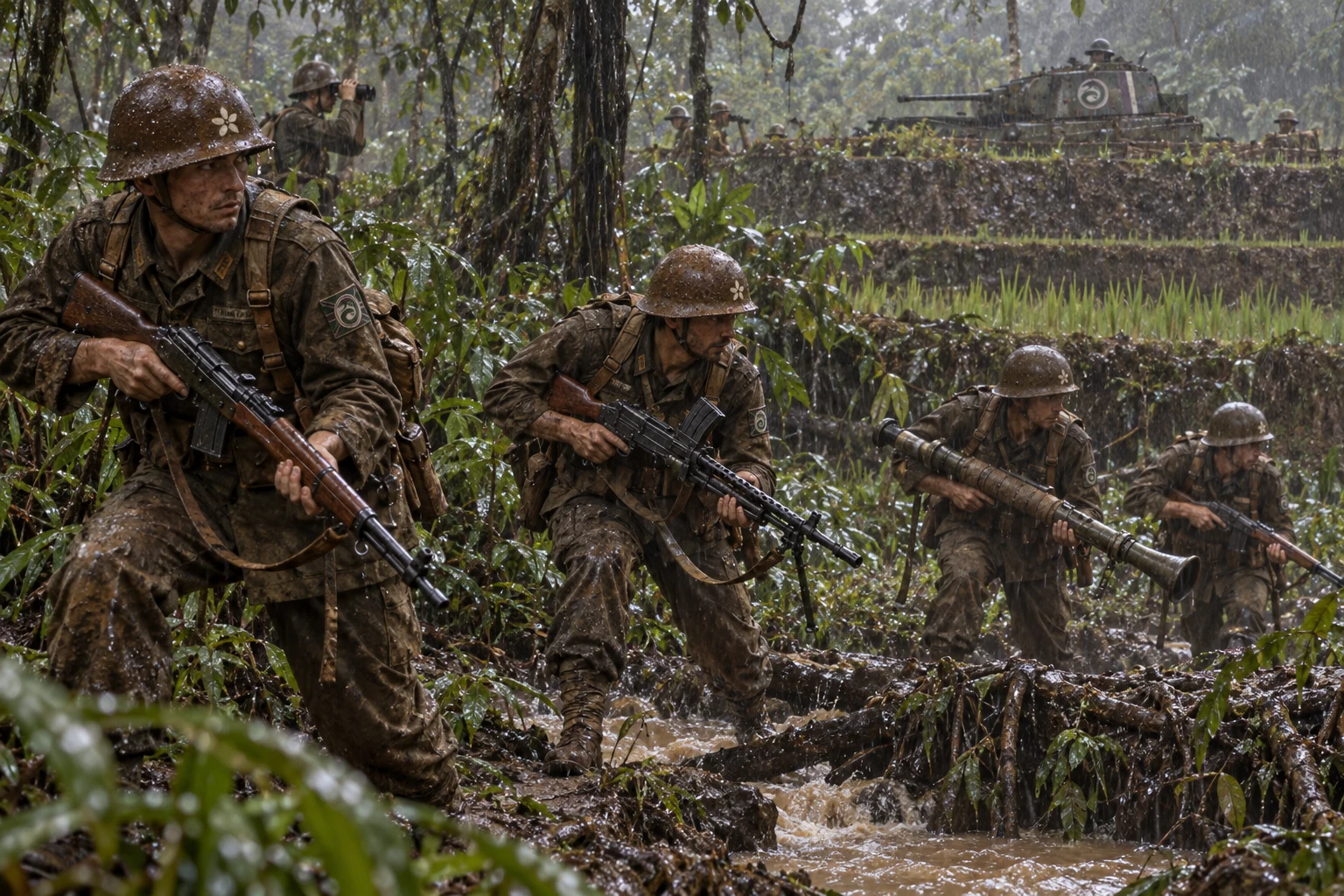
The Naviri jungle reverse
March 7–April 14, 1224 · Grand Isles · Silvian expeditionary infantry and Naviri guides against Kelonese forest defenses
Entering another kind of battlefield
After the failed Orava landing, Silvian commanders attempted to relieve pressure on Naviri's surviving inland positions. The March operation committed the Silvian 12th Infantry Brigade under Brigadier Oren Hal beside Naviri territorial troops familiar with the forest belt. General Mira Dalen approved a limited advance intended to improve the approaches to Allied villages and reduce Kelonese pressure on receiving routes. The troops possessed courage and recent training, but their experience remained shallow. Many had survived transport attacks without fighting ashore. They entered terrain where distances measured on a map bore little relationship to the time required to move a wounded soldier.
Naviri Colonel Saren Nemi warned that the proposed advance crossed several steep drainage systems hidden beneath vegetation. Silvian staff officers incorporated his cautions into written orders but retained a schedule based on faster movement than local guides considered possible. The discrepancy was never resolved before departure. Kelonese Major General Hideo Ran, now commanding a larger forest group, held the interior approaches with dispersed positions and local reserves. He did not require a continuous line everywhere. The jungle restricted movement so severely that controlling particular ridges, paths, and stream crossings could interrupt a brigade whose nominal frontage looked much broader.
March 7–14
The advance began on March 7 in heavy rain. Leading companies reached their first assigned ridge late and found that supporting equipment had fallen behind. Captain Mira Venn's company occupied an abandoned cultivation terrace, mistaking it for the planned assembly ground. A Naviri guide corrected the error after recognizing the stream below. The company moved again in darkness, arriving exhausted before the next day's attack. Hal initially attributed the delay to insufficient determination. Nemi insisted that the soldiers had followed a route that did not exist in the form shown on their map. The argument delayed a necessary correction to the brigade's timetable.
Kelonese defenders struck the leading battalion on March 10 near a narrow stream crossing. Silvian troops attempted to deploy from the path but encountered steep banks and dense undergrowth. Lieutenant Eran Vale’s company entered the forest in April; he later studied this earlier encounter’s reports as part of the army’s reform effort. The immediate fight was directed by Major Nalen Ser, who lost contact with two companies after their radios failed in the wet conditions. Naviri scouts located one company and guided it back. The other remained isolated overnight, suffering casualties while trying to determine which direction led toward friendly positions.
A renewed Silvian attack on March 14 gained a forward slope but failed to take the ridge beyond it. Supporting fire struck too far ahead because the attacking troops had advanced less than reported. The mistake did not cause a major friendly-fire incident, but it left the actual defenders unsuppressed. Sergeant Lena Var brought twelve survivors back from a position that her platoon had briefly occupied. She reported that wounded men remained in a hollow below the ridge. A rescue party returned with Naviri guides after dark and recovered seven. Four others were captured; one died before either side reached him.
Illness joins the battle
By March 20, illness was removing soldiers as quickly as enemy action. Wet clothing, contaminated water, exhaustion, and neglected minor wounds reduced the number available for duty. Medical officers had warned against hiding symptoms, but several company commanders continued reporting sick men as present because admitting their condition would reveal the formation's weakness. Dalen intervened after comparing medical admissions with infantry returns. She ordered a corrected strength report and suspended one company commander for obstructing treatment. The action addressed a dangerous practice without repairing the brigade's immediate predicament. Troops already forward still depended on an overburdened carrying system for food and evacuation.
Ran counterattacked on March 24 against the brigade's exposed northern path. His troops seized a small junction and cut off the easiest route to the aid station. Hal committed his reserve company, which recovered part of the path after six hours of fighting but could not secure it for routine movement. Stretcher parties used a longer Naviri route, requiring relays of exhausted bearers. Private Sera El, wounded in the leg, survived a fourteen-hour evacuation during which three different groups carried her. Her account later described the operation through the faces of those bearers rather than the objectives named in its orders.
The brigade's advance had now ceased, but orders still described its posture as preparation for renewed attack. Nemi challenged that language at a March 29 conference. His own troops were spending their strength locating scattered Silvian parties and maintaining routes behind them. Dalen authorized a withdrawal to a defensible line nearer existing Allied support. Hal accepted the decision after requesting time to recover the wounded and dismantle stores that could be moved. The interval was necessary, yet it allowed Kelonese patrols to identify the preparations and begin pressing positions whose defenders were already dividing attention between fighting and leaving.
The withdrawal
The retreat began on April 3. Naviri units covered the flanks while Silvian companies moved in scheduled groups along the available paths. Rain destroyed parts of the timetable. One battalion halted for hours when a loaded supply animal fell across a narrow passage, and soldiers abandoned equipment to move around it. Kelonese attacks on April 7 and 9 captured outer positions but failed to cut the main withdrawal. Captain Venn's company held a ridge until the last medical party passed, then left without attempting to recover every scattered pack. The decision preserved people at the cost of matériel the brigade had already struggled to carry forward.
The operation ended on April 14 with the Silvians back near their starting support area and the intended interior improvement unrealized. Silvian battle casualties totaled 2,184, including 593 dead; Naviri losses totaled 417, including 112 dead. Kelonese losses totaled 1,376, including 368 dead. Another 3,108 Silvian personnel required temporary removal for illness or exhaustion, recorded separately. Dalen's subsequent reforms drew directly from the reverse: realistic movement estimates, integrated local instruction, honest medical returns, and authority to alter schedules before a failure multiplied. The brigade had not been defeated by vegetation alone. It had entered an experienced enemy's terrain with an organization insufficiently prepared to understand what it was asking its soldiers to do.
Original illustrations for this source record
Original archive artwork and captions are preserved. Dates, labels and claims printed within inherited images belong to the previous edition; the revised text governs the current history.