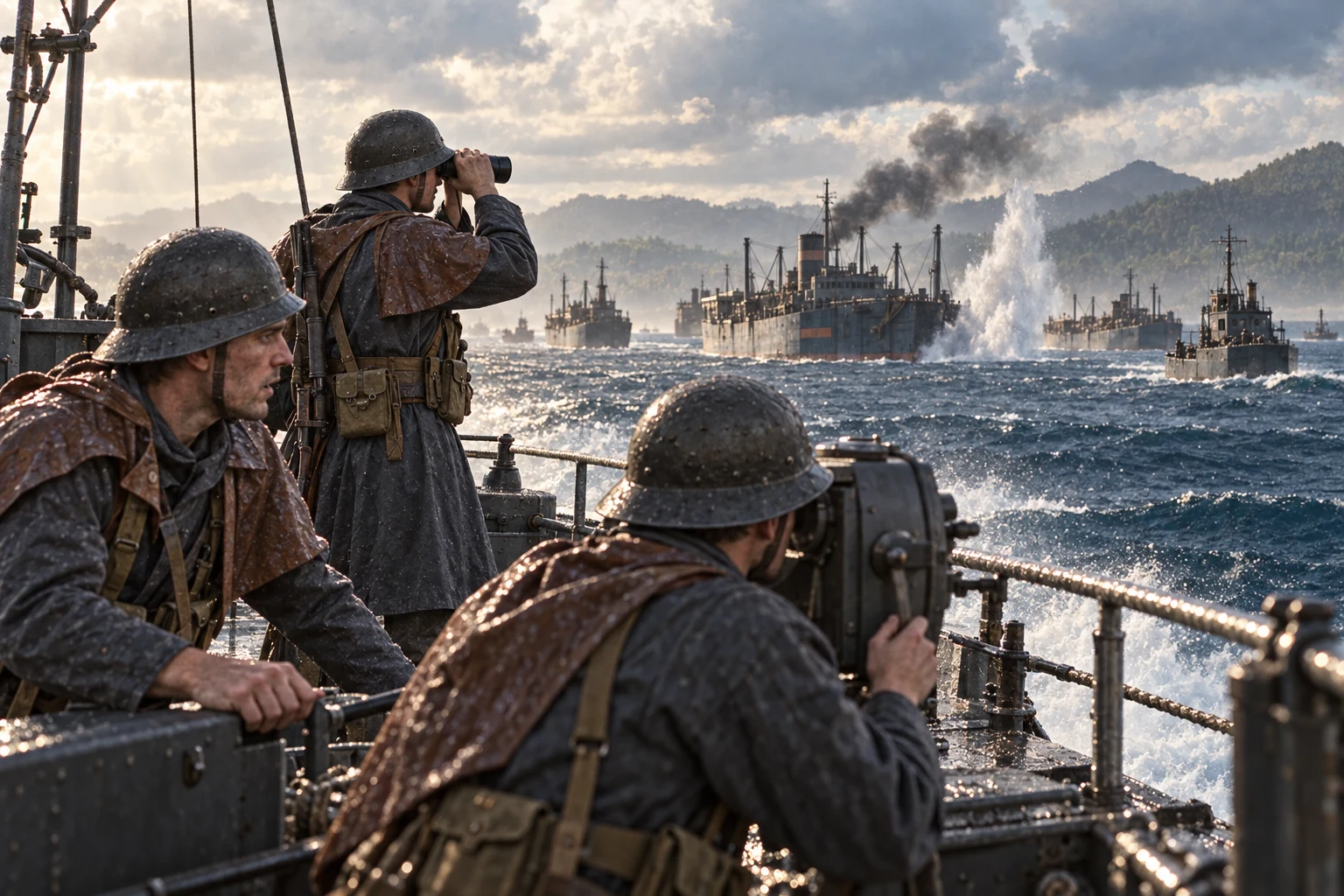
The Motari reception convoy
December 2–8, 1223 · Grand Isles · Silvian and Motari escorts against Kelonese interception forces
An army still in transit
The December reception convoy carried the first substantial expeditionary elements organized under General Mira Dalen's August appointment. Its twenty-one transports and cargo ships contained infantry headquarters, engineers, medical units, vehicles, and supplies intended for preparation in Motari. They were not yet a battle-tested landing army. Admiral Oren Vask's naval coordination staff arranged their passage under access agreements already signed with the Allied receiving authorities. Commodore Sera Venn commanded the immediate escort from the cruiser Common Liberty, accompanied by seven destroyers and two escort carriers. Motari escorts would join near the receiving area, bringing local knowledge that the Silvian crews still lacked.
The convoy sailed on December 2. Soldiers aboard the transport Civic Field practiced moving to emergency stations and discovered how crowded their accommodation became when everyone attempted the same passage simultaneously. Captain Eran Lest, an embarked infantry officer unrelated to Eran Vale, revised his company's movement order after a sailor explained which ladder served a firefighting route. The small correction illustrated the expedition's condition: army officers knew their own formations but were learning that a transport remained a ship with obligations independent of the regiment it carried. Naval authority over emergencies was explained repeatedly before the first enemy contact.
Contact on December 4
A Kelonese reconnaissance aircraft sighted the convoy on December 4 and remained near it despite attempts by Silvian fighters to intercept. Its report reached Vice Admiral Hatsu Ren, who directed aircraft against the transports and ordered a cruiser group toward the likely approach. The first air attack arrived late in the afternoon. Silvian fighter control had improved since September but was strained by the larger convoy's area. Bombs damaged the cargo ship Eastward Civic and struck near Civic Field, throwing soldiers against bulkheads and breaking unsecured equipment. The transport remained operational, though sixty-three people required medical attention after the near misses.
Eastward Civic carried bridging matériel and field workshop machines. Fire spread around wooden packing before the crew could reach several affected holds. Venn ordered a destroyer alongside to assist. Sailors transferred pumps and firefighting personnel while embarked engineers identified cargo that could be moved safely. Their cooperation preserved the ship, but it fell behind the main formation. Venn detached two escorts with it toward a previously agreed alternate Motari anchorage. Dalen's advance staff accepted the resulting delay rather than demand that the damaged vessel maintain a speed its engineers considered unsafe. The expedition lost equipment availability without losing the entire cargo.
A second attack on December 5 hit the transport Hearth Union. The explosion killed soldiers waiting below for a meal and damaged a main stairway. Sergeant Nera Talm organized survivors through another passage while a naval petty officer directed them away from smoke entering the ventilation system. Neither could see the full extent of damage. Their combined effort prevented frightened soldiers from blocking the route needed by stretcher bearers. Hearth Union remained afloat and continued at reduced speed. Talm later refused a description suggesting that infantry discipline alone had saved the passengers; she credited the sailor whose knowledge of the ship had made their movement possible.
The surface interception
Kelonese cruiser Koren and four destroyers approached during the night of December 5–6. Their commander, Captain Masaru En, expected the damaged convoy to be dispersed. Venn had instead shortened its formation and placed Common Liberty between the transports and the reported threat. The first exchange occurred beyond the merchant column, with poor visibility preventing either side from confidently assessing the other's strength. Common Liberty received two hits that damaged communications and killed personnel near its forward control position. Venn transferred command functions within the ship rather than leaving the convoy to make a more dramatic offensive movement.
The destroyer Free Harbor took the heaviest Silvian damage. Its engine room flooded after a hit near the waterline, and Captain Lena Vor ordered speed reduced while damage-control parties worked. Kelonese destroyers attempted to close, but fire from Common Liberty and two other escorts forced them away. Koren was damaged in the exchange and withdrew before dawn. En had failed to reach the transports and lacked reliable information about additional Allied ships approaching. Venn did not pursue. She ordered rescue boats toward Free Harbor and kept the convoy on course, preserving the operation's purpose while accepting that the enemy force would escape.
Motari escorts joined on December 6. Their senior officer, Commodore Nalin Aro, brought updated information on the receiving approaches and weather conditions. Venn accepted his recommendation to divide arrivals between two controlled anchorages, reducing congestion and vulnerability to another air raid. The arrangement required changes to army unloading plans, since units would receive some equipment at a different location from their personnel. Dalen's staff established a receiving office to reconcile those movements. The process was imperfect, but it replaced the dangerous assumption that every transport could reach one ideal quay and unload its formation as a complete unit.
December 8
The final main-convoy ships entered Motari's reception system on December 8. Hearth Union's wounded were taken ashore before its uninjured passengers, while Eastward Civic arrived separately after temporary repairs. Free Harbor reached safety under tow and remained unavailable for months. Soldiers stepped ashore carrying equipment marked by salt, fire damage, and hurried repacking. Local Allied veterans met them without mistaking survival of the passage for mastery of jungle war. The receiving camps began the harder task of turning transported manpower into units able to operate with ships, engineers, medical services, and experienced regional partners during the coming campaigns.
Motari reception staff translated quay instructions before the next arrivals, reducing arguments caused by unfamiliar signals and differently labeled cargo categories.
Silvian and Motari losses totaled 286 dead and 472 wounded; all twenty-one transports and cargo ships survived, although three required substantial repair. Kelonese losses totaled 219 dead or missing presumed dead and 304 wounded, with one destroyer sunk, one cruiser damaged, and thirty-one aircraft lost during the convoy operation. These losses were local to the passage, not totals for the entire Grand Isles theater. The expedition reached its training and assembly areas at a cost that exposed the distance between mobilization and readiness. Its infantry had experienced danger at sea; the defeats and hard learning of 1224 still lay ahead.
Original illustrations for this source record
Original archive artwork and captions are preserved. Dates, labels and claims printed within inherited images belong to the previous edition; the revised text governs the current history.