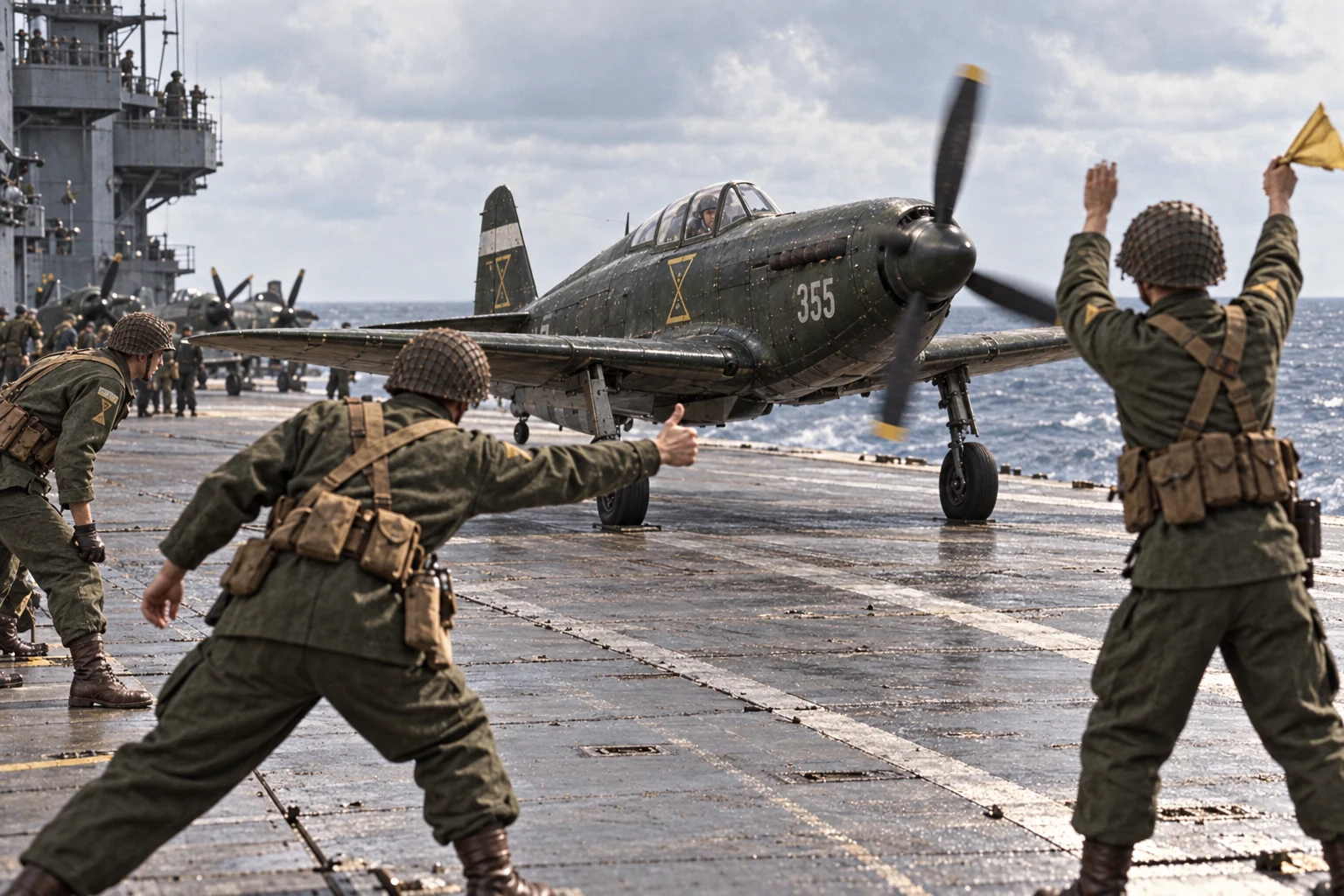
Kandar’s first wartime convoy
September 12–16, 1223 · Grand Isles approaches · Silvian escorts against Kelonese naval aviation
Leaving the damaged harbor
The first escorted wartime convoy dispatched from Kandar toward the Allied Grand Isles sailed on September 12. Its fourteen merchant and auxiliary vessels carried medical supplies, communications equipment, repair matériel, and advance service personnel. It was not the later expeditionary army landing force. Silvia had entered war against the Kelonese Empire after the June 8 attack, and the months since had been spent mobilizing, repairing damage, and negotiating access with Motari and Kavea. The convoy's destination arrangements rested on those agreements. Its departure from Kandar demonstrated a new commitment, but neither its crews nor its embarked soldiers had become veterans merely by crossing the harbor mouth.
Commodore Ralen Voss commanded the escort from the cruiser Civic Resolve. His force included five destroyers and the escort carrier Lantern, whose air group contained pilots with extensive peacetime flying experience and little combat experience. Admiral Oren Vask's staff assigned the route and supporting reconnaissance while leaving immediate convoy decisions to Voss. Merchant master Tessa Maren sailed aboard the transport Open Passage. She had navigated Kelonese harassment before the declaration and now faced a different relationship to danger: the escorts could fight, but their presence also marked the convoy as a military objective whose movement the enemy actively sought to stop.
The sighting
Kelonese reconnaissance located the convoy on September 13. A patrol aircraft remained beyond effective gunfire long enough to transmit a position before Silvian fighters drove it away. Voss ordered the formation tightened and requested additional air search. Lantern's first fighter patrol returned low on fuel after pursuing the reconnaissance aircraft farther than intended. The incident left a temporary gap in cover while replacement aircraft launched. Its pilots had achieved the visible task of driving off the observer while weakening the less visible task of remaining available against the strike that might follow. The subsequent inquiry treated this as a training failure shared by command.
The first Kelonese attack arrived that afternoon, launched from the carrier Kiyosen with supporting aircraft from regional facilities. Clouds divided the attacking formation, and several groups reached the convoy separately. Silvian fighters intercepted the leading aircraft but became scattered during the engagement. Bombers struck the merchant ship Meran Bay, setting its forward cargo on fire. Captain Lena Ar ordered firefighting parties to remain aboard while passengers moved toward boats. The destroyer Firm Accord stood nearby to rescue survivors if necessary. Meran Bay's crew contained the fire after forty minutes, preserving the ship but forcing the convoy to reduce speed.
A second attack struck near sunset. Open Passage was narrowly missed and suffered fragments through its upper passenger spaces. Maren moved injured service personnel into a lower compartment, then resisted an officer's suggestion that the transport leave formation independently. Its engines were intact, and separation would expose the ship without improving the wounded's chances of treatment. A naval medical team transferred by boat after darkness. The transfer was hazardous in the swell, injuring two sailors before the team reached the transport. It nevertheless provided care for thirty-seven wounded aboard, five of whom later died despite treatment.
The second day at sea
On September 14, Voss faced a choice between maintaining the original schedule and diverting Meran Bay toward a nearer agreed Allied receiving point. He chose the diversion, detaching Firm Accord and a patrol auxiliary while the main convoy continued. The separation reduced his escort strength but avoided forcing every vessel to match the damaged freighter. Vask approved the decision after receiving the report. The approval mattered institutionally: captains and commodores needed to know that adapting a plan under attack would not automatically be treated as disobedience when the changed circumstances were documented and the convoy's purpose remained intact.
Kelonese aircraft returned in the morning. Lantern's fighters remained closer to the convoy this time, guided by revised instructions that emphasized protection rather than pursuit. The defense was more coherent but still imperfect. Two Silvian fighters nearly collided while responding to conflicting directions, and one damaged aircraft ditched beside the destroyer Civic Hand. Its pilot, Lieutenant Nera Sol, survived rescue but suffered burns. Kelonese aircraft hit the auxiliary Wellstream, which carried workshop equipment and water-treatment machinery. The ship sank over three hours, allowing most people aboard to escape while its heavy cargo went down beyond recovery.
Voss declined to send his cruiser in pursuit of the withdrawing enemy. The decision drew criticism from officers who believed Silvia's first convoy battle should demonstrate offensive determination. He answered that the merchant ships were the operation's purpose, and that no reliable enemy surface position justified leaving them. His report later became a training example because it connected restraint to a concrete assignment rather than presenting it as a moral preference. The republic's navy had entered a large war in which protecting one movement could require accepting that the attacker would depart without suffering a decisive defeat.
Reception
The main convoy reached its agreed Motari receiving district on September 16. Local harbor crews met Silvian ships whose officers initially expected facilities resembling Kandar. The actual unloading area was smaller, worked under wartime restrictions, and shared among several Allied users. Maren adjusted Open Passage's unloading order after consultation with the harbor authority, prioritizing medical supplies and communications equipment over less urgent stores. Silvian service personnel began work alongside local staff rather than taking control of the port. The distinction prevented an early dispute from undermining agreements whose practical value the convoy had just demonstrated under enemy attack.
Maren kept the damaged passenger list beside her own voyage log, ensuring that the five deaths aboard Open Passage remained attached to individual names.
Thirteen vessels survived the passage, including Meran Bay at the alternate receiving point; Wellstream was lost. Silvian casualties totaled 173 dead and 296 wounded, including merchant crews and embarked personnel. Kelonese losses were twenty-four aircraft and ninety-one aircrew dead or missing presumed dead, with additional rescued wounded returned to service records. The convoy delivered most of its cargo but exposed deficiencies in fighter control, formation discipline, and casualty transfer. It did not turn the expeditionary army into an amphibious force overnight. Its achievement was narrower and foundational: Silvia had carried an organized military commitment from its attacked harbor into an Allied theater and kept it moving through opposition.
Original illustrations for this source record
Original archive artwork and captions are preserved. Dates, labels and claims printed within inherited images belong to the previous edition; the revised text governs the current history.