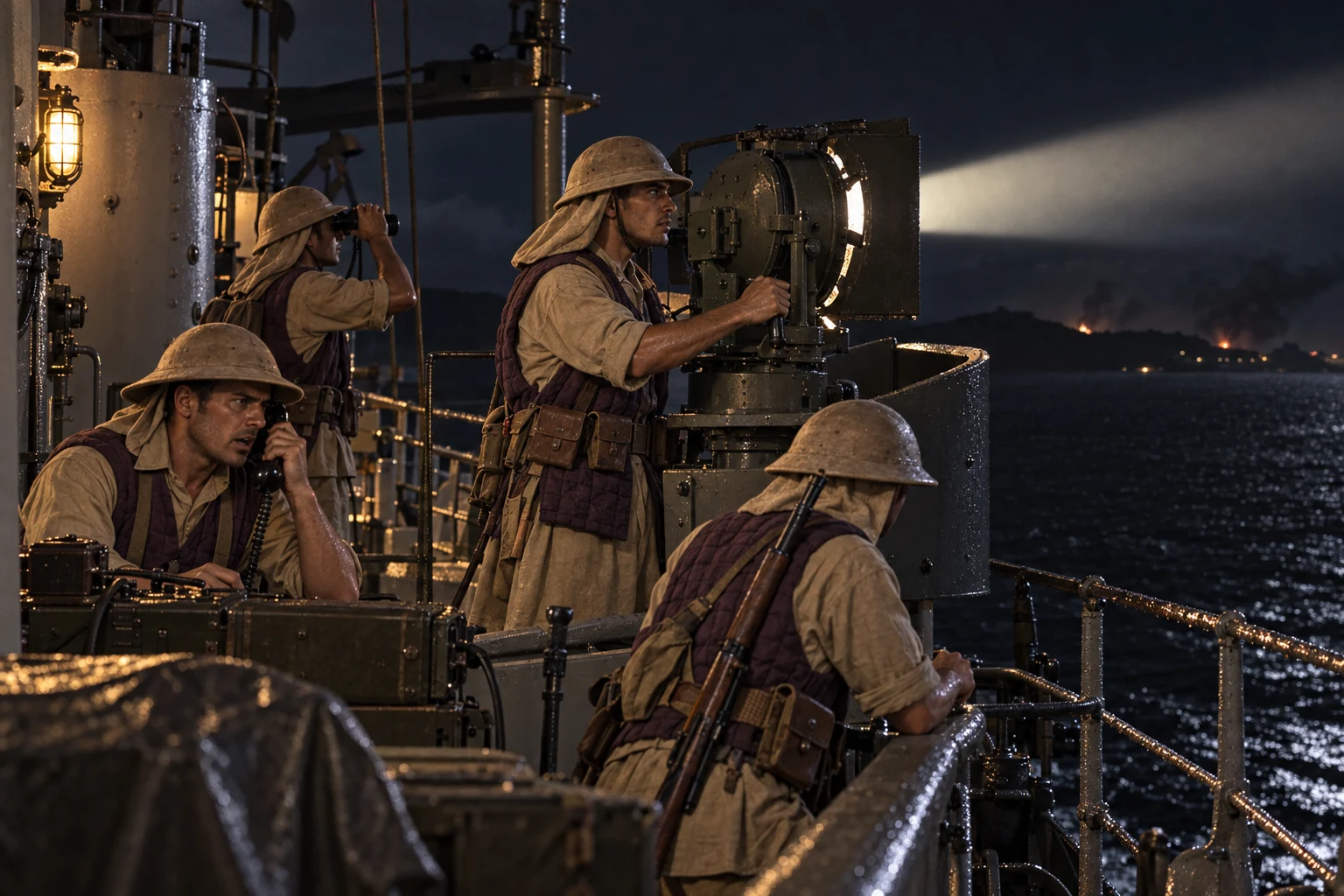
The Taluman night harbor battle
October 3–22, 1222 · Grand Isles · Taluman and Naviri naval forces against Kelonese raiders
The harbor lights extinguished
Taluma's Kera Harbor had become a receiving and repair point for surviving island forces. Its entrance curved behind a low headland, concealing ships at anchor from some sea approaches while making navigation difficult in darkness. Commodore Nalin Tera commanded the Taluman defense, which included the light cruiser Avela, four destroyers, patrol boats, and shore batteries. Two Naviri destroyers were present for repair and convoy duty. Kelonese Rear Admiral Renji Sato planned a night attack intended to damage shipping and close the entrance with wrecks. Silvia remained outside the war; every defending warship belonged to an existing island belligerent.
Sato's group consisted of the cruiser Natori, repaired after earlier campaigns, and six destroyers. Reconnaissance had identified merchant arrivals but failed to determine which harbor lights remained reliable navigation marks. Taluman authorities extinguished most lights after the first October reconnaissance flights. Harbor pilot Lena Sari retained shielded signals for scheduled arrivals, changing their use according to convoy instructions. That arrangement reduced visibility to raiders but increased the danger to friendly vessels. On October 3, a patrol boat grounded while returning during a squall. Its crew escaped, but the incident warned Tera that darkness could not be treated as protection without cost.
The first night encounter
Kelonese advance destroyers approached on October 6. They encountered the Naviri destroyer Nera off the outer patrol line. Captain Mera Sal of Nera challenged by signal after an uncertain sighting and received no valid response. Firing began moments later. Nera suffered damage to its forward control position but transmitted the warning before withdrawing toward the harbor. Sato recognized that surprise had been compromised and ordered his main group to remain outside the narrow entrance. The destroyers continued a limited attack, damaging a merchant ship anchored in the outer roadstead. The vessel stayed afloat and was towed inside after dawn.
Tera initially believed that the October 6 action was a reconnaissance for a larger attack. He shifted Avela closer to the entrance and distributed the destroyers rather than keeping them together at the repair quay. Shore battery commander Major Sela Var requested permission to fire on unrecognized movement without waiting for naval confirmation. Tera refused a blanket authorization because friendly patrols were still moving through the same water. They established a simplified recognition procedure instead. It remained imperfect, but the decision acknowledged that preventing surprise could create another danger if every uncertain shape became an immediate target.
Sato returned on October 11 during a moonless interval. His ships approached more cautiously, using the coast's silhouette rather than expecting harbor lights. The leading destroyer entered the outer channel and exchanged fire with a Taluman patrol boat. The patrol boat was sunk, but its radio warning reached Tera. Avela and two destroyers moved to engage while shore batteries opened on the reported approach. One battery fired near Avela after mistaking its movement for an enemy vessel. Var halted that battery until identification was restored. The error caused no direct hit but forced the cruiser to alter course during the engagement.
Fire across the entrance
The main exchange lasted forty-seven minutes. Natori remained outside the most confined water and fired toward Avela, while destroyers on both sides maneuvered near the headland. Taluman destroyer Saren took heavy damage and lost propulsion. Lieutenant Irena Vel, its surviving bridge officer, ordered boats prepared but delayed abandonment while damage-control crews fought flooding. The Naviri destroyer Tavi approached to assist despite ongoing fire. Its crew passed a towing line that parted almost immediately. A second attempt succeeded after the heaviest firing moved seaward. Saren reached shallow water inside the harbor and was grounded deliberately to prevent sinking in the channel.
Kelonese destroyer Akase was damaged near the headland and withdrew behind smoke from its own fire. Sato turned his group away after receiving reports that two destroyers had lost reliable communications. He could not determine whether additional Allied ships were approaching from beyond the harbor. The withdrawal preserved his cruiser but left the principal objective unfulfilled: Kera remained open. Taluman observers claimed several enemy ships sunk during the night. Later examination of Kelonese records confirmed one destroyer lost and two damaged. Tera's final report revised the claims despite criticism that doing so diminished the defenders' achievement.
The damaged harbor faced a second crisis on October 13 when a raid struck its repair area. Bombs destroyed a crane and ignited stores beside Saren's grounding place. Dock crews moved ammunition away from the fire while sailors pumped the destroyer's flooded compartments. Civilian foreman Nera Al refused an order to bring an unstable crane into operation, explaining that its collapse could kill the workers already carrying supplies by hand. The slower method saved less equipment but avoided the predicted failure. Engineers later found fractures in the crane's support that confirmed her judgment under pressure.
Holding a usable entrance
Sato conducted additional probes on October 17 and 20 without committing Natori to another close engagement. Taluman patrols drove off the first; bad weather disrupted the second. Tera kept merchant movements limited until wreckage and damaged buoys were cleared. Sari piloted three supply ships through the entrance on October 22, using temporary markers placed by boats whose crews had survived the earlier fighting. Their arrival marked the end of the harbor battle as a sustained interruption, although raids and patrol encounters continued elsewhere. Kera could again receive cargo at a predictable rate, the practical result on which the defense had depended.
Sari refused a celebratory daylight entry for the final ship. She followed the tide and visibility conditions instead, bringing it through after the public reception party had already dispersed from the exposed quay.
Taluman and Naviri naval losses totaled 327 dead and 514 wounded. One patrol boat was sunk, Saren was out of service for seven months, and three other warships required repair. Kelonese losses totaled 291 dead or missing presumed dead and 403 wounded, with one destroyer sunk and two damaged. Civilian deaths in the harbor district numbered sixty-seven. Kera's survival did not end Taluma's exposure or restore the island coalition's wider position. It preserved a particular entrance, repair service, and body of skilled workers. In a war steadily reducing such resources, keeping that combination intact was a significant defensive achievement.
Original illustrations for this source record
Original archive artwork and captions are preserved. Dates, labels and claims printed within inherited images belong to the previous edition; the revised text governs the current history.