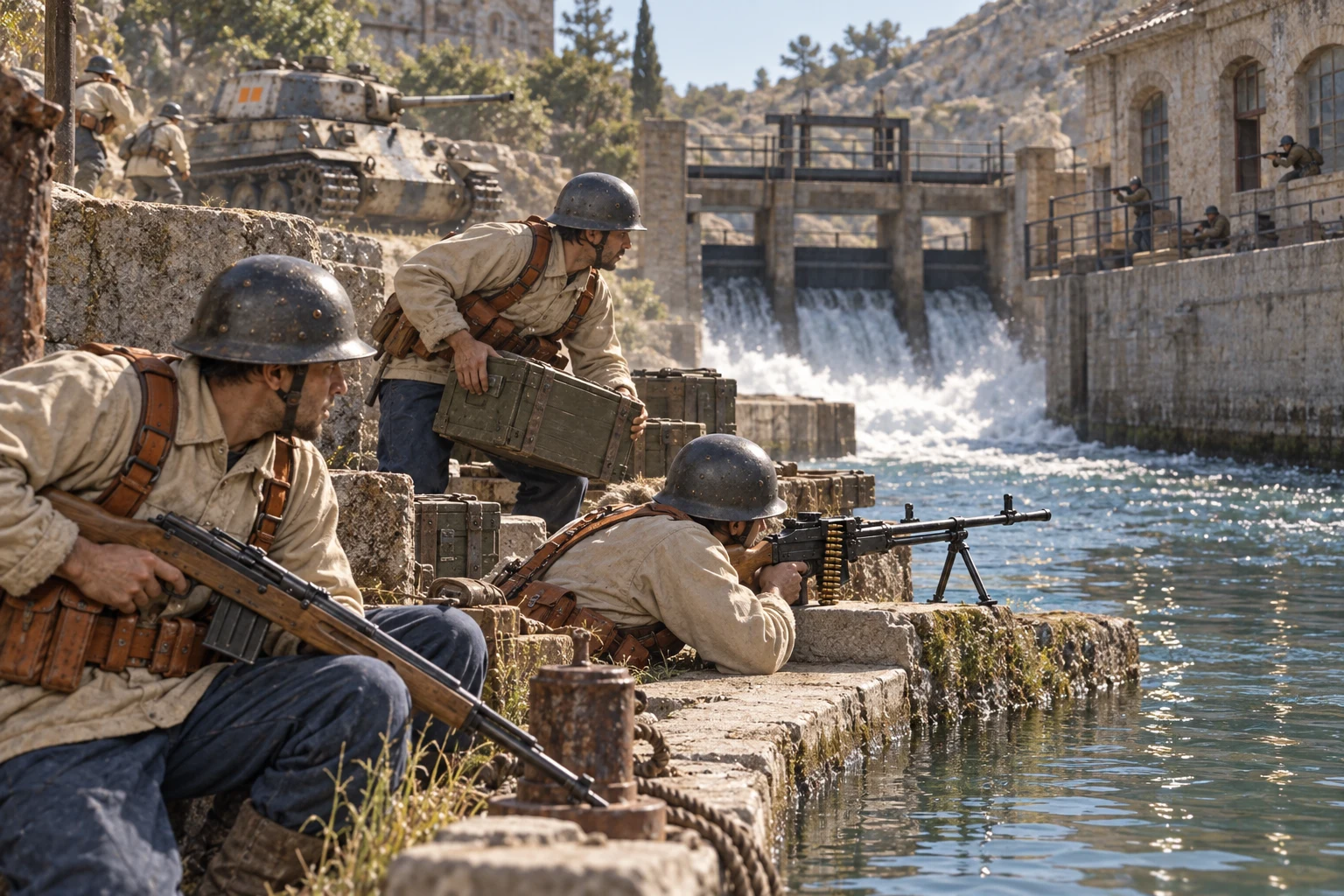
The Handistani waterworks battle
May 9–June 2, 1222 · Gaften · Handistani engineers and infantry against Ruuyaqi coalition troops
Water beyond the military map
The Merat waterworks supplied a Handistani reception district containing soldiers, displaced families, and workshops supporting the established Gaften front. Its pumping houses drew from a regulated river channel, and its reservoirs stood on slightly higher ground west of the immediate fighting. Leha Ban, promoted to colonel in 1221, commanded the defense with the 32nd Infantry Regiment and engineer companies assigned to keep the installation functioning. Ban had survived earlier withdrawals and understood that defending a waterworks required more than holding its main building. Pipes, maintenance roads, electrical connections, and the civilian operators who understood them formed a system that artillery could damage at many points.
Ruuyaqi General Qaren Sal commanded the opposing group through the existing coalition approaches. His troops operated with Jazimi support; their presence did not create a direct border between Ruuyaq and Handistan. Sal intended to seize the eastern regulator station and force the defenders to abandon the exposed pipe corridor. He expected the loss of dependable water to compel a wider withdrawal. The objective was therefore both military and civilian in consequence. Handistani authorities prepared emergency distribution before the attack, but their reserve containers and transport were insufficient for the entire district if the main works stopped for long.
May 9–14
The battle opened on May 9 with shelling around the regulator station. A damaged control gate caused water to rise unexpectedly in the maintenance channel, flooding shelters used by Handistani soldiers. Chief operator Nima Arel entered the control room with two assistants and restored partial movement of the gate while infantry covered the approach. One assistant was killed by fragments entering through a broken window. Arel completed the adjustment and withdrew only after a military engineer relieved her. Her action kept the channel from washing out the access road, preserving the route by which wounded personnel and repair equipment could move.
Ruuyaqi infantry took the eastern observation mound on May 11. From it, they could direct fire onto maintenance parties working along the exposed pipe corridor. Ban reduced daylight repairs and attempted a counterattack on May 13. Captain Ishan Mer's company reached the mound's lower slope but could not secure its crest. The soldiers withdrew after their supporting smoke dispersed sooner than expected. Mer was wounded, and command passed to Lieutenant Sena Dar. She brought back a civilian technician caught forward with the company, refusing to leave him because he was absent from the military roster used to count missing personnel.
Sal attacked the regulator station on May 14. Its defenders held the main room but lost the surrounding yard, leaving access dependent on a narrow western passage. Handistani engineers opened an alternative control connection from a secondary building. The improvised arrangement maintained reduced flow after the main station became untenable. Ban withdrew its garrison that night, accepting the loss of the installation while preserving its function through another part of the network. Sal's troops occupied the station and initially reported that the waterworks had been captured. Their claim proved premature when the defending district continued receiving water.
The reservoir road
The next phase centered on the road leading toward the reservoirs. Ruuyaqi infantry advanced on May 18 with a Jazimi battalion protecting its flank. Ban's 32nd Regiment defended a line through orchard walls and maintenance sheds. The terrain constrained observation, producing a series of small fights rather than a single continuous assault. Sergeant Taren Vaq held one shed with nineteen soldiers after adjacent positions withdrew. He sent two wounded men back as messengers, then abandoned the shed before the enemy could surround it. Their report enabled Ban to identify the gap and place a reserve platoon across the road.
Civilian distribution deteriorated despite the works' continued operation. Damaged pipes reduced pressure at the far end of the network, where displaced families lived in temporary shelters. Civil commissioner Amira Sen ordered tankers redirected there, provoking complaints from workshops losing scheduled deliveries. She published the allocation priorities and placed civilian inspectors at the distribution points. Soldiers sometimes resented waiting beside civilians for water, but Ban prohibited military personnel from taking control of queues. The decision preserved civil authority during a battle whose consequences made that authority harder to exercise. It also prevented the army's immediate convenience from consuming the community's minimum supply.
On May 23, a pipe rupture forced a twelve-hour shutdown. The damage occurred near the contested orchard line, and repair crews could not work until infantry secured a small protective perimeter. Lieutenant Dar led the covering force with forty-two soldiers. Her men occupied two maintenance huts while engineers replaced the damaged section. Ruuyaqi fire wounded five workers and nine soldiers. The repair succeeded shortly before dawn on May 24. Dar withdrew after the pressure test, bringing out the wounded and leaving the huts to be contested again. The operation recovered no lasting territory but restored water to thousands of people.
A checked advance
Sal's final attack began on May 28. His troops gained an outer reservoir service building but failed to reach the main embankment. Handistani defenders counterattacked the next evening, recovering the building after close fighting in rooms crowded with valves and spare fittings. One reservoir wall was damaged by shelling, prompting fears of a catastrophic breach. Engineer inspections found the main structure sound enough for reduced operation. Ban ordered civilians moved from the lowest adjacent ground as a precaution while retaining the defensive line. The precaution complicated reception arrangements but avoided gambling lives on an engineering assessment made under continuing fire.
Arel’s surviving assistant returned to the repaired control station after recovery, carrying the notebook in which the damaged gate’s behavior had been recorded.
By June 2, the front stabilized between the captured regulator station and the retained reservoirs. Handistani military casualties totaled 1,638, including 417 dead; the Axis group lost 1,894, including 493 dead. Civilian deaths associated with bombardment and evacuation reached 138. The waterworks operated at sixty-eight percent of its prebattle measured output until additional repairs were completed. Sal had gained ground without achieving the functional collapse he intended. Ban's soldiers and Arel's operators had preserved a system whose value could be measured in hospital treatment, cooking, sanitation, and workshop shifts. Their victory remained partial because every reduced service still required someone to endure the difference.
Original illustrations for this source record
Original archive artwork and captions are preserved. Dates, labels and claims printed within inherited images belong to the previous edition; the revised text governs the current history.