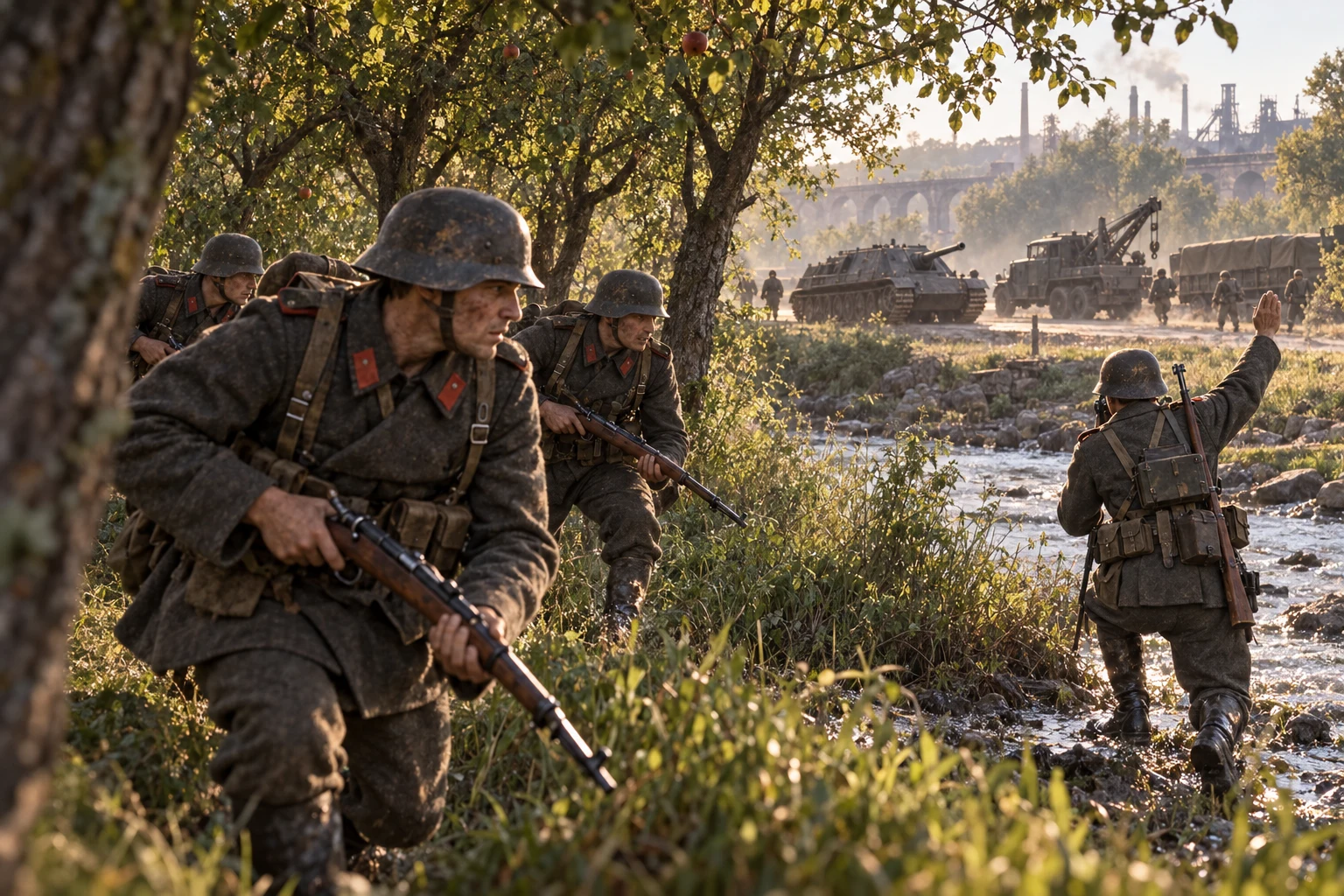
The western Praxen defense
August 3–27, 1221 · Viar · Praxen western army against Rostan 19th Division
Beyond the occupied center
Praxil had fallen in September 1219, but Chancellor Ema Doren's administration continued in western Praxen. Its army defended a reduced territory containing farms, training grounds, and workshops relocated from the lost administrative center. The August 1221 battle developed around Teren Ford, a crossing on a tributary within the western defense zone. Colonel Dena Kor, serving with the surviving Praxen army, commanded the 15th Infantry Group there. Her formation combined two regular battalions and territorial companies whose personnel knew the district. Rostan's 19th Division, led by General Varek Sen, aimed to capture the crossing and disorganize the western army's movement.
Sen's offensive was limited by demands elsewhere on the Viar front. He received artillery reinforcement for three weeks, not an open-ended concentration. His plan therefore emphasized gaining the ford quickly and forcing Kor to retreat before neighboring Allied formations could respond. Erisian support units operated behind the western army under existing agreements, while Praxen retained command of the local defense. Kor expected pressure but could not determine whether the ford was the principal objective or a diversion. She kept one company near the western road junction, resisting demands to place every soldier directly along the water.
August 3–8
Rostan artillery opened on August 3. The river was low enough for infantry to cross at several points, but vehicles depended on prepared approaches. Sen's leading battalion crossed upstream during darkness and occupied a stand of orchard trees behind the northern bank position. Praxen patrols found the intrusion before dawn. Lieutenant Mira Den led a counterattack with soldiers assembled from two companies, forcing the attackers away from the road but failing to drive them back across the river. The result created a small Rostan bridgehead. Both sides then spent the day reinforcing positions that had not existed on their previous evening's maps.
Kor ordered the nearby village evacuated on August 5. Schoolteacher Rena Var organized children and elderly residents while the army provided wagons. Several families attempted to take stored grain as well as household goods, slowing the movement. Var persuaded them to leave a documented share for military use in exchange for receipts recognized by the western administration. The receipts did not remove immediate hardship, but they prevented requisition from becoming an unrecorded disappearance of property. Doren's government later honored most claims, a modest assertion that the state surviving outside its capital still owed duties to the citizens sustaining it.
Sen enlarged the bridgehead on August 7, capturing a mill whose upper windows overlooked the ford road. Kor's reserve company counterattacked that afternoon and reached the mill yard. Its commander, Captain Orin Vell, was killed before he could coordinate entry into the building. Sergeant Sena Mal took command and withdrew the company behind a stone boundary wall. Her decision was criticized by an observer who saw only the retreat. Kor examined the company's losses and endorsed it. The mill remained enemy-held, but the reserve retained enough strength to prevent Rostan troops from advancing directly along the road.
A crossing too narrow for exploitation
The battle's center shifted to the bridgehead's supply problem. Sen could move infantry across the shallow water, but damaged banks and artillery fire delayed vehicles. Rostan engineers attempted to improve an approach on August 11. Praxen guns disrupted the work, and a damaged truck blocked the cleared track. The resulting congestion exposed infantry waiting for ammunition. Sen dispersed the waiting troops and reduced the rate of advance. His report acknowledged that the bridgehead existed on ground his division could occupy more easily than it could sustain. The distinction gave Kor an opportunity to attack before the imbalance was corrected.
An Erisian artillery battery arrived on August 13 with observers assigned directly to Kor's headquarters. Its commander, Major Taren Sol, refused to promise immediate accuracy before his teams had established reliable positions. Kor allowed the preparation despite pressure from the mill sector. The first coordinated fire on August 15 struck Rostan movement behind the bridgehead rather than the mill itself. Praxen infantry then attacked the orchard flank and recovered two fields. They did not eliminate the crossing, but they narrowed the area in which Sen could concentrate troops. The improvement allowed the western road to reopen for controlled daytime movement.
The mill was recovered on August 18 after a short assault by Mal's company and a neighboring territorial platoon. They found twenty-seven wounded Rostan soldiers in its cellar with two medical attendants. The prisoners had received no evacuation transport for two days. Praxen medical personnel treated them while engineers inspected the building for structural damage. Mal refused to let her soldiers sleep inside until the inspection was complete. That caution was vindicated when part of the upper floor collapsed during the evening. The company occupied nearby sheds instead, tired and dissatisfied but spared another loss unrelated to enemy action.
August 27
Sen launched his final substantial attack on August 22. It gained a riverside pasture and briefly threatened the northern road, but Kor's remaining reserve contained the advance. Rostan's artillery reinforcement was then reassigned, reducing the division's ability to expand the bridgehead. Sen ordered a partial withdrawal on August 25 and retained only a narrow position near the upstream crossing. Praxen patrols verified the movement before Kor advanced her line. She declined to send exhausted troops into the remaining bridgehead immediately, judging that its restricted position could be watched while her own units recovered from three weeks of combat.
Kor recommended Mal for a commission after the battle. Mal accepted only after arranging continued support for her dependent sister, a reminder that rebuilding military leadership also required attention to ordinary obligations beyond the line.
By August 27, the western defense held, the main ford remained usable under protection, and Rostan's local attack had failed to disrupt Praxen's administration. Praxen and Erisian casualties totaled 1,487, including 382 dead; Rostan losses totaled 1,963, including 524 dead. The occupied capital remained beyond reach, and no national liberation followed this modest success. Yet Kor's defense demonstrated that the western army could still coordinate reconnaissance, reserves, artillery, and civilian authority. For Doren's government, that practical competence mattered as much as any proclamation. Praxen continued to function because institutions and soldiers surviving outside Praxil could still accomplish specific tasks together.
Original illustrations for this source record
Original archive artwork and captions are preserved. Dates, labels and claims printed within inherited images belong to the previous edition; the revised text governs the current history.