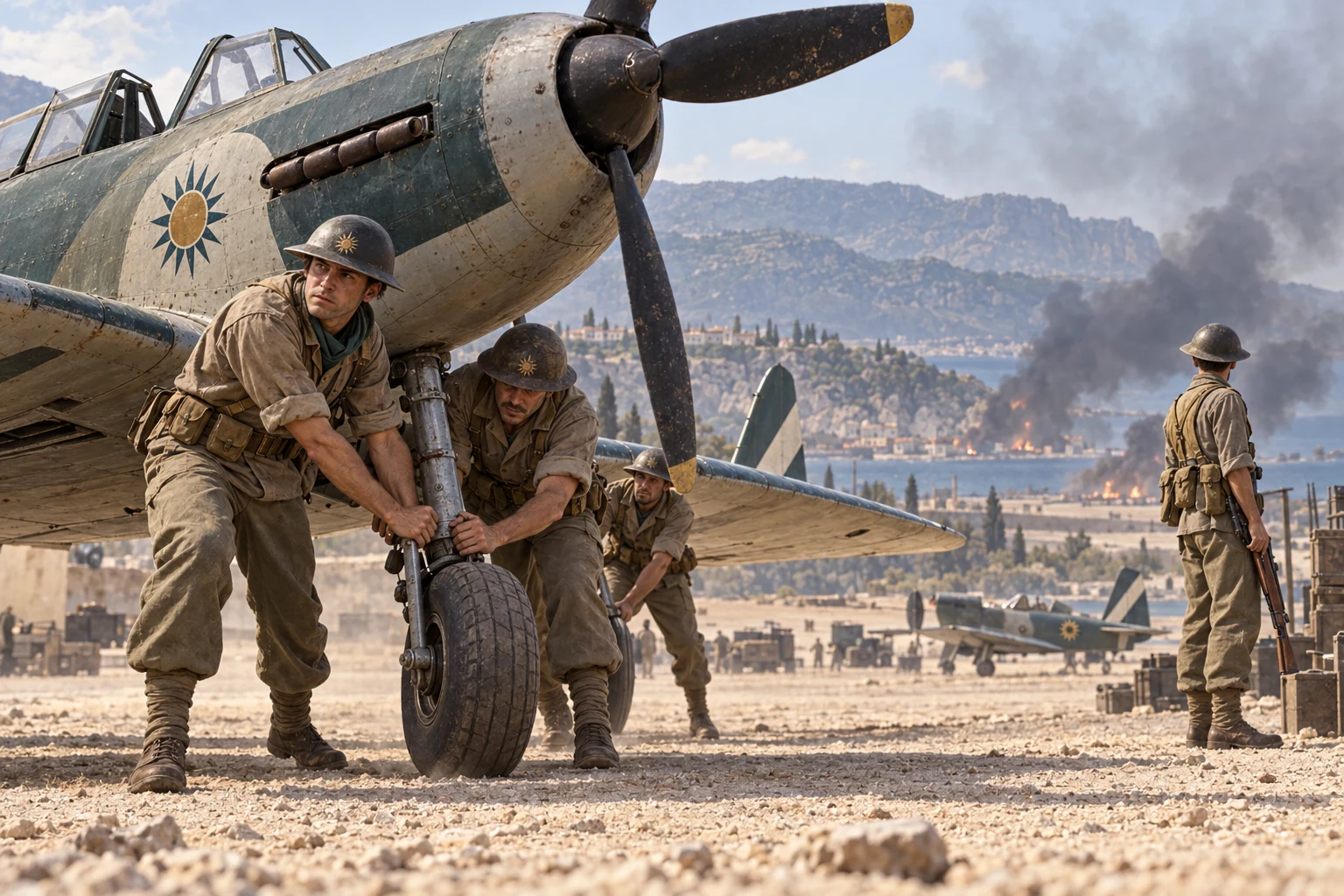
The Saffron coastal airfields
May 5–28, 1221 · Southern Volara · Athenoran and Ugoslian forces against Brevon and Cirel formations
A contest over usable air
The Saffron Littoral front had survived years of pressure without producing a decisive continental break. In May 1221, its immediate focus shifted to the coastal airfields at Savel Flats, where Athenoran reconnaissance aircraft and Ugoslian maritime patrol squadrons operated from adjoining strips. The facilities supported the established southern Volaran front against the Brevon, Cirel, and Dovran system. Silvia remained neutral and supplied no combat units. Allied air commander Colonel Nera Alven controlled the flying units, while Brigadier Oran Vess commanded the mixed ground defense. Their division of authority was workable until a ground attack required decisions about whether aircraft should depart before their defenders withdrew.
Brevon General Ralen Korr planned to seize the low ridge overlooking the strips. Cirel's 12th Air Group would attack the airfields while the Brevon 34th Regiment advanced through coastal scrub. Dovran forces held adjoining sectors, preventing the Allies from shifting every available battalion toward Savel. Korr's objective was limited but consequential: if the strips became unusable, patrol coverage over the nearby sea approaches would shrink. He did not need to capture every aircraft. Alven understood the threat and dispersed machines among revetments and satellite clearings, accepting slower maintenance in exchange for reducing losses from a single raid.
May 5–9
Cirel aircraft struck on May 5 under hazy conditions. The first formation bombed a disused strip whose surface still showed old markings. The second found the active eastern field and destroyed three aircraft on the ground. Ugoslian Lieutenant Sera Dalen, preparing a patrol departure, took off through dust before receiving a complete briefing. Her aircraft returned with damage after reporting Brevon movement toward the ridge. The report reached Vess sooner than the ground reconnaissance expected back that evening. He moved an Athenoran reserve company into the threatened sector, where it met the first enemy infantry the following morning.
The ridge battle began on May 6. Brevon troops gained the seaward end but encountered resistance around an abandoned signal station farther inland. Captain Taren Sel's Athenoran company occupied the station and adjacent scrub. Its radio failed after shelling damaged the generator, forcing messages back to the airfield by motorcycle. The first rider was wounded and returned on foot; the second reached Vess with news that ammunition was running low. Vess authorized a limited resupply movement rather than a full counterattack. The company held until May 9, denying Korr the uninterrupted view over both strips that he sought.
At the airfields, maintenance crews worked under intermittent bombardment. Chief mechanic Mara Eln repaired a patrol aircraft using a component removed from a machine too damaged to fly. The restored aircraft completed three sorties during the battle before engine failure forced it down safely on a coastal beach. Its crew credited the repair; Eln's report emphasized that the substituted component had operated within approved limits and that the later failure was unrelated. The distinction mattered in an air service where improvisation could become an excuse for sending crews aloft in equipment that should have remained on the ground.
The ridge changes hands
Korr renewed his attack on May 12, committing the Brevon 35th Regiment against the signal station. Cirel aircraft attacked the reserve area immediately beforehand, disrupting Vess's movement plans. Sel's company withdrew after losing contact with its neighboring platoon. The station fell, and Brevon observers began directing artillery toward the western strip. Alven ordered its aircraft moved to the satellite clearings. Several could not depart because damage or maintenance had left them unserviceable. Ground crews removed instruments and weapons before destroying two airframes. The act prevented capture while making the airfield's diminished strength visible to everyone working there.
Ugoslian troops counterattacked on May 16 along the ridge's inland shoulder. Their commander, Major Enna Varel, chose to recover the observation spur rather than the station building itself. The attack gained the spur after close fighting among low stone walls. Brevon defenders remained in the station, but their observers could no longer move freely along the ridge. Alven reopened part of the western strip for emergency landings. A returning reconnaissance aircraft used it that afternoon with one engine failing. The pilot had no knowledge of the morning's infantry battle; the safe landing was its most immediate practical result.
The defenders' next problem came from coastal weather. Strong winds on May 19 drove sand across the eastern strip and delayed both Allied and Axis sorties. Vess used the reduced air activity to move ammunition and repair teams. Korr used it to reinforce the station. Neither side received an uncontested advantage from the pause. Civilians from the nearby fishing settlement assisted in clearing the strip after the wind eased, receiving food and evacuation places for relatives in return. The arrangement was negotiated through local authorities rather than treated as an unlimited military claim upon every available pair of hands.
A working field retained
On May 23, Cirel aircraft mounted their heaviest raid of the battle. Allied fighters intercepted part of the formation, but bombers reached the eastern field and damaged its fuel distribution area. Fire crews isolated the burning storage before it spread to the main maintenance shelters. Two firefighters died when a damaged tank ruptured. Alven suspended operations for eighteen hours, then resumed from a reduced section. Korr's final ground attack on May 25 failed to retake Varel's observation spur. The station remained in Brevon hands, leaving the ridge divided and both armies dissatisfied with an incomplete local result.
Alven later assigned flight crews to visit the infantry positions protecting their strips. The visits were brief, but they corrected reports that had attributed every interruption of enemy airfield observation solely to aerial action.
By May 28, the Allies retained a functioning airfield complex at reduced capacity. Brevon held the signal station but had failed to make the strips unusable. Allied ground casualties totaled 1,126, including 293 dead; Axis ground losses totaled 1,389, including 371 dead. Aircraft losses were twenty-two Allied and twenty-seven Axis machines, counting air combat, bombardment, and operational accidents attributable to the battle. Patrol coverage fell during the fighting and recovered unevenly afterward. The coastal front remained intact. Savel's defenders had preserved a service rather than won a sweeping advance: aircraft could still take off, find enemy movement, and return to a place where someone could repair them.
Original illustrations for this source record
Original archive artwork and captions are preserved. Dates, labels and claims printed within inherited images belong to the previous edition; the revised text governs the current history.