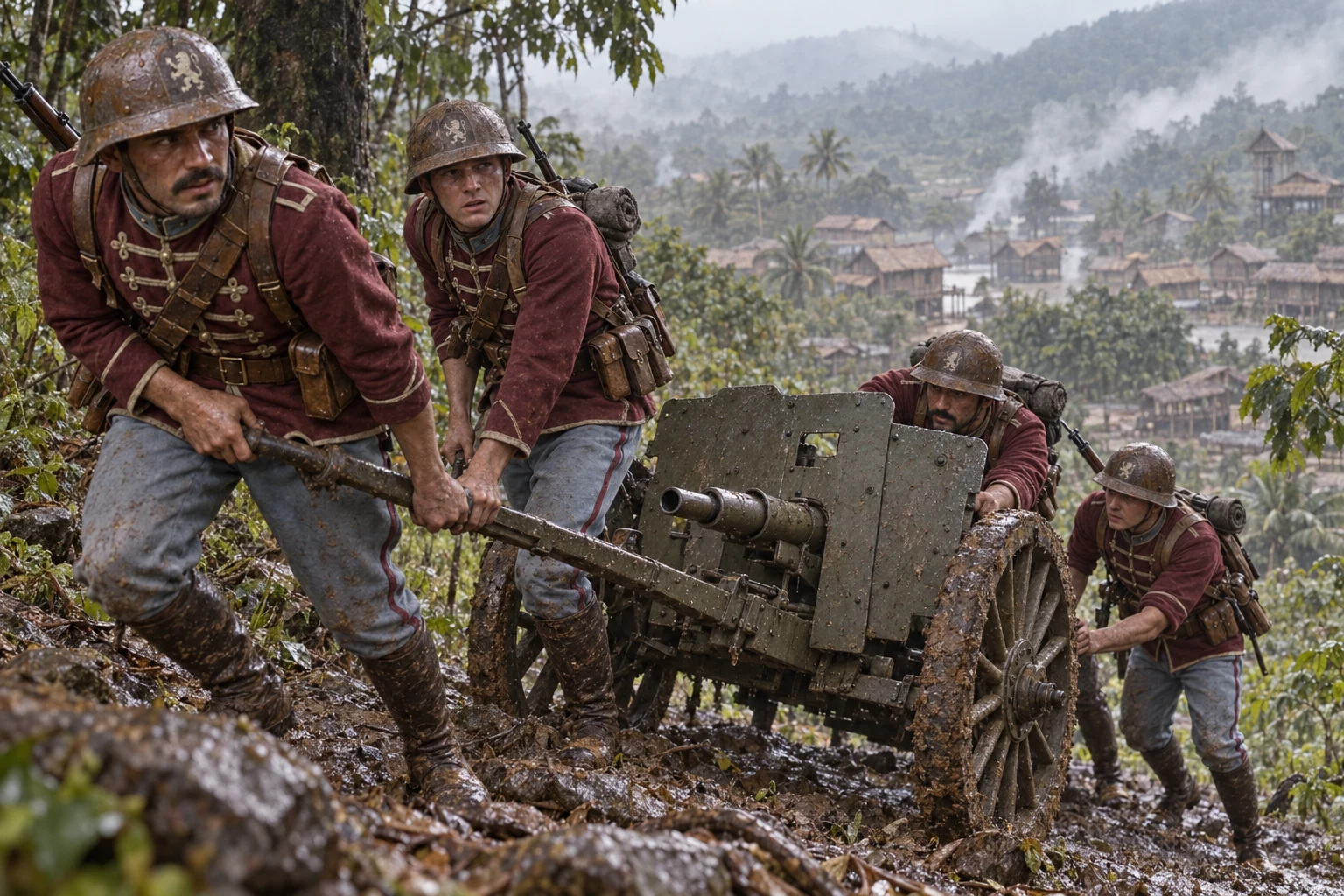
The Naviri inland villages
September 7–24, 1220 · Grand Isles · Naviri territorial troops against Kelonese inland columns
A front beneath the trees
Naviri's inland villages stood beyond the occupied coastal strips, connected by paths that followed ridges rather than straight lines. In September 1220, Kelonese troops attempted to push through the Narela village belt and sever movement between two surviving Allied districts. Colonel Saren Nemi commanded Naviri's 6th Territorial Regiment there. Its soldiers knew the forest and could endure conditions that defeated inexperienced formations, but years of losses had reduced their strength. The Kelonese column, commanded by Colonel Hideo Ran, combined two infantry battalions with engineers and local transport parties requisitioned under occupation authority. The campaign remained a Naviri and regional Allied struggle; Silvia was neutral.
Ran's objective was the ridge crossing near Vena village, not the conquest of every settlement in the interior. Capturing it would make Naviri move supplies along a longer southern route. Nemi planned a delaying defense across three villages rather than a last stand at the crossing. Civilian organizer Nera Venn coordinated evacuation and reception, drawing on experience accumulated since the opening island campaigns. She faced families who had already moved several times and now distrusted assurances that another departure would be temporary. Some concealed food and stayed near their houses, creating a civilian population scattered through the coming battlefield.
The first village
Kelonese troops reached Narela on September 7 after rain delayed their approach. The first houses appeared deserted. A reconnaissance section entered the village square and came under fire from the ridge behind it. Ran ordered his leading battalion to occupy the houses without pursuing immediately into the trees. This avoided one ambush but concentrated men in buildings overlooked by Naviri observers. Nemi's artillery consisted of only a few light pieces, yet their fire made prolonged occupation costly. Ran dispersed his troops along the village edge, where dense vegetation reduced observation and made company boundaries difficult to maintain.
On September 9, a Kelonese company advanced along an old timber path and encountered a Naviri platoon led by Lieutenant Mira Kal. The fighting began at close range after both groups mistook movement ahead for their own scouts. Kal withdrew toward a streambed, carrying a wounded radio operator whose equipment had been damaged in the first exchange. She reached the next village without the radio and sent runners to Nemi. Their reports arrived hours apart and gave different impressions of the encounter. Nemi treated the enemy's strength as uncertain, retaining his reserve until additional patrols confirmed the direction of movement.
Venn's evacuation teams worked behind this shifting defense. At Kesa village, a family refused to leave because an elderly grandfather could not walk. The assigned stretcher had been taken for a wounded soldier. Venn found four volunteers who fashioned a carrying frame from household timbers. The delay kept fourteen civilians in the village until the following morning, when Kelonese scouts were already nearby. Naviri troops escorted them out without firing. The incident later entered village memory as a rescue, but Venn recorded it as an organizational failure corrected by neighbors after the planned means of assistance disappeared.
Fighting for the ridge crossing
Ran attacked Vena's outer position on September 13. The ridge narrowed there between steep slopes, forcing his infantry into a restricted frontage. Naviri defenders held the first assault and withdrew before artillery arrived, avoiding the bombardment that destroyed their empty shelters. Ran recognized the pattern and sent patrols toward the southern path. One reached a food cache belonging to evacuated families. Soldiers began consuming its contents before officers intervened. The seizure deprived civilians of supplies intended for their eventual return and revealed how quickly an army's hunger could undermine its command's promises about protecting local property.
Nemi counterattacked on September 16 with two companies, seeking to reopen the southern path long enough for a final movement of civilians and stores. The assault recovered a small terrace but stalled near a fallen tree that obscured a Kelonese position. Sergeant Talen Var crawled forward to locate the fire and was killed before reporting. His section leader inferred the position from the direction in which the survivors had withdrawn and redirected the attack. The company gained the path after dark. It held for fourteen hours, sufficient for the planned movement but too briefly to constitute a permanent recovery.
The most severe fighting occurred on September 19 at the ridge crossing itself. Naviri's remaining defenders numbered fewer than three hundred in the immediate position. Ran committed a fresh company and engineers to clear obstacles along the approach. Rain reduced visibility and made the slopes hazardous. Several Kelonese soldiers fell while carrying ammunition; Naviri stretcher bearers suffered similar accidents on the withdrawal route. Nemi ordered the crossing abandoned that evening. Captain Sela Rin's rear guard stayed until dawn, maintaining enough resistance to conceal the movement without attempting to hold ground the regiment could no longer support.
What the advance accomplished
Kelonese troops occupied Vena on September 20 but did not pursue rapidly beyond it. Their wounded required evacuation, and the forest road could not carry supporting equipment at the pace Ran had requested. Naviri troops established a new line farther west and continued moving supplies along the longer southern route. Fighting diminished into patrol encounters by September 24. The enemy had gained the crossing and three damaged villages while failing to destroy Nemi's regiment. For the civilians, the limited scale of the military result did not diminish the loss of homes, gardens, and food reserves that sustained life outside army ration systems.
Venn preserved separate lists for people choosing to remain near their farms. This avoided treating every absence from a reception camp as desertion, collaboration, or proof that an entire household had been killed.
Naviri military casualties totaled 786, including 203 dead; Kelonese losses totaled 941, including 258 dead. Venn's teams registered 2,607 displaced civilians and eighty-nine civilian deaths. Forty-three people initially listed missing were later found living near abandoned farms, illustrating the difference between administrative disappearance and death. Nemi retained enough strength to defend another line, and Ran obtained a route that remained expensive to maintain. The battle's lasting effect was a further thinning of Naviri's inhabited interior. A map could show the new front clearly; it could not show how many village paths now led to empty houses instead of working communities.
Original illustrations for this source record
Original archive artwork and captions are preserved. Dates, labels and claims printed within inherited images belong to the previous edition; the revised text governs the current history.