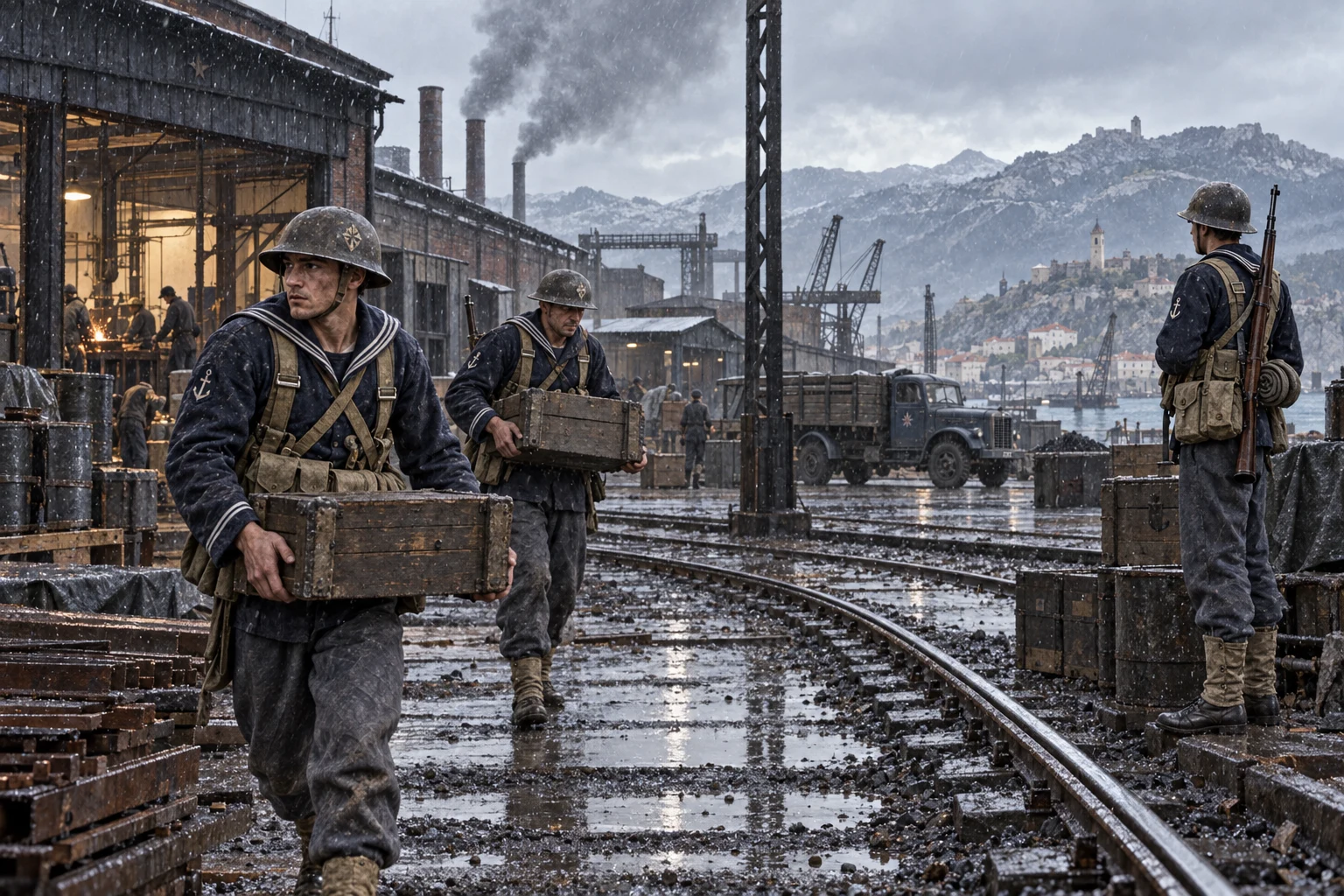
The second Haveran factory belt
November 2–18, 1220 · Havera · Haveran 21st Division against Hukular 51st Division
Factories rebuilt into the next line
After the eastern works fell in April, Havera transferred production into smaller installations farther west. The resulting factory belt was dispersed enough to survive individual raids but still depended on a common power station and railway loop near Vesar Junction. General Talen Har's 21st Division defended this district. Many of its soldiers had relatives working behind them, a connection that strengthened resolve while complicating withdrawal decisions. Hukular General Koren Vask, commanding the 51st Division, sought Vesar's eastern shops and the heights overlooking its loop. The offensive was another limited territorial gain intended to magnify Havera's accumulated industrial exhaustion.
Vask had orders from the theater command to avoid a costly assault on the power station if its isolation could achieve the same result. His artillery first targeted the railway loop, hoping to interrupt the removal of machinery and force the defenders to choose between factories and soldiers. Har recognized the danger but lacked a reserve large enough to hold both flanks comfortably. He placed the 62nd Regiment around the station approaches and the 63rd in the residential belt. The 61st, reduced by earlier fighting, covered an exposed ridge with attached industrial guards who possessed excellent local knowledge and limited infantry experience.
November 2–6
The opening attack on November 2 struck the ridge during sleet. Hukular soldiers struggled to distinguish abandoned workshop sheds from defended positions. Several entered a paint store whose chemical fumes made prolonged occupation impossible. Haveran defenders mistook their sudden emergence for a renewed assault and opened fire, inflicting casualties before the attackers reached safer shelter. The incident persuaded Vask to require reconnaissance of industrial buildings before concentrating troops inside them. The requirement slowed his advance but prevented repeated accidents. Factory terrain contained hazards that military maps did not show and that courage alone could not identify.
Har's ridge line held until November 5, when Hukular infantry captured its southern observation post. Industrial guard Mara Lenis had maintained the post's telephone using cable recovered from a damaged workshop. She transmitted the warning while the neighboring shelter burned, then withdrew with its military occupants. The report enabled Har to pull the nearest company back before it was surrounded. Lenis suffered burns and lost two fingers. Her later recognition came from both the army and the industrial service, reflecting the ambiguity of a worker whose technical duty had become inseparable from front-line combat.
The loss of the ridge placed Vesar's railway loop under direct observation. On November 6, a machinery train attempted to leave between bombardments and was struck near the western switch. Its locomotive remained serviceable, but two loaded wagons derailed. Driver Eren Val detached them after receiving permission from the machinery supervisor riding aboard. The abandoned wagons carried specialized components from the April evacuation. Losing them a second time was especially bitter to workers who had dismantled and reinstalled the same machines within one year. Val brought the remaining train out with seventeen wounded railway employees in its covered vans.
Houses between armies
Fighting entered the residential belt on November 8. The houses were narrow, with shared cellars and rear courtyards that connected several streets. Haveran Captain Sela Vor commanded a company whose platoons had grown up in three different parts of the district. Their familiarity allowed movement unseen from the main road, but the same passages contained civilians reluctant to leave. Vor ordered basement routes marked separately from shelters so soldiers would not repeatedly draw fire toward families. The distinction was imperfect under bombardment. One marked shelter became inaccessible when an adjacent staircase collapsed, trapping forty-two residents for nearly a day.
Hukular Lieutenant Deren Olt reached that shelter while his platoon cleared the adjoining house. He suspended the advance locally to remove the trapped inhabitants, sending them toward the rear under two guards. Haveran troops across the courtyard initially fired before recognizing the civilian movement. Vor stopped the shooting after a woman emerged carrying a white sheet. Thirty-nine residents survived; three had died before rescue. Olt later resumed combat in the same block. The episode did not produce a broader truce, but testimony from both sides preserved a specific interruption of the battle for people who otherwise would have remained underground.
Har requested permission to shorten the line on November 11. The national command authorized withdrawal from the eastern shops but insisted that the power station remain operational long enough to transfer the final production loads westward. Engineer Nera Holl explained that changing the electrical distribution could not be accomplished by simply moving a switch. Crews worked through the next two nights while artillery damaged exterior lines. On November 13, the western installations separated successfully from Vesar's supply. The army could then withdraw without causing an immediate shutdown across the remaining industrial system, though output still fell sharply.
The second loss
Vask attacked the station approaches on November 14. The Haveran 62nd Regiment held the main entrance while engineers removed control equipment. Sergeant Arlen Sen's platoon defended a turbine hall already silent except for water dripping through shell holes. When Hukular infantry entered through the maintenance yard, Sen withdrew his men along a service gallery. He left behind a wounded soldier who could not be carried through its narrow opening. The soldier, Private Taren Hes, survived captivity. Sen's account after the war named him rather than allowing the abandonment to disappear into an impersonal statement about unavoidable losses.
The final Haveran withdrawal occurred on November 18. Hukular gained the eastern shops, Vesar loop, and disabled power station. It did not take Havera's capital or destroy the country's government. Military casualties totaled 2,968 for Havera and 3,331 for Hukular; the respective dead were 774 and 891. Civil authorities recorded 209 deaths and 6,742 newly displaced people. The surviving western factories absorbed another wave of workers and equipment while operating under heavier demands. Har's soldiers occupied their new line knowing that the workshops behind them were no longer a reserve comfortably distant from battle. They were the next industrial ground the army might be ordered to defend.
Holl retained the successful transfer chart as a technical reference. Its clean lines concealed exhausted crews, severed cables, and the narrow interval between preserving electrical continuity and losing the station that had supplied it.
Original illustrations for this source record
Original archive artwork and captions are preserved. Dates, labels and claims printed within inherited images belong to the previous edition; the revised text governs the current history.