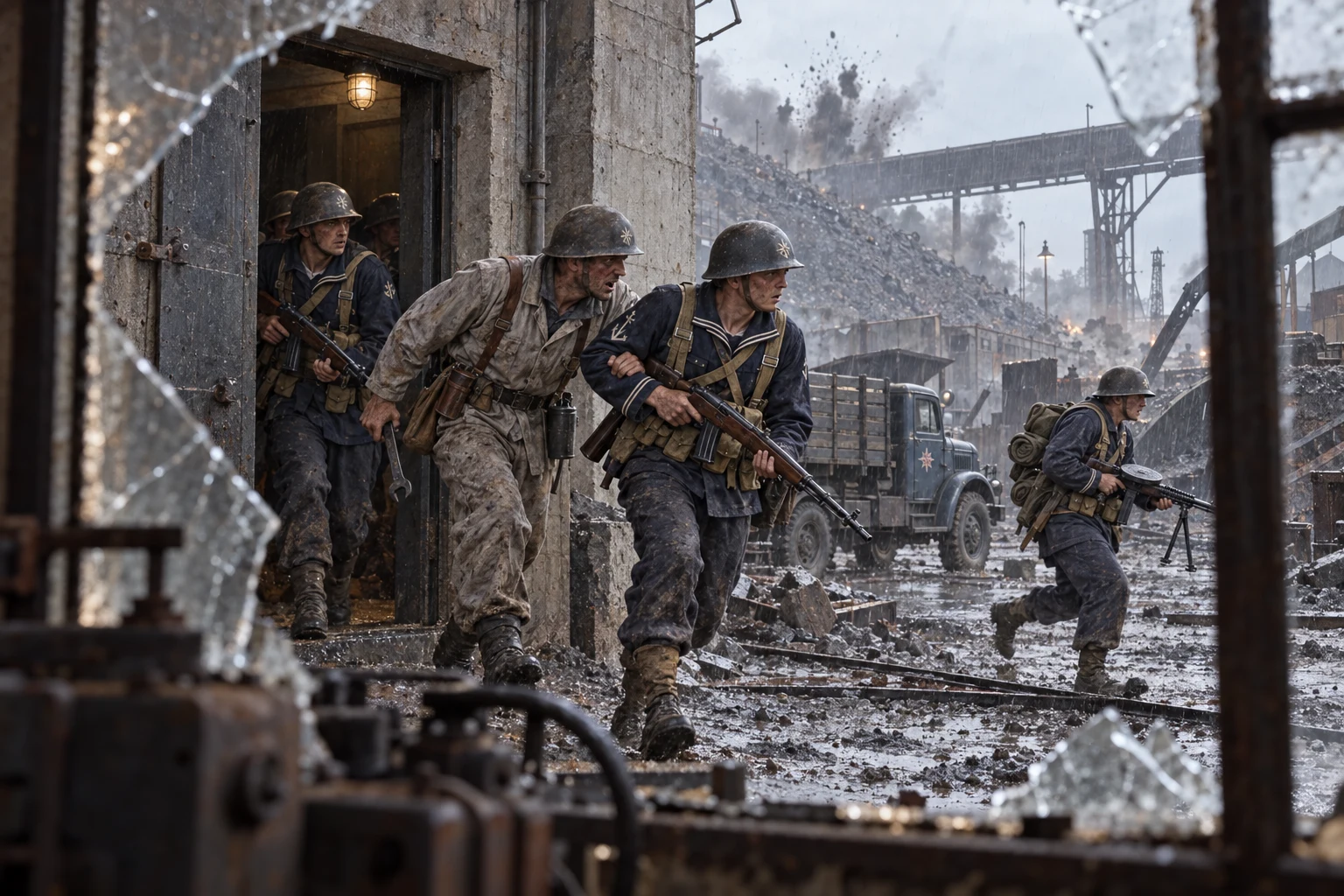
The eastern Havera works
April 10–24, 1220 · Havera · Haveran industrial defense group against Hukular 28th Corps
The works behind the lost approaches
The industrial approaches lost in 1219 had brought Hukular guns closer to eastern Havera's working factories. By April 1220, the Keren Works district stood within a front shaped around rolling mills, boiler houses, railway embankments, and workers' homes. General Olin Varr retained responsibility for the sector, though his formations had changed through casualties and reinforcement. Colonel Mira Fenn commanded the immediate defense with the rebuilt 13th Regiment and industrial protection battalions. Across the front, Hukular Lieutenant General Radan Kelm prepared to take the works themselves. The campaign threatened Havera's production and eastern territory, not an immediate invasion of Hestunia.
The factory managers had already removed specialized gauges and portable machinery. Heavy presses remained because dismantling them required time and lifting equipment the army could not spare. Chief engineer Sena Vor opposed destroying the presses before evacuation became unavoidable. Military officers feared they would be captured intact. The compromise authorized preparatory work but reserved the final decision to the regional command. Workers continued producing spare parts in buildings partly prepared for demolition. Their families lived in western reception districts, so each shift entered a workplace that might be lost before they returned the following morning.
April 10–14
Hukular's attack began on April 10 against the eastern slag embankment. The embankment appeared solid but contained unstable pockets where rain had eroded old industrial waste. Infantry from Hukular's 83rd Regiment advanced across its lower slope and encountered fire from concrete maintenance buildings. Several sections sought cover in depressions that subsequently collapsed under shelling. Survivors described fighting a landscape that shifted beneath them. Fenn's defenders knew the safer routes but could not cover all of them. The embankment changed hands in fragments, with neither side controlling a continuous crest until the evening of April 12.
Captain Irena Hal's Haveran company held the northern maintenance building after the neighboring position fell. Its windows faced the wrong direction for the new threat, forcing soldiers to fight from doors and roof access points. A factory electrician restored an internal lighting circuit so wounded men could be treated in the basement. The light also escaped through a damaged stairwell and drew enemy fire. Hal ordered it extinguished above the cellar and covered the opening with metal sheeting. The company held another day before withdrawing through a cable passage that emerged behind the rolling mill.
Kelm occupied the slag embankment on April 13 and paused long enough to move observation teams forward. From there, they could see movement between the principal factory halls. Haveran vehicles began crossing at night, but the workers' foot routes remained exposed. On April 14, a shell hit a group carrying dismantled machine fittings, killing seventeen people. Vor ordered subsequent parties to carry fewer components and move separately. The change reduced the chance of a single catastrophic loss but slowed removal. It illustrated why evacuation schedules calculated from peacetime workshop practice ceased to mean much once every movement became an enemy opportunity.
The rolling mill
The battle entered the rolling mill on April 16. Hukular infantry gained the southern loading bay while Haveran troops held the central hall. Machinery divided the interior into corridors, and noise from shelling made spoken orders nearly useless. Sergeant Mera Venn used a factory signal bell to warn her platoon when movement began in the adjoining bay. The soldiers understood her improvised code because most had been workers before mobilization. Newly arrived replacements did not. Two moved at the wrong signal and were wounded. Venn abandoned the system once the platoon could no longer share its assumptions safely.
Fenn requested permission to withdraw on April 18. Varr granted it after confirming that the western defense line could receive the regiment. The demolition decision passed to Vor, who identified machinery that could be disabled without bringing down occupied shelters. Engineers worked while infantry covered the remaining halls. A planned blast in the boiler house was canceled when medical personnel reported patients in an adjoining tunnel. The enemy subsequently captured portions of the installation repairable. The cancellation preserved thirty-two patients and six attendants. It also became a contentious detail in later arguments over how much industrial capacity had been denied to Hukular.
The most difficult withdrawal occurred on April 20 at the administrative block. Clerks had retained personnel files needed to identify workers, dependents, and the missing. A truck assigned to remove them was destroyed before reaching the building. Civil administrator Leva Norr chose the identification registers and casualty correspondence over financial ledgers. Soldiers carried the selected volumes in ammunition cases alongside wounded men. Some papers were lost in the rain during the movement. Their survival was incomplete, but enough remained to prevent hundreds of displaced families from having to prove their relationships solely through testimony after the district's capture.
April 24
Hukular troops reached the western factory gate on April 22. A Haveran rear guard held nearby houses for another night while the final military stores moved away. Lieutenant Daren Sol was ordered to leave when the neighboring company withdrew, but its signal failed to reach him. He sent a patrol that found the position empty and began his own retreat. Twenty-eight men escaped; thirteen wounded remained and were captured. Sol later testified that he had disobeyed the literal order in order to fulfill its purpose. Fenn endorsed his interpretation and recommended that withdrawal orders include deadlines independent of unreliable neighboring signals.
The Keren Works district was fully occupied by April 24. Haveran military casualties totaled 3,419, including 906 dead, while Hukular losses reached 3,782, including 1,012 dead. Civilian deaths during the battle numbered 384. Most portable precision equipment escaped, but buildings, heavy machinery, and electrical infrastructure remained lost. Hukular gained damaged industrial ground rather than immediate replacement production. Havera retained its capital, government, and western works, whose burden increased sharply. The surviving workers arrived there with tools, records, and habits formed in factories now across the front. They could help restore output, but their arrival could not recreate the vanished district's full capacity.
Vor's disabled presses returned to Allied control only years later. Examination confirmed that the canceled demolition had preserved the hospital tunnel exactly as its medical staff had warned.
Original illustrations for this source record
Original archive artwork and captions are preserved. Dates, labels and claims printed within inherited images belong to the previous edition; the revised text governs the current history.