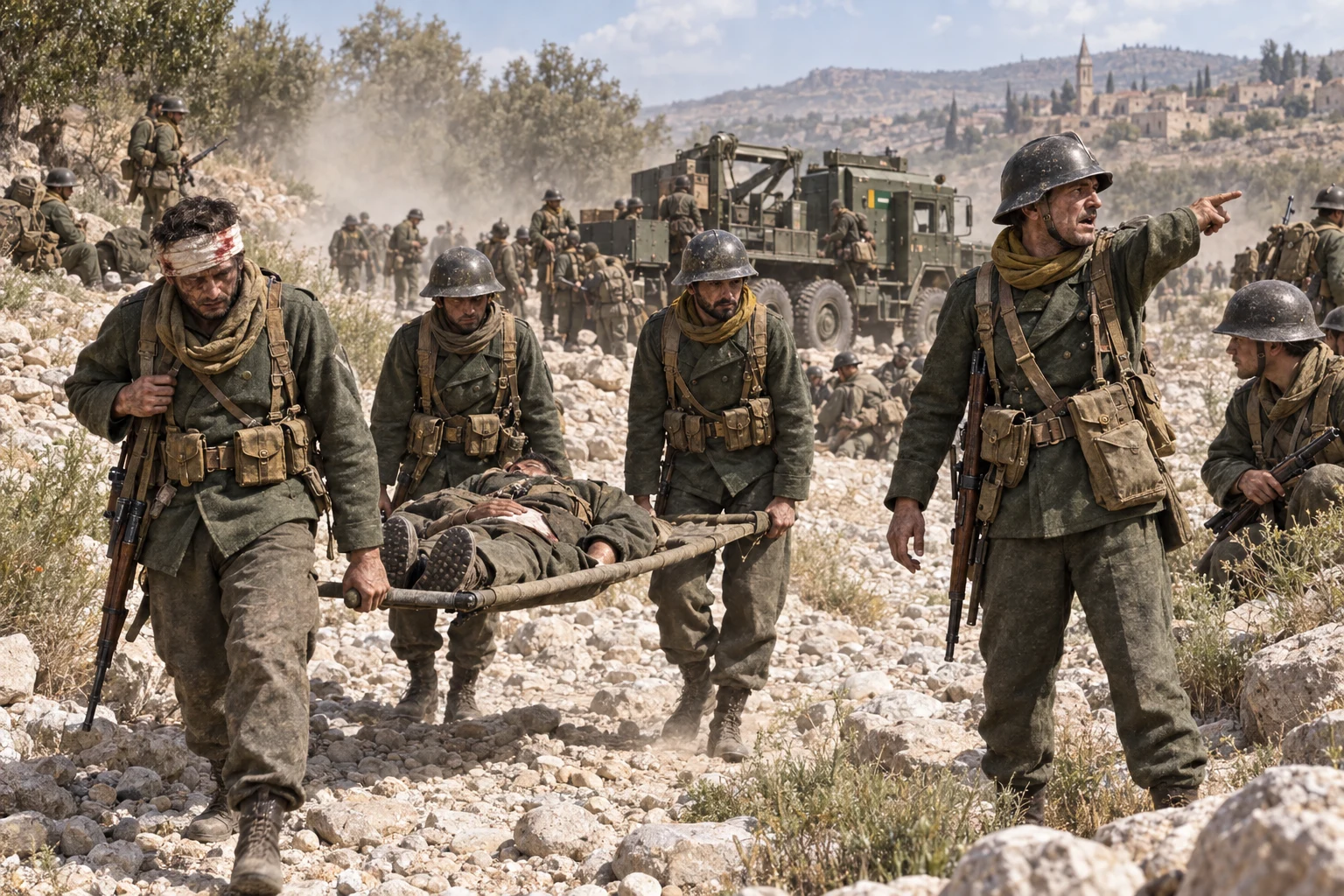
The Handistani relief battalions
June 26–July 19, 1219 · Gaften · Handistani and Huqaiti troops against Ruuyaqi and Jazimi formations
Relief that arrived as fighting began
Handistan's 23rd and 24th Relief Battalions were supposed to replace exhausted troops in a quiet section of the established eastern front. Their designation described their assignment, not a special kind of elite infantry. Many recruits had completed shortened training, while their officers included veterans recovering from wounds. Colonel Amel Dar commanded the receiving sector near the Teshan ridges, where a road crossed low agricultural hills before entering safer western districts. The battalions arrived on June 26 just as Ruuyaqi and Jazimi forces began a limited offensive. Units intended to restore another formation's strength instead entered battle before completing the handover.
The Axis attack group included Ruuyaq's 42nd Infantry Regiment and two Jazimi battalions operating through the existing coalition approaches. Major General Qaren Sal sought the outer Teshan ridge, whose observation would improve pressure on Handistan's next defensive belt. His supply arrangements depended on Jazimi facilities and contested regional routes; they provided no direct national frontier with Handistan. Dar knew the enemy had assembled troops but expected a later attack. The difference of two days meant that his departing battalions had already packed portions of their equipment while their replacements had not learned the positions they were expected to occupy.
The unfinished handover
Artillery struck on the afternoon of June 26 while officers from both formations were inspecting the northern companies. A shell destroyed the shelter holding the sector's updated position sketches. The incoming commander, Major Nera Vahid, survived but could not immediately identify which nearby posts were occupied. She retained the outgoing company guides instead of releasing them to join their battalion. That decision prevented several replacement platoons from walking into positions already overrun. It also left the old formation short of experienced soldiers when ordered to assemble as a reserve. For the first night, neither battalion existed in the arrangement shown on headquarters' strength table.
Ruuyaqi infantry captured the forward crest on June 27. The Handistani 24th Relief Battalion attempted a counterattack before its supporting weapons had all arrived. The leading company reached a terrace below the crest and stopped under fire from an unexpected lateral position. Lieutenant Salen Mir brought his soldiers back in small groups, using wounded men who could walk to guide stretcher bearers. His report admitted that he had mistaken the first terrace for the assigned objective. The error cost thirty-eight casualties. Dar chose instruction over punishment, reasoning that an inaccurate handover had placed the young officer in a situation his preparation had not covered.
The 23rd Battalion fared better on the southern slope, where veteran Sergeant Isha Ren recognized a dry streambed from previous service. She guided a company to a defensible bend after its original position became untenable. Ruuyaqi troops following the retreat encountered an organized line rather than a scattered force. The company held through June 29, allowing Dar to rebuild contact between his northern and southern elements. Ren was wounded during the final evening and evacuated. Her influence survived through the soldiers she had positioned, demonstrating the practical value of a single experienced leader within a battalion still learning how battle altered its training.
Huqaiti support
A Huqaiti battalion reached the sector on July 1 under Major Varen Hus. Its arrival did not create numerical superiority across the front, but it gave Dar a unit that could occupy one position without first disentangling itself from another. Hus took responsibility for the road junction behind Teshan and established a medical collection point in a pottery workshop. The building's kiln remained warm from a firing interrupted by the attack. Wounded soldiers initially welcomed the heat during cold nights, then struggled with smoke when damaged ventilation failed. Civilian potters helped clear the flue and stayed to carry water.
Sal renewed the attack on July 4. Jazimi infantry pressed the road while the Ruuyaqi regiment attacked the remaining ridge position. The Huqaiti battalion held the junction, losing its forward company commander and nearly a third of that company's strength. Vahid's 23rd Battalion conducted a limited counterattack against the Ruuyaqi flank on July 5. Unlike the earlier attempt, its objective was a nearby observation hollow rather than the full crest. The battalion took and retained it. That small success reduced enemy visibility over the relief route and allowed several damaged vehicles to be recovered instead of abandoned.
The fighting exposed shortages within both coalitions. Sal's artillery could not maintain its opening rate, while Dar's troops lacked enough serviceable footwear after repeated moves through irrigation channels. A Trenoan supply consignment included boots in sizes unsuitable for many soldiers, prompting hurried exchanges among units rather than immediate distribution. The inconvenience mattered because foot injuries were removing men from the line without appearing in the battle's initial casualty reports. Medical Captain Leva Sam insisted that the daily returns record these losses separately. Her figures prevented headquarters from mistaking nominal battalion strength for the number of people actually able to stand duty.
A limited front preserved
From July 10, the battle contracted into local attacks around the observation hollow and road junction. Sal gained a southern farm enclosure on July 13 but could not use it to break the Handistani line. Dar declined proposals to recover every lost terrace, concentrating on the positions that protected continued relief. The original outgoing battalions finally departed on July 16, twenty days after their scheduled release. Their replacements had become combat veterans through a process no training plan could recommend. Several soldiers leaving the sector embraced recruits who had arrived expecting to take over from strangers and instead had fought beside them for weeks.
The action ended on July 19 with the Axis holding the outer crest and the Allies retaining the junction and shorter main line. Handistani and Huqaiti casualties totaled 1,764, including 419 dead; Axis casualties totaled 1,938, including 501 dead. Medical returns listed another 612 temporary removals for illness and foot injuries, distinct from those battle casualties. The relief battalions had preserved the sector but failed to provide the rest their arrival had promised. Dar's report praised their endurance and criticized the rushed handover. Both judgments were necessary: the soldiers had adapted successfully to a preventable crisis, and their success did not make its causes acceptable.
Original illustrations for this source record
Original archive artwork and captions are preserved. Dates, labels and claims printed within inherited images belong to the previous edition; the revised text governs the current history.