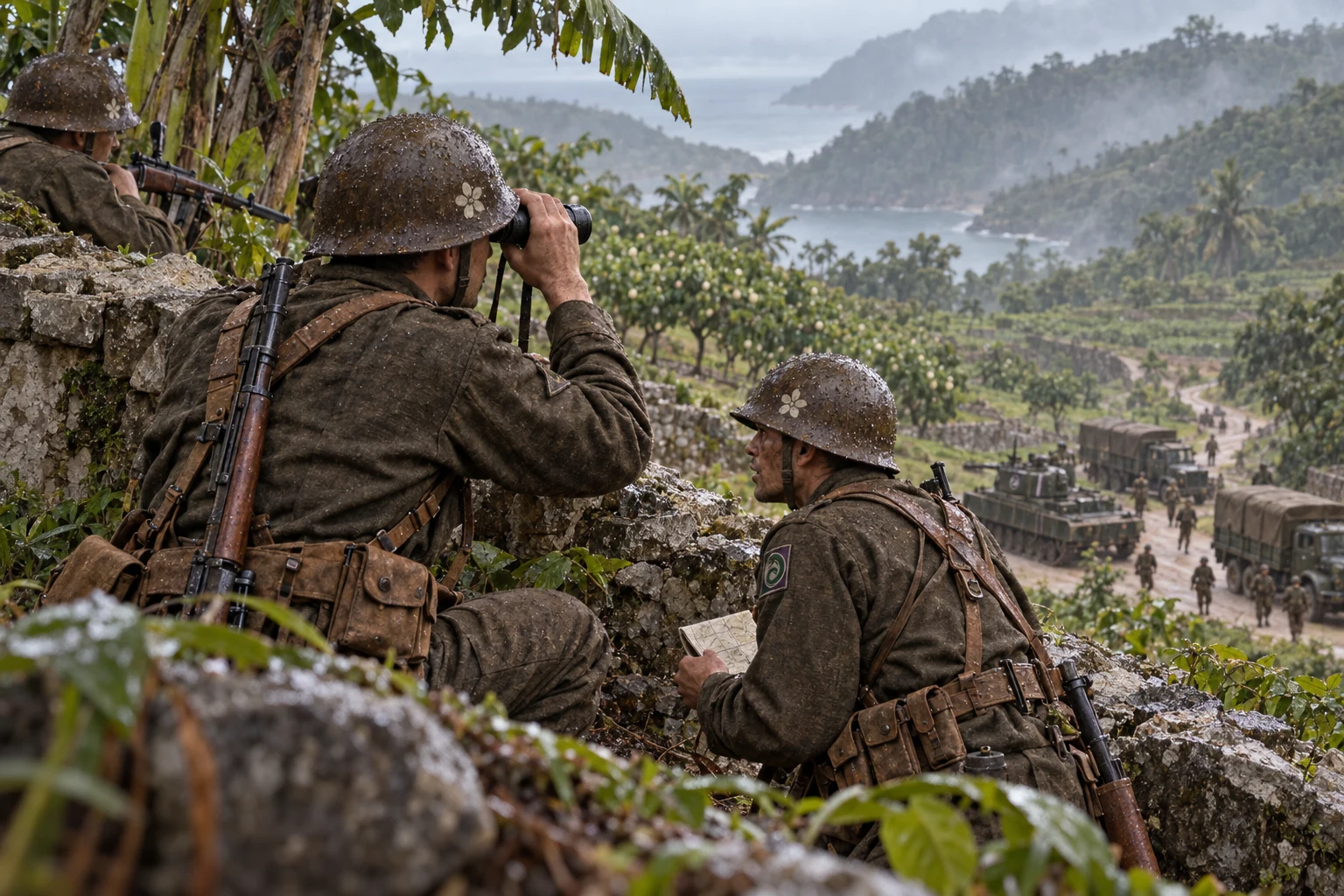
Kalanu’s last dependable receiving district
May 18–June 21, 1219 · Grand Isles · Kalanu defenders against Kelonese coastal assault forces
The remaining district
By May 1219, Kalanu's government depended on the receiving district around Vana Cove for predictable contact with its allies. Other beaches still accepted boats, but only Vana combined shelter, storage, and a usable road into the remaining defended area. General Neris Tal commanded the district with three coastal battalions, a reduced field regiment, and naval personnel whose vessels had been lost or disabled. The troops had fought through repeated contractions of their position. Their experience improved local defense, but it could not replace ammunition or restore the workshops lost during earlier campaigns. Every successful unloading now carried disproportionate importance.
Kelonese General Arata Men received reinforcements after the previous year's fighting and planned to take the heights overlooking Vana's road. His objective was to make continued government residence impractical without committing immediately to the capture of every coastal village. The 48th Regiment led the attack, supported by artillery brought through existing occupied districts. Naval aircraft searched the approaches for relief shipping. Kalanu's leadership understood that departure might become necessary and had arranged reception in Motari, an Allied country already at war. The arrangements were sovereign agreements between partners, not an assumption that any convenient island could be used without consent.
The heights above Vana
The battle began on May 18 with an attack against the orchard terraces east of the receiving road. Kalanu Captain Sera Ven commanded a battalion reduced to 418 effective soldiers. Her outer companies held the first assault but suffered heavily when the enemy brought artillery onto known shelters. A school cellar used as an aid post collapsed on May 20, trapping patients and medical personnel. Local mason Tavin El led a rescue party that opened a passage through the adjoining storeroom. Thirty-seven people were recovered alive. Eleven died before the rubble could be moved, including the battalion's senior medical officer.
Ven withdrew from the upper terraces on May 23 rather than risk losing her remaining companies. Men pressed forward cautiously, expecting the retreat to conceal a counterattack. None came. Tal had no fresh battalion available, and he needed his reserve to protect the road junction nearer the coast. Kelonese observers occupied the abandoned crest on May 25. Their view was incomplete because lower hills concealed the cove itself, but they could watch traffic entering the receiving district. Shelling forced movement into darkness and interrupted the repair of vehicles whose breakdowns now blocked narrow roads at the worst possible moments.
A Kalanu counterattack on May 29 sought to remove the observers from the nearest crest. Lieutenant Colonel Mera Sol assembled two companies and naval volunteers familiar with the coastal paths. They reached the lower enemy position during rain but could not take the summit before daylight. Kelonese troops counterattacked from a neighboring spur and divided the assault force. Sol withdrew with the larger group. Forty-six men and women remained isolated around a stone chapel, where they resisted until their ammunition was nearly exhausted. They surrendered on May 30. Their capture eliminated much of the district's remaining reserve without restoring the road's security.
The receiving ground becomes a battlefield
On June 4, a relief vessel attempting to unload after dark was damaged near the cove entrance. It reached shallow water, allowing most aboard to escape, but its cargo obstructed the main landing stage. Dock worker Nalen Var organized smaller boats to salvage medical crates before the tide covered them. Some containers had split and could not be used. The salvaged supplies kept the hospital functioning for another week. Var's crew included teenagers previously assigned only to carrying food sacks. The district's shrinking labor force was erasing distinctions between civilian work considered acceptable and tasks once reserved for experienced adults.
Men attacked the receiving road directly on June 8. Kalanu's field regiment held the junction for three days before withdrawing toward the coast. Sergeant Iren Salo stayed with a machine-gun section in a burned bus shelter, allowing wounded personnel to pass behind it. When his position was outflanked, he led the survivors through a drainage channel and rejoined the regiment with only one usable weapon. The action delayed the enemy for hours rather than days. Its importance lay in who passed during those hours: medical staff, transport drivers, and communications specialists whose capture would have crippled any continued Kalanu effort abroad.
The government decided on June 12 to transfer its principal officials and records to Motari. Tal was instructed to defend embarkation while avoiding any statement that the country had surrendered. Civil clerks prepared duplicate lists because a lost vessel could otherwise erase the identity of evacuees. Military and civilian passengers were assigned separate priorities, provoking anger among families split across departures. Ministerial staff voluntarily surrendered several reserved places to hospital patients after the first list became public. The change helped, but it could not make a dangerous and selective evacuation fair to everyone who wished to leave.
June 21
The final organized departure of principal officials took place on June 21. Tal retained command ashore; many troops and civilians remained in Kalanu. Motari escorts covered the departing vessels while Kalanu shore batteries fired their limited remaining ammunition against Kelonese positions threatening the cove. One transport returned briefly to collect survivors from a launch disabled near the entrance. Its captain, Rema Hal, accepted the delay despite orders emphasizing speed. All twenty-three people aboard the launch were recovered. The convoy reached Motari, where Kalanu's recognized institutions continued operating and its surviving naval personnel joined the wider Allied effort.
Tal retained a duplicate of the evacuation manifest ashore. When one passenger list was lost during reception in Motari, his copy settled questions about seventy-eight officials, dependents, and hospital patients who had traveled together.
The battle cost Kalanu's military forces 2,316 casualties, including 608 dead and 391 prisoners. Kelonese losses totaled 2,087, including 537 dead. Civilian deaths registered from the district reached 294. The departure of officials was not the October 22 local garrison armistice, which remained four months away and would bind different authorities in different circumstances. Vana Cove continued to receive small boats intermittently, but it had ceased to provide dependable national support. The surviving government carried its legal continuity across the sea while the people and troops left behind faced a progressively narrower physical space in which to continue the war.
Original illustrations for this source record
Original archive artwork and captions are preserved. Dates, labels and claims printed within inherited images belong to the previous edition; the revised text governs the current history.