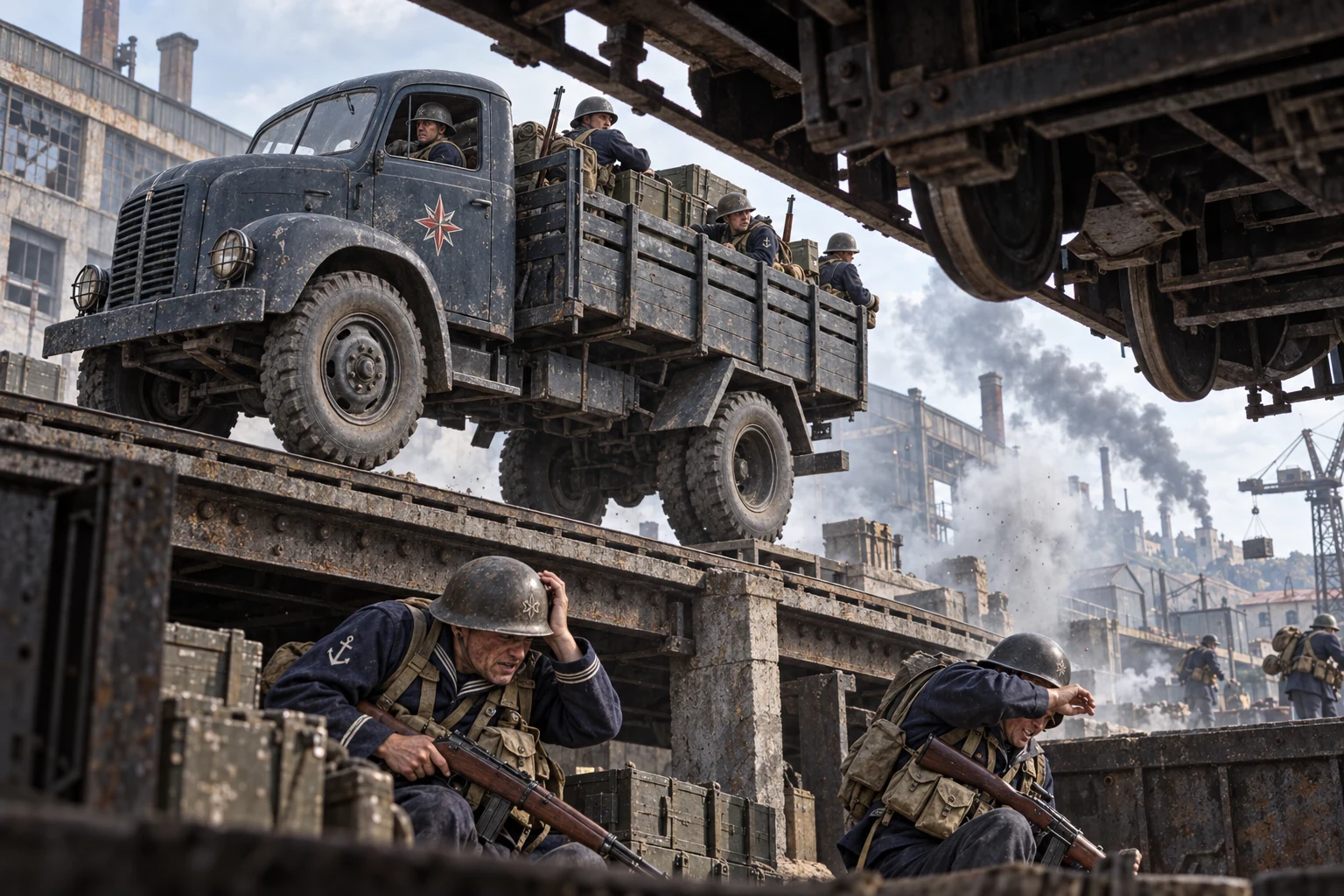
The Haveran industrial approach
March 11–April 9, 1219 · Havera · Haveran 5th Army Group against Hukular 28th Corps
The approach to the works
The eastern Haveran industrial district had become both a source of matériel and a defensive zone. Its approach through Deren Vale contained workers' settlements, a tramway, and a narrow river crossing serving several metalworking plants farther west. General Olin Varr commanded Havera's 5th Army Group, an administrative designation covering two weakened divisions and supporting units rather than a full-strength field army. Hukular's 28th Corps, led by Lieutenant General Radan Kelm, sought the eastern approaches. Possession would bring important installations within dependable artillery observation. Havera's capital and national government remained farther behind the front and outside the operation's immediate reach.
Kelm's first objective was the tramway depot at East Deren. Its capture would separate the forward Haveran positions from the river crossing. Colonel Mira Fenn's 13th Infantry Regiment defended the depot with engineers drawn from the industrial protection service. The workers knew the drainage system and maintained portable power for the military telephones. They also resisted an order to remove their families immediately, fearing that temporary evacuation would become permanent abandonment. Civil commissioner Leva Norr secured transport and written accommodation guarantees before the majority agreed to leave. That negotiation prevented panic but consumed days the army would later wish it possessed.
March 11–17
Hukular artillery opened the battle on March 11, damaging the depot's overhead electrical equipment and setting two tramcars on fire. The first infantry attack reached the maintenance sheds but was driven back by Haveran troops firing from the raised inspection platform. Corporal Enna Vesh moved along the platform carrying ammunition after its stairway collapsed. Her section held until smoke made breathing difficult. Fenn then ordered the platform abandoned and occupied the lower workshop rooms. The action saved the defenders from the burning roof but surrendered the observation advantage that had made the first attack so costly for Hukular.
Kelm shifted his effort toward the riverbank on March 14. Hukular's 83rd Regiment advanced through allotment gardens whose owners had dug storage pits before the war. Several became improvised fighting positions, changing hands repeatedly. Haveran Lieutenant Saren Vel discovered a group of civilians still sheltering beneath a potting shed in the middle of the contested ground. His platoon escorted twenty-eight people out after dusk, losing two soldiers during the movement. The episode delayed a planned counterattack by forty minutes. Fenn accepted the delay; the attack later failed for other reasons, though subsequent criticism tried to make the evacuation responsible.
The depot fell on March 17 after Hukular troops reached its western exit. Fenn withdrew across the tramway embankment, bringing most wounded but leaving heavy equipment that could no longer move. The engineers severed the industrial power connection only after the field hospital transferred to a generator. This avoided plunging the operating room into darkness, at the cost of leaving military communications exposed longer than intended. A Hukular interception team obtained several routine messages before the circuit went dead. They revealed unit identities and casualty movement but no complete defensive plan, limiting the practical value of the captured connection.
The river crossing
Varr concentrated his remaining reserve around the Deren bridge. The crossing had been widened for industrial traffic, leaving two parallel structures with different load capacities. Military maps showed a single bridge symbol. When a damaged artillery tractor entered the older span on March 20, it broke through weakened decking and blocked the approach. Civil engineer Nalen Hor explained the distinction to army officers who initially accused him of concealing information. He had submitted the load restrictions twice before the battle. His surviving correspondence later became part of the inquiry into why technically accurate civilian advice failed to reach operational decisions.
Hukular infantry approached the bridge district on March 23. Haveran defenders held the eastern abutment for two days, using warehouses whose walls were thick enough to resist small-arms fire. The surrounding timber stores burned after artillery struck them, producing smoke that obscured both armies' observations. Kelm authorized an attack through the smoke, but his leading battalion lost direction and entered a defended side yard. Its commander was captured with thirty-six men. The failure gave Varr time to remove additional industrial workers and dismantle portable machinery. It did not change the increasing vulnerability of the position once the smoke cleared.
On March 28, Hukular troops gained houses overlooking the newer span. Varr ordered its demolition after the rear guard crossed. Captain Levan Ar's company remained east of the river when the order reached the engineers. A runner located Ar, who had moved wounded into a cellar after losing radio contact. The company withdrew under fire, carrying thirty-one patients. The bridge was destroyed twenty minutes after the announced deadline. Kelm's advance patrols reached the broken edge almost immediately. The delay saved Ar's wounded while allowing several Hukular groups close enough to fire into the western bank during the crossing's final moments.
A narrower industrial defense
The battle continued along the western bank through early April. Hukular artillery could now observe the outer industrial approaches, but it lacked a secure crossing for the next phase. Varr used this pause to organize a shorter line behind the damaged riverfront. A limited Haveran counterattack on April 4 recovered an observation building without reopening the lost depot. The soldiers who took it found tools and lunch tins still hanging where workers had left them. Their report requested removal of the personal effects before another bombardment. That small action helped the civil office account for employees previously believed missing.
By April 9, Hukular held East Deren and the eastern bridge district. Havera retained the western works and a functioning government, though the enemy had moved closer to facilities whose output supported more than its own army. Haveran losses totaled 2,874 military casualties, including 711 dead; Hukular losses totaled 3,206, including 846 dead. Civil authorities recorded 247 deaths and 8,930 displaced residents. The tramway no longer carried workers to their shifts. Fenn's surviving soldiers occupied buildings from which some of those same workers could still see their former homes across the river, now separated by a destroyed crossing and an increasingly permanent front.
Hor remained with the repair service. His revised bridge drawings thereafter carried load restrictions in large lettering on the map face rather than in a technical annex.
Original illustrations for this source record
Original archive artwork and captions are preserved. Dates, labels and claims printed within inherited images belong to the previous edition; the revised text governs the current history.