Kalanu’s shrinking receiving coast
August 28–September 23, 1218 · Grand Isles · Kalanu coastal brigades against Kelonese 16th Landing Division
A coastline with fewer usable places
Kalanu's receiving coast had narrowed through repeated raids, ground losses, and damage to the facilities that connected ships with the inland garrison. The district at Serei Inlet still possessed a sheltered landing stage, a road to the western stores, and workshops capable of repairing small craft. Brigadier Nalen Suri commanded two Kalanu coastal battalions there, reinforced by a company of engineers and convalescent sailors assigned to shore defense. None imagined that holding the inlet would reverse the war. It offered a place where a modest cargo could still become food or ammunition before the next attack interrupted unloading.
Kelonese General Arata Men commanded the 16th Landing Division's local assault group. His objective was the ridge immediately north of the inlet, from which observers could direct fire onto the landing stage. The force contained the division's 47th Regiment, a marine reconnaissance company, and artillery already established on occupied Kalanu ground. Its advance therefore combined land pressure with coastal movement; it was not an invasion of an untouched island. Kelonese naval vessels supported the operation from the approaches, while Kalanu patrol craft attempted to keep open the route toward Allied receiving ports elsewhere in the Grand Isles.
August's final days
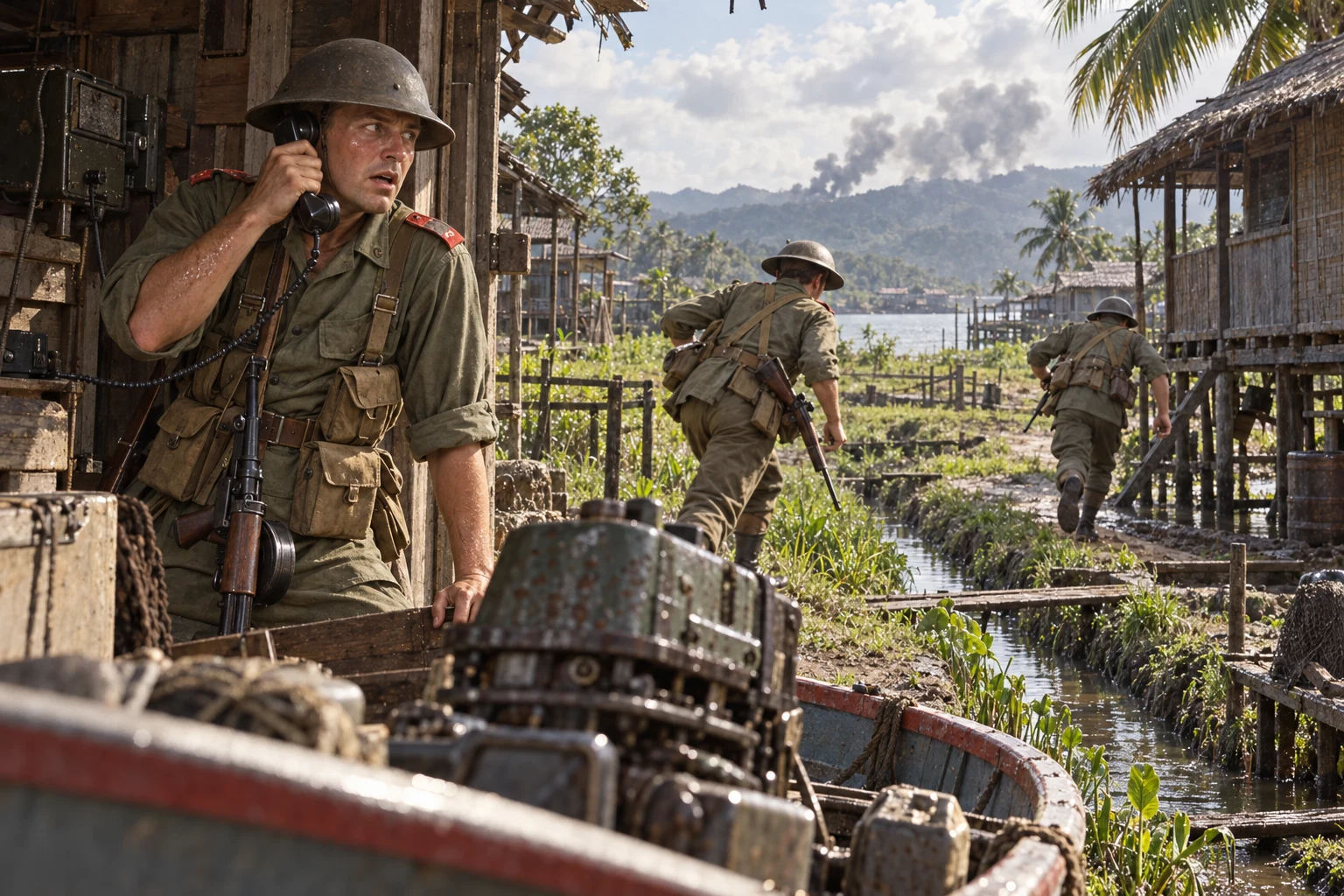
The attack opened on August 28 beneath low cloud. Kelonese infantry crossed abandoned plantation ground where drainage ditches repeatedly broke their formation. Kalanu defenders occupied the ridge's lower terraces rather than its exposed crest. Their fire stopped the leading companies, but a secondary Kelonese movement along the shore reached a deserted fishing village behind the outer position. Sergeant Mera Tal spotted the movement from a repair shed and warned Suri by a field telephone intended for harbor administration. The warning allowed a reserve platoon to occupy the inland exit before the village became a passage into the receiving district.
Fighting in the village continued until August 31. Houses built on raised foundations offered concealment but little protection from heavy fire. Kalanu Lieutenant Evin Sar moved his platoon through connected household gardens, using residents who had refused evacuation to identify passages. One family sheltered six wounded Kelonese soldiers beneath its house. Sar ordered them treated alongside his own casualties and posted a guard to prevent frightened troops from firing into the shelter. The village remained divided after three days. Men then withdrew his exposed shore detachment and concentrated on the ridge, accepting that the attempted shortcut had failed.
The landing stage under observation
Kelonese troops gained the northern crest on September 4. They could now observe parts of the landing stage whenever the cloud lifted. A coastal freighter already unloading there received two hits and settled beside the quay. Its wreck sheltered small boats but blocked the only berth deep enough for another vessel of its size. Harbor master Lena Vori redirected traffic to a gravel beach farther south. The change reduced unloading capacity and required cargo to be carried over ground exposed to rain. Food sacks burst, medical crates became waterlogged, and the defenders' survival depended increasingly on civilian labor under fire.
Suri attempted to recover the crest on September 7 with his remaining fresh company. The attack entered the first Kelonese position but stopped when supporting troops lost contact in dense vegetation. Captain Talen Mor reached a rock outcrop with forty-three men and held it through the afternoon. He requested reinforcements twice. Suri had none that could be committed without abandoning the inlet's southern approach. Mor withdrew after dark, carrying seventeen wounded. The decision preserved the company but ended the possibility of reopening the original landing stage through a quick counterattack. Suri began preparing a smaller defense around the southern beach.
The retreat plan required dismantling workshop equipment while fighting continued nearby. Sailors objected to leaving a lathe whose specialized fittings had survived every previous move. Vori allowed one extra boatload for its components, then insisted that the final workshop launch take patients and civilians. The machine's main bed remained on shore. Its absence later limited repairs, but recovering it would have displaced people already waiting on stretchers. Such choices were recorded individually in the harbor log. The document shows an institution shrinking by decisions that were each defensible and together steadily destructive of its future capacity.
The southern perimeter
Men attacked again on September 14, using the captured ridge to support pressure against the inlet road. Kalanu defenders withdrew through a school compound after demolishing the bridge used for military vehicles. Civilian foot traffic crossed a temporary walkway until the last families passed. A Kelonese patrol reached the opposite bank sooner than expected and opened fire, killing three engineers and two civilians. The walkway was abandoned rather than defended indefinitely. Suri's rear guard established itself at the next bend, where the road ran between steep banks and the enemy's ridge observers could no longer see it clearly.
The final serious assault came on September 19. Kelonese infantry reached the southern perimeter's outer houses but failed to take the beach access. Kalanu sailors fighting ashore supplied a stubborn reserve, though their loss would weaken future boat crews. Petty Officer Nera Sem led a counterattack that recovered a storehouse containing the defenders' remaining medical supplies. She was killed while helping move a wounded soldier from its entrance. The storehouse remained in Kalanu hands. Men suspended further attacks after artillery ammunition and replacement infantry failed to arrive together, leaving his new gains secure but the reduced receiving point still functioning.
Vori subsequently organized salvage of the stranded freighter’s accessible stores. Divers recovered tools and packaged provisions over several nights, while the ship itself remained a permanent obstruction until the district was recovered years later.
By September 23, Suri had lost the inlet, workshops, and northern ridge while retaining the smaller southern beach. Kalanu casualties totaled 1,283, including 344 dead; Kelonese losses totaled 1,617, including 428 dead. Registered civilian deaths were 176, and 3,904 people moved to other Allied-controlled districts. The receiving system survived at less than half its previous measured daily capacity. Kalanu's government continued fighting, and the local garrison armistice remained more than a year away. Serei's significance lay in that interval: survival remained possible, but every further month required an organization already deprived of several things that had once made survival routine.
Original illustrations for this source record
Original archive artwork and captions are preserved. Dates, labels and claims printed within inherited images belong to the previous edition; the revised text governs the current history.