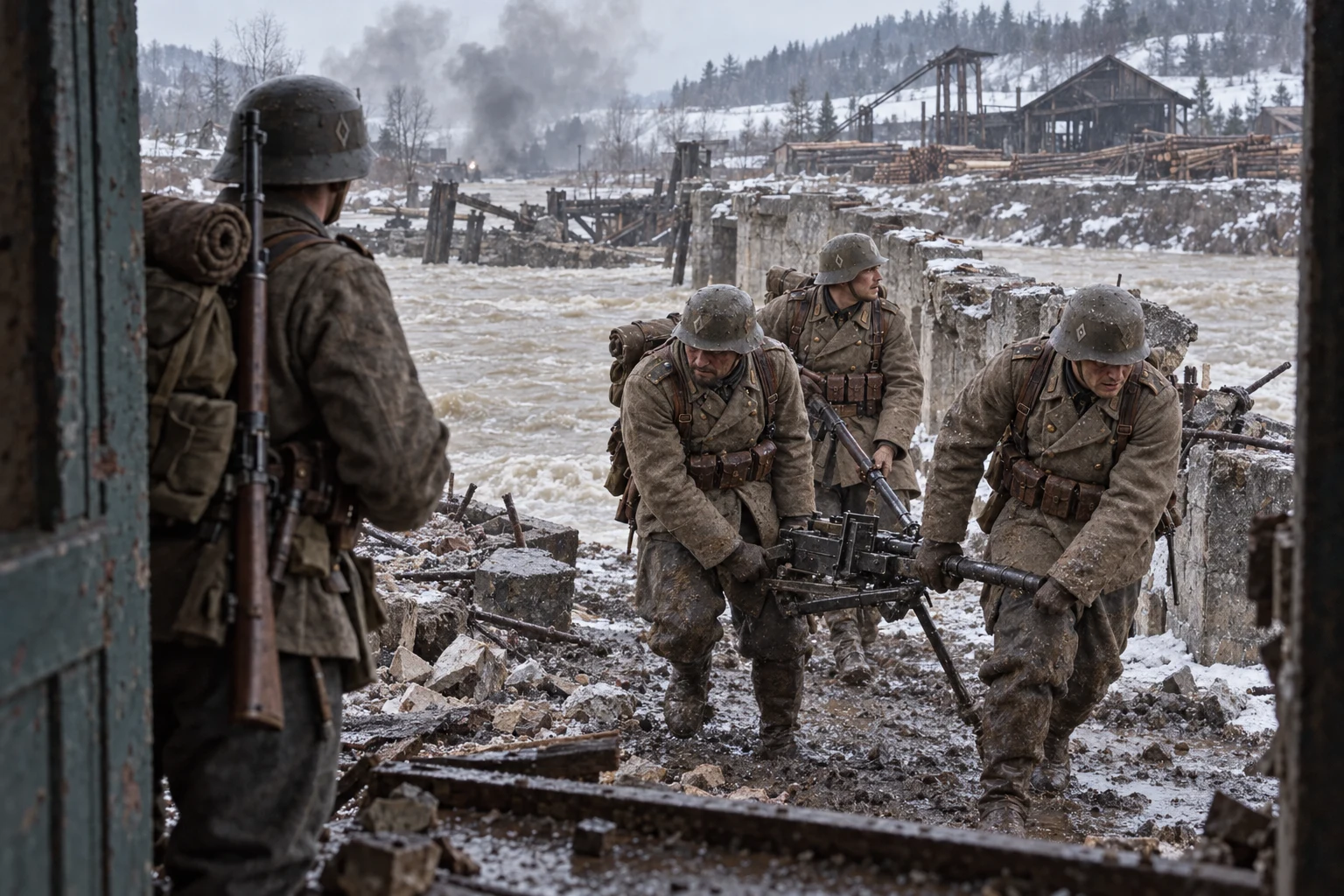
The isolated Pavren field army
April 5–June 14, 1218 · Pavren · Isolated Allied field group against Hukular containment forces
A country continuing beyond its captured capital
Pavenor had fallen in November 1217, but Pavren's remaining formations had not all surrendered with its buildings. An isolated field group held a broken district of woodland, villages, and damaged roads beyond the occupation's consolidated positions. General Merel Vant commanded 20,871 military personnel there at the beginning of April, including wounded and support troops. Recognized government representatives continued abroad, and Free Pavren formations fought outside the pocket. Vant therefore commanded an endangered army group rather than the legal existence of the nation. His decisions could bind the troops under him, but could not make Pavren an Axis state.
Hukular Lieutenant General Roven Kest controlled the containment operation. His two divisions were themselves unevenly supplied, and he preferred to reduce the pocket by separating its districts instead of assaulting every position. The first April objective was the road junction at Eren Wood, connecting Vant's northern battalions with his central hospitals. Snowmelt had swollen the small streams and made cross-country movement difficult. Kest's staff believed that cutting the junction would oblige the northern troops to surrender. Pavren officers understood the same danger and concentrated the 12th Provisional Regiment there, though it consisted of survivors from seven earlier formations.
The April battles
The attack began on April 5 with shelling that destroyed the junction's remaining bridge parapet. Hukular infantry entered the eastern village but met resistance from houses on the opposite bank. Pavren Major Taren Vell organized the defense around the school and a sawmill. His soldiers used ammunition from several batches, some badly deteriorated during winter storage. Two machine guns failed before noon. Vell redistributed their crews as riflemen and retained the school until darkness. The sawmill fell after a fire forced its defenders outside. The bridge remained contested, which prevented Kest from sending vehicles directly into the pocket's central district.
Vant ordered a northern withdrawal on April 8. The movement saved most of the threatened battalions but abandoned a hospital containing 214 patients too seriously wounded to travel. Doctor Selma Ran stayed with seventeen medical personnel and sent a marked delegation to the Hukular commander. The hospital was taken intact on April 9, and its patients entered captivity. Several later accounts described the episode as a successful evacuation because the patients survived the battle. Ran rejected that wording after the war. Their survival depended on surrender and subsequent treatment, not on an escape that had never occurred.
Kest resumed pressure farther south on April 17, taking two agricultural depots and reducing the field group's food reserve. Pavren civilians had already surrendered much of their stored grain to communal distribution. Vant prohibited further military requisition without civil approval, knowing that hungry soldiers would find the order difficult to obey. Captain Nera Vol, assigned to investigate theft, discovered one infantry company sharing stolen flour with the village from which it had supposedly been taken. The incident complicated disciplinary categories without eliminating the problem. Hunger was turning every dispute about ownership into a dispute about whose survival the army protected.
The attempted movement west
In early May, Vant explored a breakout toward surviving Allied positions. Reconnaissance parties reported defended roads and exhausted villages between the pocket and any dependable reception area. The proposed movement would have required thousands of wounded and civilians to remain behind. On May 6, a reinforced battalion tested the western approaches at Meren Hollow. It penetrated an outer Hukular post but could not cross the next defended ridge. Lieutenant Irena Kes brought back a sketch showing a new gun position absent from earlier reports. Her battalion returned with 183 casualties and no route capable of carrying the field group.
The failure did not immediately end resistance. Vant retained several defensible ridges and hoped that operations outside the pocket might alter the situation. His radio section maintained intermittent contact with the recognized Pavren command abroad. Those exchanges made clear that no relief operation was imminent. Haren Vol, now associated with Free Pavren outside the pocket, urged preservation of trained personnel where possible but did not order a national surrender. Vant's surviving staff later described these messages as both necessary and devastating. They preserved the distinction between the army's predicament and the nation's cause while removing the expectation of timely rescue.
Kest attacked the central ridge on May 23. Pavren troops held its crest for two days, then withdrew when their flank position fell. The retreat brought the front within artillery range of Vant's principal casualty station. Ran's earlier surrender arrangements provided a precedent for negotiating medical protection, but artillery fire continued elsewhere. On May 28, a shell struck a village bakery serving both soldiers and civilians, killing forty-one people. The dead included two bakers whose names appeared on the army's essential-worker exemptions. The documents had protected them from conscription, not from the narrowing battlefield around their ovens.
A field armistice
Vant opened negotiations on June 3 after his medical chief reported that ordinary dressings were nearly exhausted. Kest demanded the surrender of weapons and military stores, registration of personnel, and cessation of resistance within the pocket. Vant demanded explicit exclusion of the Pavren government and formations elsewhere from the agreement. After eleven days of exchanges, the instrument signed on June 14 applied to the isolated field group alone. It provided access for medical inspection and identified protected treatment facilities. Its terms were harsh, but they did not pretend that a surrounded commander possessed constitutional authority over an entire nation.
Kest assigned separate registration teams to the medical facilities. Their records allowed Ran to track patients transferred between hospitals, and later enabled relatives abroad to learn that men reported missing in April remained alive in captivity.
By the armistice, 19,842 military personnel were in captivity, including 4,116 patients already in organized medical care. Those patients included 1,387 people wounded or sick before April and 2,729 wounded during the final campaign. The April–June fighting had caused 3,758 military casualties in Vant's group, including 1,029 dead; captured wounded appear in both medical descriptions but only once in the personnel accounting. Hukular losses totaled 2,604. Civilians remained under occupation rather than becoming prisoners of war. Vant survived captivity and testified after liberation. His account made no claim that surrender was victory. It explained why further resistance had ceased locally while the government, Free Pavren formations, and their national allegiance continued beyond the closed roads of the pocket.
Original illustrations for this source record
Original archive artwork and captions are preserved. Dates, labels and claims printed within inherited images belong to the previous edition; the revised text governs the current history.