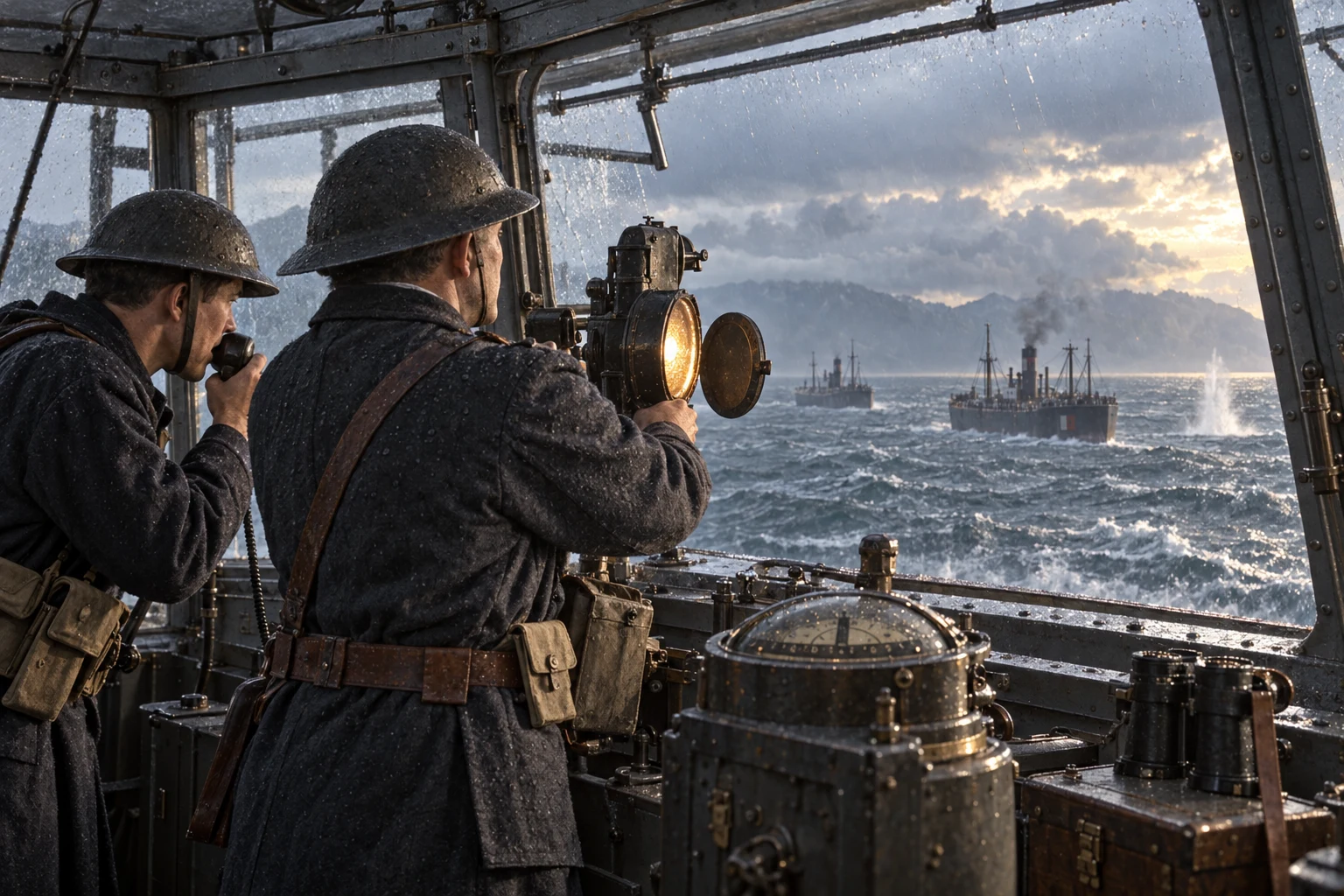
The Kalanu receiving convoy
August 4–10, 1217 · Grand Isles · Kalanu and Motari escorts against Kelonese naval forces
Ships expected at an exhausted coast
Convoy Kelm Seven approached Kalanu with twelve merchant ships carrying grain, medical stores, machinery, and replacements drawn from its own returning personnel. The escort consisted of Kalanu's light cruiser Sela, three destroyers, and two Motari patrol sloops. Commodore Ilan Reme commanded from Sela. His instructions prioritized arrival at the receiving coast over engagement with any enemy force encountered. Kalanu could replace neither its cargoes nor its trained dock workers quickly. A convoy that fought impressively but turned away would leave the garrison facing the same shortage. The ships sailed under Allied arrangements; no Silvian warship or military observer participated.
Kelonese Vice Admiral Hatsu Ren directed the interception from a regional naval headquarters. He assigned aircraft from the carrier Arisen and a surface group built around the cruiser Natori. Ren lacked a reliable position for the convoy until a reconnaissance aircraft sighted smoke on August 4. Its report overestimated the number of escorts and misidentified Sela as a heavier cruiser. This error delayed Natori's approach while Arisen launched an initial strike. Reme received warning from a merchant lookout whose first report was dismissed as an unusually large seabird flock. The correction arrived with enough time to close the convoy's formation.
The first attack
The attack on August 5 began in broken cloud. Kelonese aircraft approached in separate groups, their coordination disrupted by differing estimates of the convoy's course. The merchant vessel Evin Coast was struck first. Fire spread through cargo stacked near its forward hatch, and Captain Mara Len ordered the ship out of the convoy line to avoid colliding with its neighbor. The Motari sloop Hara moved alongside despite falling debris. Its crew removed ninety-six people before a second explosion made continued rescue impossible. Thirty-eight were missing; twenty-nine were later confirmed dead, while nine survived in a boat recovered the following morning.
Sela suffered damage to its after steering position, forcing Reme to transfer some control functions to a secondary station. A destroyer mistakenly interpreted its turn as an order to reverse the convoy's course and began leading two merchants away. Reme's flag lieutenant corrected the movement by signal lamp after the radio circuit became congested. The incident lasted minutes but opened a gap in the protective screen. A Kelonese aircraft attacked through it and hit the grain carrier Toval. Toval remained afloat, reduced speed, and became the convoy's limiting vessel. Its captain refused an initial suggestion that the cargo be abandoned.
Reme chose to detach a destroyer with Toval while keeping the main convoy moving. He knew that dividing the escort created another vulnerability, but ordering the entire formation to match the damaged ship's speed would expose every cargo for longer. The destroyer Mira escorted Toval toward a secondary receiving point already controlled by Kalanu. The route did not pass through neutral facilities. Local harbor officials initially protested that they lacked cranes for the cargo. Their protest ended when the wounded began arriving in the ship's boats. Unloading would take days, but the grain had reached a coast where it could feed people.
The surface threat
Natori's group approached during the night of August 6. Its commander, Captain Renji Sato, expected to encounter the diminished escort before the convoy reached coastal protection. Rain squalls and conflicting reconnaissance reports placed his ships farther from the convoy than intended. The first contact occurred between Natori's destroyer Akase and the Kalanu destroyer Venn. Both ships opened fire after a brief interval of uncertain identification. Venn received three hits, including one that disabled its forward gun. Its captain, Lera Sen, turned away while reporting the enemy's position. That warning allowed Reme to move the merchants toward the receiving coast.
Sela and the remaining destroyers engaged long enough to prevent Sato from closing without opposition. The action was confused and brief. Natori took a hit near its aircraft-handling deck; Sela lost its main rangefinding position. Neither cruiser sank, and neither force achieved the decisive engagement its later public reports implied. Sato withdrew before dawn when coastal aircraft appeared, unwilling to risk his damaged ship against an uncertain number of defenders. Reme did not pursue. His cruiser had accomplished its immediate purpose by keeping the attacking force occupied while the merchant captains continued toward harbor under instructions they could execute independently.
Arrival under fire
The surviving main convoy reached Kalanu on August 8. Entry took longer than expected because wreckage from an earlier raid narrowed the channel. Harbor pilot Nema Varen boarded the largest freighter from a launch whose engine repeatedly stalled. She guided it past the obstruction while shore batteries fired at another approaching air formation. Several merchant sailors assumed the batteries were signaling that entry had been canceled and prepared to anchor. Varen ordered the bridge to continue. Stopping in the channel would block every vessel behind them. The freighter reached its berth with shell fragments embedded in its upper works.
A final Kelonese air attack on August 9 damaged two dock cranes and the merchant ship Belan Star. Dock workers continued unloading by smaller derricks and manual handling. Kalanu soldiers carried ammunition directly from quay to trucks while civilians formed separate teams for food sacks, a division intended to prevent military cargo from consuming all available labor. Reme protested when wounded naval personnel were delayed behind cargo movements. The harbor authority assigned a dedicated landing stage for casualties. The argument illustrated the convoy's predicament: arrival concentrated several urgent needs in a place whose capacity had already been reduced by years of attack.
By August 10, ten ships had reached the main harbor, Toval was unloading at the secondary point, and Evin Coast alone had been lost. Escort and merchant casualties totaled 214 dead and 386 wounded; Kelonese losses were 146 dead or missing presumed dead and 203 wounded, with nineteen aircraft lost. The cargo prevented an immediate ration reduction and restored several repair functions. It did not reverse Kalanu's deteriorating position. Sela required months of repair, Venn was unavailable for six weeks, and the next convoy would sail with fewer experienced escorts. The battle preserved a receiving system by consuming strength needed to preserve it again.
Len returned to sea after six weeks ashore. She requested another merchant command because the surviving crew had already volunteered to sail together, making separation seem a second loss.
Original illustrations for this source record
Original archive artwork and captions are preserved. Dates, labels and claims printed within inherited images belong to the previous edition; the revised text governs the current history.