Handistan’s exposed belt
April 9–30, 1217 · Gaften · Handistani 11th Division against Jazimi and Ruuyaqi coalition forces
Settlements beyond the defensible line
The exposed Handistani belt comprised farming settlements and transport stations connected to the contested eastern approaches. Its military value came from the roads crossing it, while its inhabitants valued fields, wells, shrines, and homes that maps reduced to symbols. General Nalin Shah commanded the Handistani 11th Division there. His three regiments were under strength, and the outermost battalions depended on routes threatened from more than one direction. Ruuyaqi-supported forces reached the sector through the existing Jazimi and contested Qarimi system. They had not crossed an imaginary common frontier between Ruuyaq and Handistan, and their access remained dependent on holding those approaches.
The Axis field group was commanded by Jazimi General Hamid Resh. Its main infantry came from Jazim's 9th Division, supported by Ruuyaqi artillery and the Ruuyaqi 31st Motor Battalion. Resh's immediate objective was the settlement belt around Darun Wells, not the destruction of the Handistani army. He intended to take the outer road stations in sequence and force Shah to abandon the agricultural district before his troops were cut off. The method required repeated short battles. It also allowed Resh to stop whenever his artillery and transport fell behind, an important limitation in terrain whose apparent openness concealed poor cross-country movement.
The first settlements
Shelling began on April 9 at Harun Station, the northernmost defended road point. Handistani Captain Leha Ban's company occupied a grain cooperative and adjacent houses. The buildings withstood the initial bombardment, but a fire in the cooperative's storage wing forced soldiers and civilians into the same courtyard. Ban divided her remaining troops between the perimeter and firefighting. When Jazimi infantry entered the eastern street, they encountered a defense already fragmented by the effort to save people trapped beneath the roof. Harun fell that evening. Ban withdrew with ninety-four soldiers and 163 civilians, leaving thirty-seven wounded under a volunteer medical orderly's care.
Shah ordered the neighboring position at Senat Orchard reinforced, hoping to prevent the loss of one settlement from opening the whole belt. The reinforcement arrived on April 11 after a circuitous night movement. Its commander, Major Ishan Val, found that refugees had already occupied the intended reserve buildings. Rather than evict them into the shelling, he established his command post in an irrigation office. That decision complicated communications but preserved a civilian shelter. Resh attacked Senat on April 13, using the Ruuyaqi motor battalion to threaten the road beyond it while Jazimi infantry pressed into the orchards.
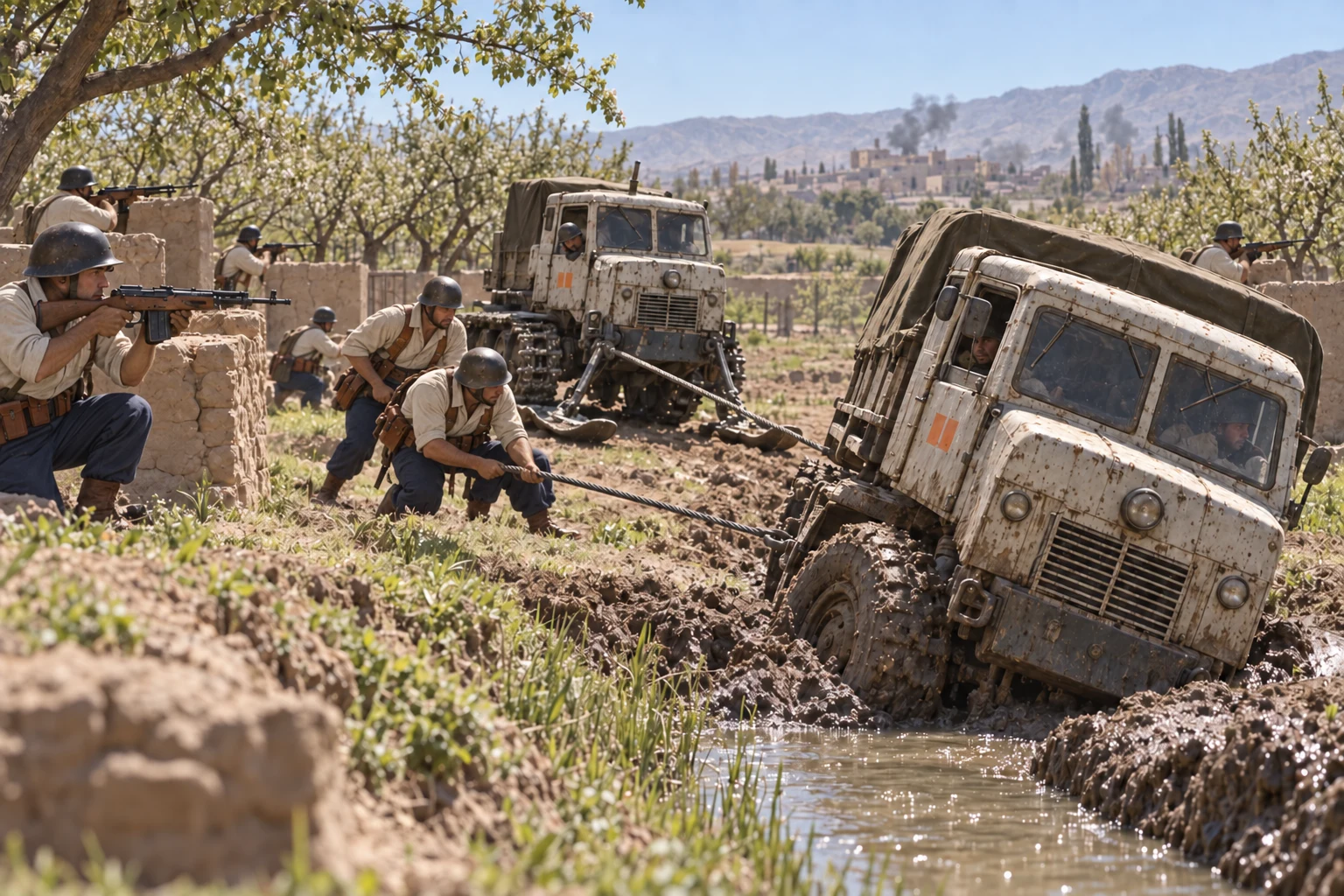
The motor battalion gained less than its reputation promised. Vehicles bogged down where irrigation channels crossed the apparently firm fields, and Handistani defenders used garden walls to remain concealed until the accompanying infantry approached. Ruuyaqi Lieutenant Saren Qad lost two vehicles before withdrawing to the road. His report blamed inaccurate terrain information rather than enemy armor, which was absent. The failure bought Shah two days. It did not restore the northern position or remove the threat to the belt. Resh redirected the battalion toward transport protection and continued the infantry battle, accepting slower progress instead of repeating an unsuitable maneuver.
Civilians and the withdrawal decision
On April 16, Shah requested permission to abandon the exposed belt. The regional government initially refused because the proposed line left seven inhabited settlements outside protection. Civil commissioner Amira Sen visited the divisional headquarters and asked whether additional troops could hold them. Shah answered that reinforcements might delay the outcome but would themselves require the same threatened roads. Sen authorized evacuation preparations while seeking formal approval for withdrawal. The resulting two-day interval was costly. Families received warnings before transport was available, and roads filled with carts whose owners feared that obeying the instruction later would mean being left behind.
Huqaiti assistance arrived on April 18 in the form of transport companies, medical teams, and one infantry battalion assigned to protect the receiving district. It did not replace the Handistani division at the front. Trenoan supplies enabled the evacuation organization to issue food beyond the existing military ration system, while Syran medical stores replenished the casualty stations. These coalition contributions were visible in the movement's survival rather than in a dramatic counterattack. The newly arrived Huqaiti battalion escorted civilians through the western road junction and resisted demands that it abandon that task to recover a settlement already being evacuated.
Senat Orchard fell on April 21 after a dawn attack separated Val's forward companies. One company escaped through irrigation plots with local farmers as guides; another surrendered around the village clinic. Val withdrew after learning that the northern road was closed. He later faced criticism for leaving before receiving a written divisional order. Shah endorsed his action, explaining that the order had been transmitted twice over failed communications and that waiting would have trapped the entire battalion. The inquiry preserved testimony from civilians who saw the withdrawal, preventing the official account from becoming solely a dispute among surviving officers.
Darun Wells
The final rear-guard battle occurred at Darun Wells from April 25 to 28. The position covered two roads joining west of the exposed belt. Lieutenant Colonel Nema Aran held it with composite companies from the 11th Division and a small engineer detachment. Resh attacked cautiously, recognizing that the withdrawal had shortened Handistani communications. His troops took the eastern wells but failed to seize the western junction before darkness on April 27. Aran used the interval to move the last organized civilian convoy. Engineers then disabled the military storage facilities while leaving the surviving civilian wells usable, a distinction specifically recorded in Shah's orders.
The rear guard withdrew on April 30. Handistan lost the belt but retained the division and a coherent shorter front. Military casualties totaled 2,093 for Handistan and supporting personnel, against 2,417 in Resh's coalition group. Registered civilian deaths reached 318; 11,406 displaced residents arrived in Allied-controlled reception districts. The figures did not include every household that moved independently. Resh gained roads and agricultural land, yet inherited damaged stations and inhabitants whose cooperation could not be ordered into existence. Shah's report called the withdrawal necessary. Sen accepted that judgment while listing, settlement by settlement, the property and people necessity had failed to protect.
The retained wells sustained several occupied villages during the following dry weeks. Their preservation became one of the few decisions both military reports and returning civilian witnesses praised without qualification.
Original illustrations for this source record
Original archive artwork and captions are preserved. Dates, labels and claims printed within inherited images belong to the previous edition; the revised text governs the current history.