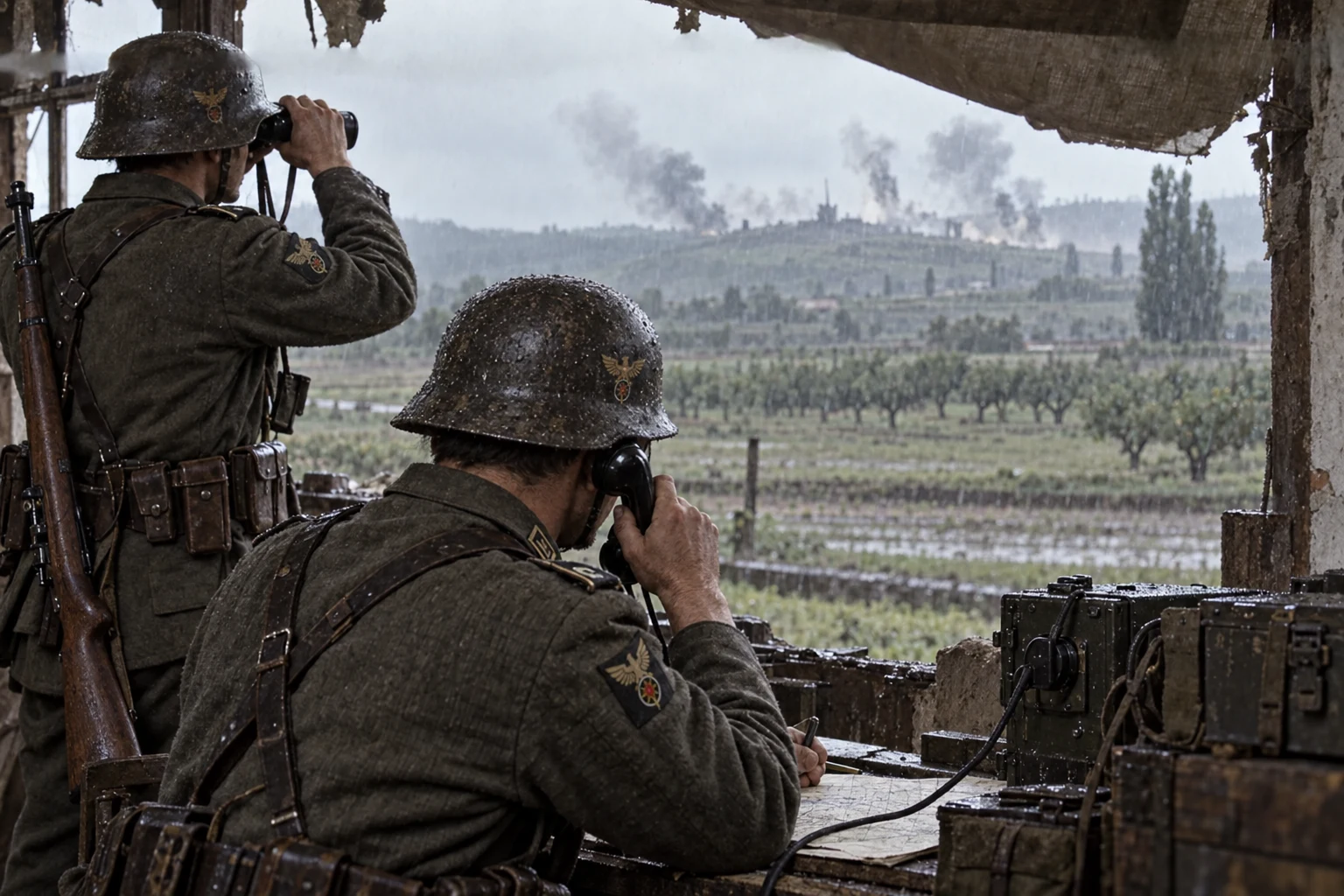
The failed relief of Pavren
June 4–July 2, 1217 · Pavren · Allied relief group against Hukular blocking formations
A corridor sought
The relief offensive begun on June 4 sought to reopen reliable access to Pavren's threatened field formations after the secondary railway was severed. It did not aim to recover the whole occupied country. Hestunian General Varen Hel commanded a temporary group comprising the Hestunian 18th Division, Pavren's battered 9th Division, and the Haveran 6th Brigade. Their immediate objectives were the roads west of Leren Cut and a ridge overlooking the nearest surviving unloading area. Pavren's government in Pavenor requested an early attack. Its urgency was understandable: waiting improved Allied preparation while allowing the trapped districts to consume their remaining reserves.
Hel rejected a direct assault through the railway cut, where Hukular observers could see nearly every approach. He selected the low ridge at Narel Farm, hoping that its capture would make the railway position untenable. The plan required the Hestunians to take the ridge while Pavren troops attacked adjacent ground and the Haverans protected the southern flank. Hukular General Rendal Ost, whose 62nd Division held the captured district, expected such an operation. His infantry had suffered heavily in May, but new defensive work and a supporting regiment from the 44th Division gave him enough strength to contest the approaches.
The first week
The opening bombardment on June 4 struck several Hukular forward positions but failed to suppress guns beyond the ridge. Hestunian infantry crossed the initial fields and occupied Narel Farm's ruined outer buildings. Their advance stopped at a sunken lane where the terrain concealed surviving defenders. Captain Jora Vel's company entered the dairy and discovered that a cellar connected it to a house still held by Hukular troops. Fighting inside the passage lasted nearly two hours. Vel finally sealed the connecting door and withdrew the wounded through a window, retaining the dairy while leaving its neighboring house in enemy hands.
Pavren's attack farther north gained an abandoned orchard but met stronger resistance near the railway cottages. Many soldiers of the 9th Division recognized houses they had defended weeks earlier. Familiarity helped them find covered routes but also encouraged assumptions about entrances and walls altered since the retreat. A platoon attempted to enter a cottage through a former doorway that had been blocked with masonry. Fire from the adjoining garden pinned it against the wall. Sergeant Iven Tor led eight survivors out through an animal enclosure. His account became important evidence that local knowledge could become dangerous when treated as current intelligence.
By June 8, Hel possessed a shallow salient with too little room for dependable relief of its forward battalions. Rain made its single supporting track difficult for wheeled transport. The Haveran brigade widened the southern approach at considerable cost, taking a millpond embankment whose significance was chiefly that stretchers could now travel behind it. Major Sena Har, the brigade's medical officer, opened a dressing station in the mill's surviving stone room. Water entered through shell holes, and the staff stood on flour sacks while treating casualties. The station handled 391 wounded during its first forty-eight hours, including thirty-six Hukular prisoners.
The pause that did not restore strength
Hel suspended major attacks on June 11 to replenish ammunition and reorganize the crowded salient. Pavren officials feared that a pause would become abandonment. First Minister Irena Valt sent a representative who asked the general to distinguish military impossibility from unwillingness to bear further losses. Hel showed him the casualty returns and the routes available for another attack. The exchange produced no easy reconciliation. Valt's government accepted a renewed effort on June 18, but the debate exposed the coalition's problem: a stronger partner could decide that an operation was unaffordable while the threatened nation had no affordable alternative.
Ost used the same interval to rotate two Hukular battalions and repair his observation network. His engineers converted a wrecked agricultural store into a protected command post, allowing the division to maintain contact during renewed shelling. On June 16, a local counterattack recovered part of the orchard held by Pavren troops. The ground was small, but its loss narrowed the Allied salient and forced another change in the proposed attack. Hel retained the date while reducing the objective. Instead of forcing Ost from the railway district, the renewed offensive would first capture the ridge's lower northern spur.
The June 18 assault briefly succeeded. Hestunian troops reached the spur, and a Pavren company advanced far enough to see the railway embankment through breaks in the trees. Then Hukular artillery struck the routes behind them. Reinforcements arrived in scattered groups, unable to determine which officer controlled the new position. Lieutenant Mara Jen, commanding the leading Hestunian platoon after her captain fell, held the spur until the following morning. When ordered back, she brought out seventy-two men from three different units. Twenty-one wounded who could not be moved remained with two volunteers and were subsequently captured.
The end of the attempt
During the final ten days, Hel's troops fought chiefly to retain usable exits from their own salient. The Haveran brigade withdrew from the millpond on June 25 after engineers completed a less exposed track. Pavren soldiers covered the removal of the medical station, carrying patients past fields where they had expected to be advancing. Hukular attacks on June 27 and 29 failed to trap the rear guard. These local defensive successes prevented a worse outcome but did not alter the offensive's result. On July 2, Allied headquarters ended the relief attempt and adopted a shortened line west of its original objective.
The attacking group recorded 5,608 casualties, including 1,417 dead, 3,702 wounded, and 489 captured or missing later confirmed prisoners. Hukular losses in the relief sector totaled 4,126, including 1,091 dead. These figures exclude the earlier railway battle. The corridor remained closed, although small road movements still reached threatened districts under increasingly difficult conditions. Pavenor survived until November, and its continued resistance mattered; the July defeat was not its immediate fall. For soldiers at Narel Farm, the result was immediate. They had spent a month trying to reopen a country's movement and ended by defending the road required for their own withdrawal.
The failed offensive also delayed harvest work behind the new line, where military traffic occupied farm lanes during the first available dry interval.
Har retained the mill's casualty register after its roof collapsed. The water-stained pages identified nineteen men previously listed only by the formations that had carried them there.
Original illustrations for this source record
Original archive artwork and captions are preserved. Dates, labels and claims printed within inherited images belong to the previous edition; the revised text governs the current history.