The severed secondary railway
May 6–21, 1217 · Pavren · Pavren 9th Division against Hukular 62nd Division
The line that still connected the front
The secondary railway through Leren Cut had become more important after earlier losses displaced traffic from Pavren's eastern yards. It was a modest line, with steep grades and short passing loops, but it allowed trains to reach the surviving front without entering the most exposed junctions. General Soren Kast selected its interruption as the objective of the May offensive. Capturing the entire western district was unnecessary. If Hukular troops could hold the cut and its adjoining heights, Pavren would have to send military supplies onto roads already carrying refugees. The railway's small capacity concealed its considerable importance as an alternative.
Pavren's 9th Division, commanded by Colonel Haren Vol in an acting divisional appointment, defended the Leren sector. Vol had six effective infantry battalions, two reduced battalions performing local security, and artillery whose ammunition allotment was being rationed. Railway superintendent Anja Terv had warned that the line could not tolerate repeated interruptions at the cut. Vol agreed but lacked troops to occupy every slope. He concentrated the 26th Regiment on the northern shoulder and used the 27th to cover the station settlement. The southern limestone workings were watched by a company and local railway guards, an economy that Hukular reconnaissance identified during late April.
May 6–10
Hukular's 62nd Division opened its attack on May 6. General Rendal Ost used the 184th Regiment to engage the northern shoulder while the 185th moved against the limestone workings. A morning mist delayed both forces. When visibility improved, Pavren observers saw the southern movement and brought artillery onto the exposed quarry road. The fire broke up the leading battalion, killing its commander. Ost did not replace the failed attack with an immediate second wave. He allowed the regiment to occupy sheltered hollows and brought forward light guns overnight, preserving enough strength to resume the operation the following day.
The quarry defense turned on a workers' incline running beneath the southern observation post. Pavren troops had blocked its upper entrance but had not occupied a side gallery because civilian engineers considered it unstable. Hukular Sergeant Darven Il found the opening while searching for shelter from artillery. His platoon passed through and emerged behind the post on May 8. The gallery partially collapsed afterward, trapping eleven men. The attackers who reached the surface seized the observation hut, but their success was narrower than later propaganda suggested. They possessed one crest and had no secure route for bringing supporting equipment forward.
Vol committed his divisional reserve on May 9. Captain Neva Sorn's company reached the hut's lower terraces and recovered several wounded Pavren soldiers left during the first withdrawal. The company could not regain the summit. Its supporting artillery fired late because a message described the target using a quarry workers' name absent from the military map. Sorn halted rather than advance into uncertain fire. Hukular troops reinforced the summit that evening. The incident produced a sharp dispute inside Vol's headquarters: the reserve had failed to restore the position, but its restraint had prevented a second and entirely avoidable disaster.
The railway under observation
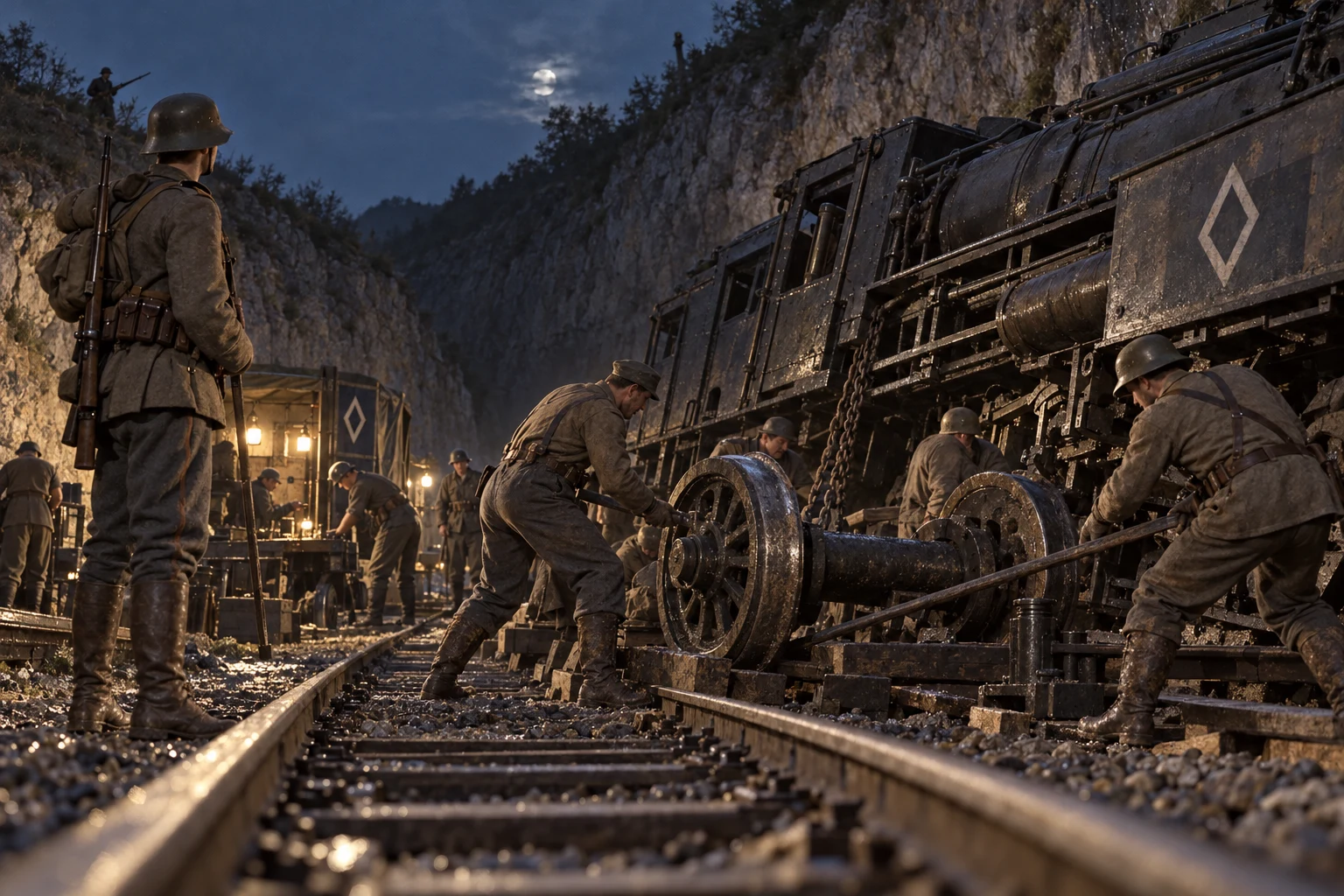
Once Hukular observers occupied the quarry crest, movement through Leren Cut became visible during clear weather. Trains continued at night. Drivers extinguished unnecessary lights and accepted delays while track gangs inspected newly damaged stretches. On May 12, a locomotive struck wreckage near the eastern mouth and derailed without overturning. Terv personally organized the removal effort, using railway workers and infantry labor. They cleared a single track before dawn. The first train through carried artillery ammunition; the second carried wounded westward. Both crews later recalled hearing rifle fire from the northern shoulder, where the infantry battle had continued throughout the repairs.
Ost shifted pressure to that northern shoulder on May 14. Pavren's 26th Regiment held two orchard villages but had lost the ground between them. Company commanders improvised a line through garden walls and a disused brick kiln. The arrangement delayed Hukular infantry yet made communication difficult. A runner could travel two hundred meters and encounter the enemy without leaving what headquarters still marked as friendly ground. Vol ordered the forward village abandoned on May 16. Civilians who had stayed were gathered in the school courtyard and escorted toward the station before the troops withdrew. Forty-seven elderly residents refused evacuation and remained.
Hestunian reinforcements reached the western end of the sector on May 17, too late to restore the original position. Their commander, Brigadier Coren Hal, proposed using them to protect an alternate unloading point rather than immediately assault the quarry. Vol accepted after consulting Pavren's army headquarters. The decision offended politicians who believed that the arrival of fresh troops must lead directly to a counterattack. In military terms, however, the railway was already becoming unusable. Establishing a defensible receiving point could preserve the army's capacity to fight after the cut was lost. Retaking it without securing the rear might accomplish little.
May 21
The final train crossed Leren Cut shortly after midnight on May 20. It brought out 286 wounded and the last portable signaling equipment. Terv stayed with the railway demolition party until the withdrawal order reached her. On May 21, Hukular troops occupied both mouths of the cut and the station settlement. Vol's rear guard fought from the western cottages until midmorning, then withdrew under smoke from burning railway stores. One platoon missed the agreed route and surrendered after finding its path blocked. The forty-seven civilians who had refused evacuation were registered by the occupying authorities; forty-four survived to liberation.
Pavren and its Hestunian supporting troops suffered 1,734 battle casualties, including 463 dead and 209 captured. Hukular's recorded losses were 2,011, including 516 dead. Neither total made the railway usable to its captors immediately. The decisive effect was denial: Pavren's remaining army had lost another means of shifting men and supplies when threatened. Pavenor remained in Allied hands, and the front had not collapsed. Yet every wagon diverted to the roads displaced some other movement. The failed relief campaign that followed in June would begin with this restriction already imposed, making Leren Cut a victory whose consequences extended beyond its modest length.
Vol attached Terv’s railway report to his own assessment, preserving an independent account of which movements had actually occurred.
Terv carried the station's brass working timetable west. Its empty spaces recorded trains canceled before their crews ever received orders to move.
Original illustrations for this source record
Original archive artwork and captions are preserved. Dates, labels and claims printed within inherited images belong to the previous edition; the revised text governs the current history.