Qarim’s first open battle
February 2–19, 1216 · Gaften · Qarimi and Handistani forces against Jazimi troops with Ruuyaqi support
The road at Sahran
Qarim entered open fighting on February 2 at the Sahran road district, where warehouses and irrigated plots bordered the eastern approaches used by the Axis coalition. Jazim had become an open Axis belligerent on January 24. Its army now moved under its own colors rather than presenting armed detachments as escorts for commercial traffic. The Ruuyaqi contribution consisted of artillery advisers, communications personnel, and two motorized battalions operating through agreed Jazimi facilities. No direct Ruuyaq–Handistan frontier existed. Qarim's road network and the contested approaches between allied territories determined where these formations could actually fight.
Colonel Samira Vaq commanded Qarim's 8th Frontier Brigade. Her three battalions had trained chiefly for border security and had fewer heavy weapons than their wartime designation suggested. A Handistani liaison group accompanied the brigade, followed by the 22nd Support Battalion carrying medical equipment and ammunition already contracted by Qarim. Vaq positioned her strongest companies around Sahran's pumping station, because possession of the road without its water supply would produce an encampment rather than a useful staging district. Civil administrator Halem Suri began moving families from the exposed eastern gardens. Many refused until shell fragments struck the market roof.
A belligerency announced by guns
The first Jazimi attack began shortly after sunrise on February 2. Colonel Rashid Tam's 17th Regiment advanced along two existing tracks, expecting Qarimi posts to withdraw once their flanks were threatened. Instead, the frontier brigade held the customs houses and broke the leading companies into small groups. A Jazimi armored car reached the market square but reversed when its supporting infantry failed to appear. Qarimi defenders damaged it near the eastern gate; its crew escaped into a drainage ditch. That modest episode became an inflated public story about the destruction of an armored column, although only three vehicles had approached.
Vaq's actual concern was the southern orchard belt. Its irrigation banks concealed movement, and local guides warned that a dry secondary channel connected the Jazimi approach with the pumping station's service road. On February 4, she transferred her reserve company there. The decision frustrated a renewed attack but weakened the customs-house defense. Tam accepted this exchange and brought forward a Ruuyaqi artillery observation team. Shelling on February 5 collapsed the customs office and buried its surviving telephone equipment. Twenty-six defenders were killed or trapped. The others crossed the exposed yard in pairs, carrying the wounded on doors pulled from adjacent houses.
Tam's regiment occupied the customs district on February 6. He then discovered that civilian evacuation had removed most usable transport and that the pumping station still lay under Qarimi protection. His soldiers possessed roofs but lacked sufficient clean water for a prolonged concentration. The Ruuyaqi liaison officer, Major Varen Qal, urged immediate exploitation toward the pumps. Tam refused to send tired companies across ground that had already stopped the first attack. Their disagreement survived in both officers' reports. It concerned the pace of an offensive, not a rupture between their governments, and was settled when additional Jazimi troops arrived.
The pumping station
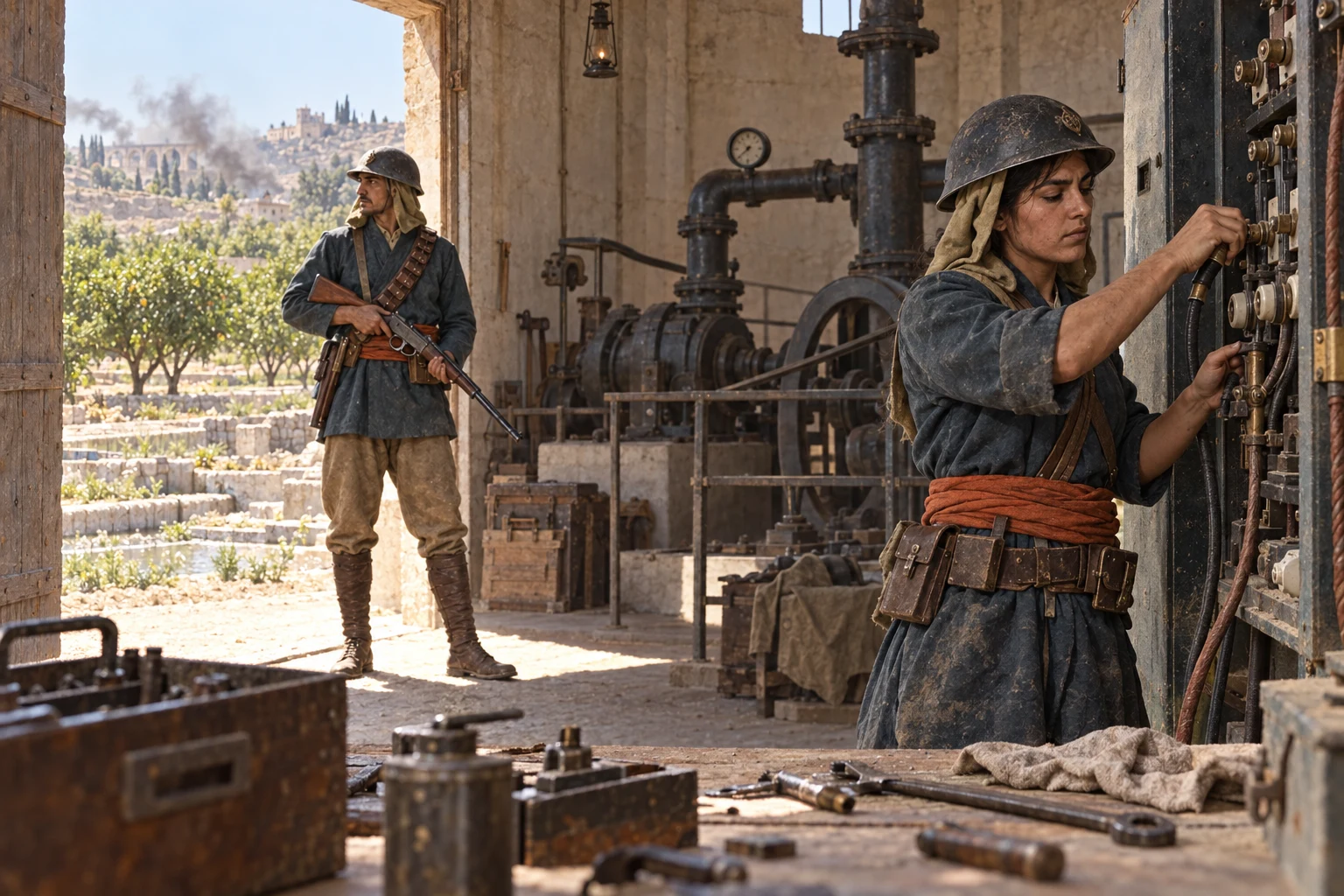
The reinforced assault began on February 9 during a hot wind that carried grit across the irrigated fields. Qarimi machine-gun crews repeatedly cleared sand from their weapons. Jazimi infantry reached the outer pump buildings in the late afternoon and fought through the maintenance court. Corporal Nima Sar, an apprentice electrician serving with the defenders, kept one auxiliary pump running after the main switchboard was damaged. Her work maintained water in the western distribution tank, allowing both soldiers and civilians to remain through the next day. She received a military citation; two civilian mechanics who helped her were recognized separately.
The Handistani support battalion had not been intended for an assault role. When Jazimi troops entered the maintenance court, its commander, Major Jalen Mir, committed one security company to help restore the perimeter. Qarimi soldiers knew the buildings but had lost several section leaders. Handistani troops supplied fresh bodies and a working radio. Together they recovered the turbine annex on February 10, capturing nineteen isolated attackers. They could not recover the eastern yard. Vaq accepted a divided position rather than spend her last reserve attempting to make the installation look intact on a map. Water distribution continued through patched connections.
Civilian conditions worsened faster than either army's reports recorded. The remaining inhabitants occupied schoolrooms west of the station, where the roof provided shade but little protection. Suri organized separate queues for drinking water and washing, then suspended washing when a shell ruptured the reserve tank. A convoy from the safer western districts arrived on February 12 with food and canvas containers. Its drivers returned carrying 417 civilians and seventy-one wounded soldiers. Those movements occurred on roads controlled by Qarim and its consenting partners. The convoy's survival did not imply access through neighboring neutral territory or an unlimited regional transport corridor.
A line accepted
Tam attempted a final attack on February 15, using his fresh battalion against the station's northern wall. The approach gained the filter sheds but exposed the attackers to fire from Qarimi positions beyond the immediate compound. By evening, the battalion had lost its commander and could not coordinate further movement. Vaq ordered a short counterattack after dark. It recovered the sheds and left the eastern yard in Jazimi hands. Both commands then recognized that their troops needed relief. Negotiations through medical officers produced a four-hour recovery interval on February 17; it was local, supervised, and did not suspend hostilities elsewhere.
The two mechanics cited with Sar were brothers, Eren and Tavin Suri. Both returned to civilian operation of the surviving pumps, declining army enlistment because their technical work remained necessary to the displaced population.
By February 19, the front had settled west of the customs district and east of the operational pumps. Qarim had lost ground in its first open battle while retaining the installation that sustained its defense. Qarimi and Handistani losses totaled 612 killed, wounded, and captured; Jazimi and attached Ruuyaqi losses totaled 784. Of Sahran's prebattle civilian population, 2,180 people had been registered farther west, while sixty-three civilians were confirmed dead. Vaq's report called the outcome a checked advance. The phrase preserved both halves of the result: the invaders had been stopped, and Qarim had already paid in territory and inhabitants to stop them.
Original illustrations for this source record
Original archive artwork and captions are preserved. Dates, labels and claims printed within inherited images belong to the previous edition; the revised text governs the current history.