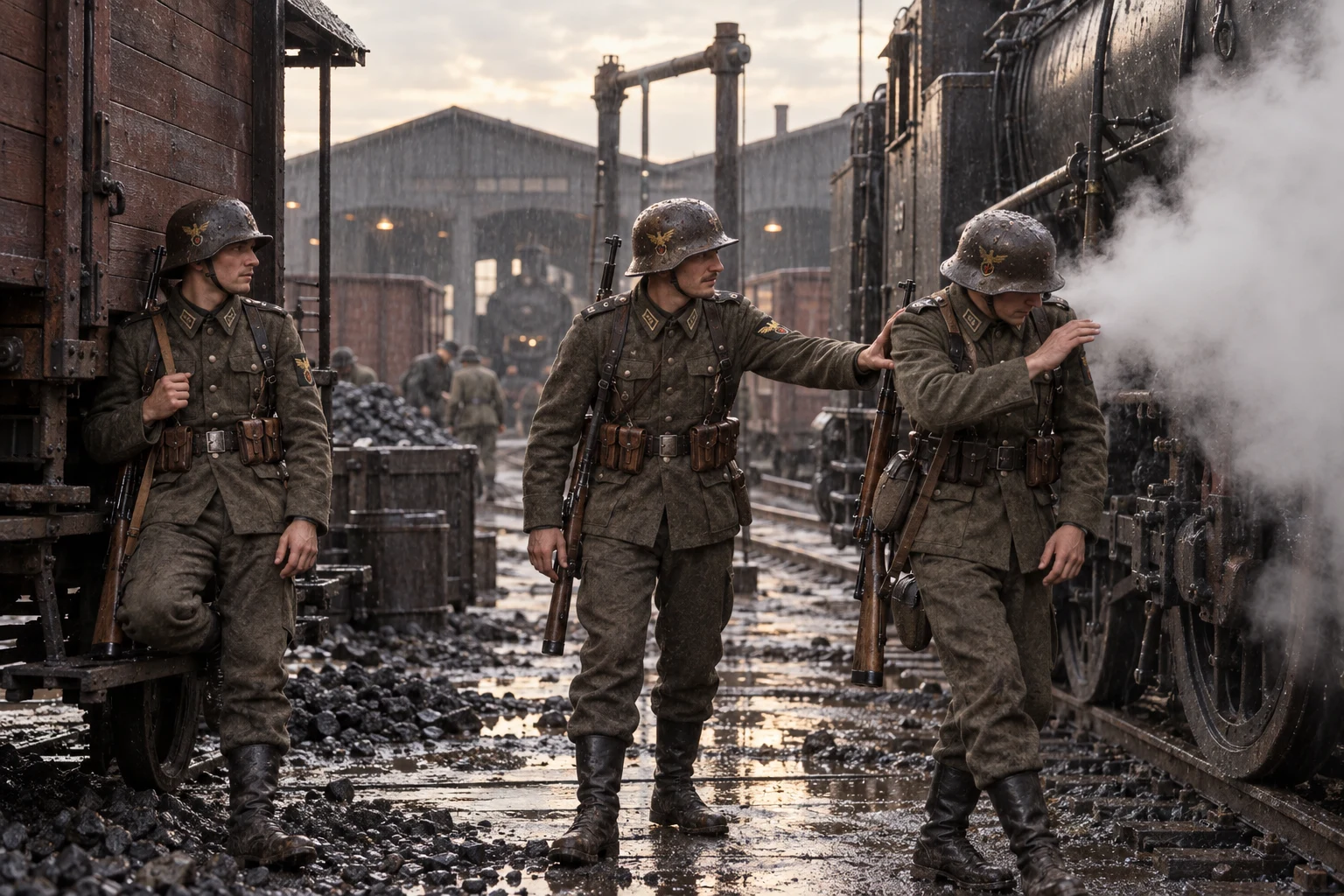
The lost Pavren railway yard
August 8–26, 1216 · Pavren front · Pavren 14th Division and Hestunian detachments against Hukular 46th Division
A yard made into a front
The railway yard at Velset stood east of Pavren's remaining principal reception district. Its six sidings, locomotive shed, and wagon-repair enclosure were valuable because trains could be divided there without occupying the main line. Colonel Eren Vos, commanding Pavren's 41st Infantry Regiment, disliked the position. The embankment protected men facing east but concealed movement along the southern drainage channel. Factory buildings gave excellent observation until their roofs burned. Nevertheless, abandoning Velset would force every damaged wagon farther west, carrying its interruption with it. Vos received orders to hold while the railway authorities prepared an alternative sorting point.
General Soren Kast assigned the attack to Hukular's 46th Division under Major General Ardan Kes. Kes had three infantry regiments but committed only the 137th and attached engineers initially. The third regiment remained available to replace exhausted battalions rather than make a theatrical final charge. Hukular artillery registered on the water tower and southern signal cabin during August 8. Pavren railwaymen recognized the pattern before several officers did: the enemy was isolating the installations required to use the yard, not simply bombarding the largest buildings. The first shelling killed nine railway employees who had stayed to detach a damaged locomotive.
The southern channel
On August 10, rain filled the drainage channel and reduced visibility across the sidings. Kes postponed his intended daylight assault but retained a reconnaissance ordered for that evening. Lieutenant Beren Hals led thirty-one Hukular soldiers into an abandoned coal enclosure. They discovered that the nearest Pavren listening post had withdrawn after losing its field telephone. Hals occupied the enclosure without firing and brought forward a second platoon before dawn. Their presence did not break the defense, but it placed Hukular rifles behind the first line of railway sheds. Pavren's morning ration party encountered them at less than fifty meters.
Vos sent Captain Ilva Dren's reserve company to recover the enclosure. Dren found the obvious passage between sheds already covered and moved through the repair shop instead. Her men emerged among pits holding dismantled wheel assemblies; two fell before they understood where the fire originated. A mechanic named Savel Norn opened a side door leading into the neighboring washhouse. That improvised route enabled one platoon to reach the enclosure wall. The counterattack recovered half the ground by noon but stalled against a machine gun behind a coal hopper. Dren, wounded in the shoulder, remained until another officer arrived.
The three-day contest that followed established the character of Velset. Hukular troops advanced from one industrial compartment to another, while Pavren counterattacks tried to restore a continuous line through spaces never designed for defense. A locomotive boiler struck on August 12 released steam across the nearest siding. Both sides initially mistook the obscuring cloud for a deliberate screen and fired into it. Stretcher parties subsequently found casualties from both armies beside the same overturned wagon. Vos ordered the disabled engines drained where possible. The measure made the yard less dangerous without making it any easier to defend.
The workshops change hands
Hestunian support arrived on August 15: two infantry battalions, an observation section, and a battery whose transport had been delayed by congestion farther west. Their commander, Major Selin Art, persuaded Vos to abandon a wrecked eastern shed that could no longer shelter its defenders. The withdrawal shortened the front and released one Pavren company. Kes responded by shifting the 138th Regiment toward the northern carriage works. A captured Hukular map later showed that this was a limited adjustment within his existing objective, not the beginning of a drive on Pavenor. The immediate contest remained the yard and its western exit.
On August 18, the northern works fell after a bombardment severed their connection to the signal cabin. Pavren Sergeant Toman Erel brought twenty-two men out through a culvert used for electrical cables. They left their heavy weapon after discovering that its tripod could not pass the narrow opening. Art used these survivors to guide a Hestunian counterattack that evening. The force recovered the carriage office but could not enter the main workshop. Inside, Hukular engineers had cleared firing apertures through stacked timber. The counterattack cost seventy-three casualties and yielded a building whose upper floor remained exposed to enemy fire.
The railway evacuation was almost complete by August 22. Six locomotives and 184 serviceable wagons had been removed since the fighting began. Twenty-seven damaged vehicles remained because repairing or towing them required personnel now serving as stretcher bearers. The station superintendent, Rema Voln, wanted another day. Vos granted six hours and detached soldiers to help move records, specialist tools, and the remaining railway families. Voln accepted the limit after seeing the casualty station in the goods warehouse. The last westbound railway movement left before midnight, carrying wounded troops in vehicles originally reserved for workshop equipment.
August 26
Kes launched his final yard assault on August 24. His previously rested 139th Regiment passed through the battered assault units and took the water-tower enclosure the following morning. Pavren defenders held the western signal cabin until its ground floor caught fire. Vos then ordered withdrawal to the prepared embankment beyond the yard. Art's rear guard left on August 26 after destroying switches that could not be removed. A platoon isolated in the carriage office surrendered that afternoon. Its lieutenant had received neither the withdrawal order nor any response to the runner sent west; the eventual prisoner list accounted for thirty-nine men.
Voln later identified the captured platoon from a duplicate railway passenger ledger that had recorded soldiers helping with the final evacuation. The seemingly irrelevant civil document corrected eleven misspelled names in the first military prisoner list.
The battle cost the defending formations 1,146 casualties, including 287 dead, and the attacking division 1,509, including 402 dead. These were losses within the Velset action, not the whole Pavren front. Hukular acquired an important position but spent another month repairing it before dependable military trains could enter. Pavren preserved most rolling stock while losing the flexibility that the yard had provided. Pavenor remained under its own government. For railway workers operating beside an unfinished western siding, the front's movement was measured by the disappearance of another place where damaged machinery could once be made useful again.
Original illustrations for this source record
Original archive artwork and captions are preserved. Dates, labels and claims printed within inherited images belong to the previous edition; the revised text governs the current history.