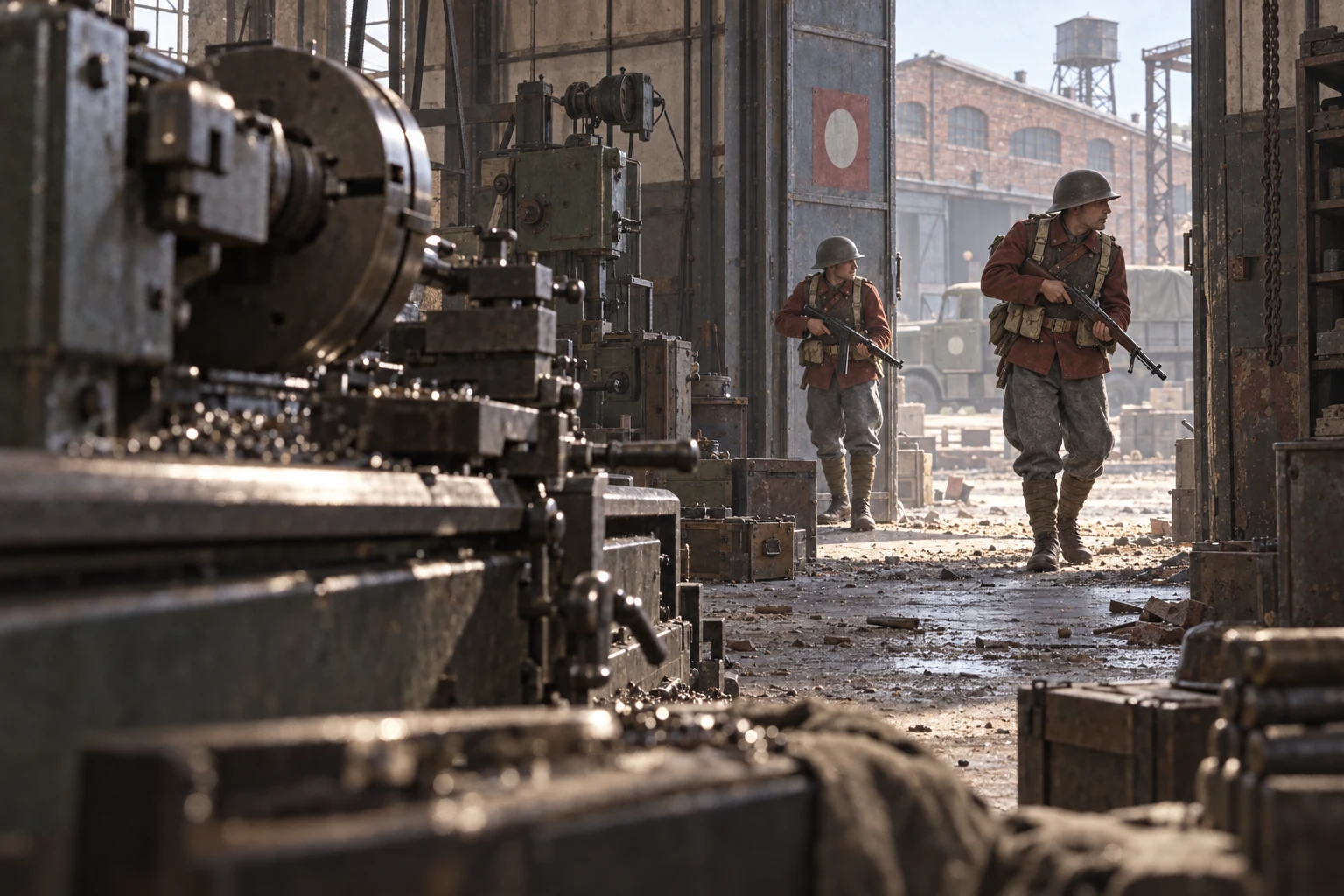
The Praxen workshops
June 3–29, 1216 · Praxen workshop belt, Viar · Praxen 14th Division against Rostan 27th Assault Group
A second generation of repair capacity
The workshops threatened in June 1216 were part of Praxen's dispersed repair belt, including facilities expanded after earlier industrial losses. They were not the same machine hall already lost at Heren Vale in 1214, nor were they the national administrative center, which would remain Allied until September 1219. General Hara Keld commanded Praxen's 14th Division and local guards, 17,300 personnel in the immediate district. Rostan General Naren Vesk directed the 27th Assault Group, 26,800 strong, against workshops and transport installations around the district of Teren Works.
The district repaired civilian agricultural machinery as well as military vehicles and communications equipment. That mixed role made its loss dangerous beyond the army. Director Irena Tel had sent specialists from the earlier displaced workshop organization to help establish production there. She now faced the prospect of moving machines again, this time with fewer transport vehicles and less unoccupied space available farther west. Her first evacuation list prioritized unique tools and trained workers rather than the equipment most impressive to photograph for an official salvage report.
Rostan opened its attack on June 3 with bombardment of the outer defense and railway service district. Praxen troops held an embankment and low factory housing beyond the main works. Shells struck civilian homes before many residents had received clear departure instructions. Local official Lena Darr opened the district school as a collection point, then moved it after artillery reached the playground. The second site lay farther from transport and forced families to carry possessions longer distances. Safety and convenience diverged before the main infantry battle had even reached the workshops.
June 4–10: The housing belt
Vesk's infantry entered the eastern housing belt on June 4. Praxen's 41st Regiment defended rows of narrow houses separated by gardens and service alleys. Captain Nera Korl commanded its forward battalion. She organized withdrawal through successive blocks after the first line became exposed from both flanks. Soldiers familiar with the district guided replacements through connecting gardens, but shell damage repeatedly blocked routes they expected to find open. Knowledge of yesterday's ground had to be revised under fire.
On June 7 Rostan troops captured the district power substation. Electricity failed across several workshops, stopping cranes and ventilation equipment while evacuation work continued. Tel's workers used smaller independent generators where available, reserving them for tasks impossible by hand. The reduced power slowed machinery removal and forced difficult choices. A large press remained because moving it would consume transport needed for several smaller specialized machines. Its crew painted identification numbers on removable components before leaving, preserving the possibility of repair or reclamation without pretending the whole press had been saved.
Keld counterattacked the substation on June 9. His troops recovered the western control building but could not restore operation because transformers and cables had been destroyed. The military gain therefore failed to produce the industrial recovery hoped for in the plan. Tel sent an engineer to explain the damage directly to corps headquarters. The explanation ended demands for an immediate restart based solely on the building's recapture. Possession of the control room did not bring electricity back to the factories whose production reports depended on it.
June 11–20: The works themselves
Rostan renewed the attack on June 11 and reached the outer machine sheds. Praxen defenders fought among equipment awaiting removal, with heavy pieces blocking sightlines and movement. Korl withdrew one company from a shed after fumes from damaged industrial stores made occupation dangerous. The enemy entered and encountered the same conditions, leaving the building contested but largely unusable. Neither side could treat every substantial roof as suitable shelter. Medical personnel recorded numerous nonfatal respiratory injuries alongside the wounds normally expected from the fighting.
Tel's final organized machinery movement departed on June 14. It carried selected lathes, gauges, electrical components, and workers' technical records. Families of evacuated specialists traveled separately when transport could be arranged, creating separations that lasted weeks. Several workers refused departure until their children were located in reception areas. Military officials initially called that refusal insubordination, then discovered the children had been moved without updated records. Darr's staff reconstructed the transfers and reunited most families before the last available civilian column left the district.
On June 17 Vesk attacked the central transport yard and forced Praxen troops toward the western workshops. Keld committed his reserve battalion to hold a road junction supporting withdrawal. It stopped the first attack but lost its commander and much of its communications equipment. Korl assumed temporary coordination of the adjoining units, using surviving officers to maintain contact. The defense remained organized, though its front grew shorter each day. Keld reported that condition plainly rather than let the existence of unit headquarters imply the same fighting strength they had possessed on June 3.
June 21–29: The machinery left behind
The last week centered on the western works and the road beyond them. Praxen engineers removed essential components from equipment that could not be transported, while military troops covered the remaining movement. Not every machine could be denied to the enemy without greater risk to workers and defenders. Some remained serviceable, others damaged beyond rapid repair. Later claims that the entire industrial district had been either captured intact or completely destroyed concealed that mixed reality, which occupation engineers would spend months sorting through.
Vesk's troops captured the western workshop row on June 26. Keld withdrew the surviving defense to a shorter line beyond the immediate industrial belt. A final rear guard held the road junction until June 29, when Rostan secured the targeted portion of the district. The capital Praxil remained under Allied government, and Praxen's army continued fighting. Rostan had won an industrial and tactical success without achieving national collapse. Its gain reduced the rate at which damaged equipment could return to service and increased Praxen's dependence on partner deliveries.
Praxen's local grouping recorded 1,426 killed, 3,514 wounded, and 1,087 captured. Rostan recorded 1,718 killed, 4,063 wounded, and 263 captured. Civilian workers and residents suffered 527 deaths. The saved machinery reached several western facilities rather than one replacement factory. Tel's first consolidated report showed restored capacity far below what Teren Works had produced before the attack. It also showed workshops operating, trained people still together in some places, and a state capable of continuing the war despite another permanent reduction in the resources with which it had begun.
Original illustrations for this source record
Original archive artwork and captions are preserved. Dates, labels and claims printed within inherited images belong to the previous edition; the revised text governs the current history.