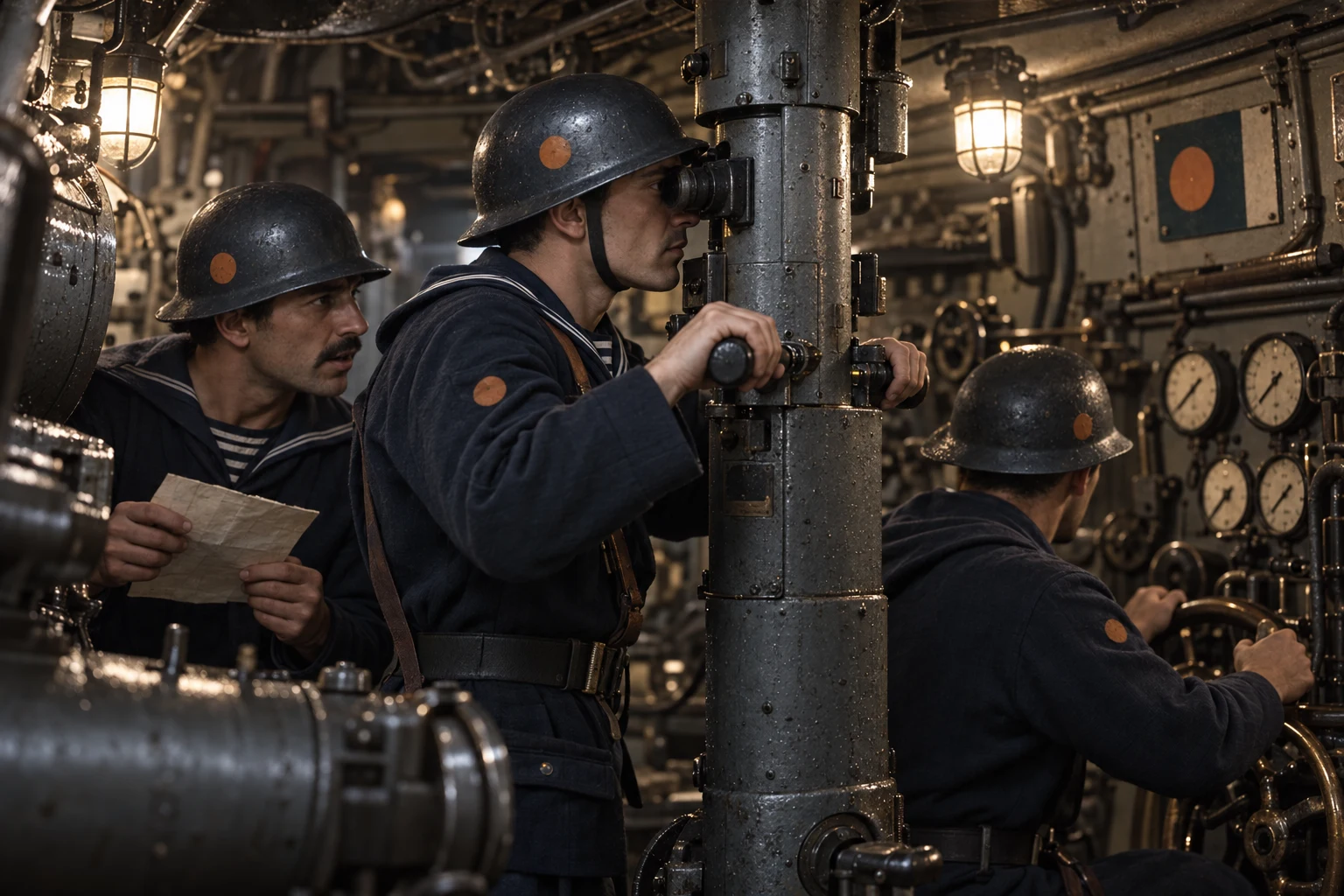
The Vespolian escort battle
August 4–29, 1215 · Vespolian Ocean and Allied receiving approaches · Viaran and island Allied escorts against Kelonese and Navaroan forces
A passage between active allies
The August escort battle followed Allied convoy E26 through a series of engagements rather than one continuous day of gunfire. The convoy carried machinery, food, military stores, and passengers between consenting Allied receiving points serving Viar and the island theater. Rear Admiral Sera Dar of Fujaro coordinated its escort with Motari and Erisian naval officers. The initial force comprised four cruisers, fourteen destroyers, and eighteen smaller escorts protecting forty-six merchant and service vessels. No Silvian warship participated; Silvia remained outside the war and its neutral commerce was separate from this military organization.
Kelonese Rear Admiral Masen Tori directed the principal surface interception force, supported by Navaroan submarines and reconnaissance arrangements established after Navaroa's entry. Navaroa retained its established geographic position. Ships operated through authorized Axis facilities and existing ocean deployments. Tori's immediate surface group included three cruisers and twelve destroyers. He sought opportunities against ships separated by weather, mechanical failure, or the convoy's scheduled division among destinations, avoiding a single concentrated encounter with every Allied escort at once.
The first loss occurred on August 4 when the freighter Amber Vale suffered an underwater explosion during a period of poor visibility. Its crew initially reported a mine, while escorts suspected a submarine. Later Navaroan records confirmed the attack by submarine N-18. The vessel sank after its engine room flooded. Thirty-six crew and passengers died; 112 were rescued. Dar revised the passage schedule and maintained protection around the rescue ships, accepting delay because survivors in the water were part of the convoy's responsibility rather than an obstacle to it.
August 8–13: A surface contact in broken weather
On August 8 the Erisian cruiser Open Horizon sighted Tori's leading ships through a gap in rain. Captain Irena Sel turned toward them while merchant vessels moved away under the remaining escorts. The resulting exchange damaged Open Horizon's forward director and disabled a Kelonese destroyer. Visibility then closed again, interrupting accurate fire. Sel resisted an order from a subordinate to pursue the damaged enemy ship, retaining contact with the convoy instead. Her cruiser had lost part of its own fighting capacity, a fact not visible to every officer watching the enemy withdraw.
Chief Gunner Naren Vel restored limited local control to the cruiser's forward guns. The change reduced coordination and accuracy but kept the weapons useful if the enemy returned. Below decks, medical staff treated splinter injuries while damage-control crews cleared water from a ruptured pipe system. Several wounded men were initially sent to a compartment designated as an aid station in prebattle plans but rendered unusable by smoke. The medical officer shifted the station to a mess deck and sent guides to prevent later stretcher parties following obsolete directions.
The convoy divided on August 12 according to its receiving plan. Dar retained the more heavily damaged ships with a slower group under Motari Commodore Hara Rel, while the faster group continued under Fujaro escort. Tori attacked the slower group the following morning. His cruisers damaged the freighter Long Orchard and forced it to stop. Rel's destroyers laid a covering screen while tugs from the convoy's own service group took the ship in tow. The operation preserved most of its cargo but tied several escorts to a vulnerable movement for days.
August 14–22: The ships that could not keep station
Mechanical failures multiplied during the next week. Two merchant vessels suffered engine problems unrelated to direct enemy hits, and one escort required emergency repairs after collision damage in darkness. Dar's staff distinguished these failures from combat losses while recognizing their common operational effect: fewer ships could move at the planned speed. Tori's reconnaissance reported scattered vessels but could not always tell which were protected by escorts outside immediate view. The uncertainty prevented some attacks and encouraged others against groups stronger than he expected.
On August 17 Navaroan submarine N-23 attacked a detached pair of service vessels. It sank the repair tender Quiet Lantern before an escort damaged the submarine and forced it to withdraw. The tender's loss killed forty-seven technicians and sailors and removed workshops that had been supporting several damaged ships. Surviving technicians distributed themselves among the remaining service vessels. They retained expertise but lacked many tools. The convoy therefore reached its receiving points with a repair burden that would continue after the last enemy contact.
Kelonese aircraft struck the faster group on August 21 near an Allied receiving approach. Local fighters joined the convoy defense, but bombs damaged two freighters and the Fujaro destroyer Clear Morning. Its commander grounded the ship in sheltered water after flooding exceeded the pumps' capacity. The crew survived in large proportion, yet the ship was later written off. Its loss was counted when the final assessment established that repair was impracticable, not on the first day when an optimistic signal described it merely as temporarily grounded.
August 23–29: Completion without a clean ending
The last surface contact occurred on August 23. Rel's slow group encountered two Kelonese destroyers while Long Orchard remained under tow. The Motari cruiser Motari Dawn and accompanying destroyers drove them off after a brief exchange. It suffered damage to a secondary gun position and continued escorting at reduced readiness. The attack failed to reach the tow, but it postponed repairs and exhausted crews already serving repeated emergency watches.
By August 29 surviving ships had reached assigned Allied ports or protected repair areas. Five merchant or service vessels were sunk or written off, eleven damaged, and one destroyer lost beyond repair. Seventy-nine percent of planned cargo tonnage arrived within the convoy period, with further damaged cargo recovered afterward. Allied military and merchant losses totaled 417 killed and 683 wounded. Axis naval and air forces recorded 286 killed and 441 wounded, with one destroyer sunk, two submarines damaged, and twenty-seven aircraft lost across the series of engagements.
The convoy preserved a necessary connection without proving the Vespolian safe. Its escort force required rest, ammunition, and repairs before repeating the passage. Open Horizon entered dock with its damaged director still lashed beneath protective canvas, while technicians from Quiet Lantern reported to unfamiliar workshops ashore. Their arrival illustrated the operation's uneven result: ships lost, cargo delivered, repair capacity displaced, and a coalition able to continue maritime movement only by paying costs that did not end when the convoy's name disappeared from the operations board.
Original illustrations for this source record
Original archive artwork and captions are preserved. Dates, labels and claims printed within inherited images belong to the previous edition; the revised text governs the current history.