The Athenoran littoral positions
June 20–July 31, 1215 · Varen coastal district, Athenor · Athenor 6th Coastal Corps against Brevon and Cirel formations
The coast after the northern battle
Rauk's failure to break the northern Allied defense in April did not reduce the pressure felt by Athenoran troops on the Saffron Littoral. Their enemy retained positions around Sorel and the damaged outer districts of Varen Bay. General Mara Sel now commanded the 6th Coastal Corps, with 24,600 personnel immediately assigned to the threatened sector. Brevon General Taren Veld concentrated 31,800 Brevon and Cirel troops for a summer attack. Dovran and Arvessan commitments continued elsewhere in the regional system, preventing the Allies from treating the coastal battle as the whole southern war.
The new objective was the Keren coastal road, which linked Varen's surviving receiving facilities to dispersed inland stores. Sel had rebuilt the road's defense around low ridges and the masonry remains of seaside factories. The position was stronger than in 1213 but manned by troops carrying years of losses. Colonel Hara Dast's 23rd Regiment included companies whose senior survivors had fought at the same warehouses three summers in succession. Familiarity helped them interpret the ground and made every renewed evacuation feel like evidence that previous sacrifices had secured little permanence.
Veld opened the attack on June 20 with artillery fire against observation posts and road junctions. His leading infantry captured a coastal quarry and advanced toward the factory belt. Sel allowed the quarry garrison to withdraw rather than commit reserves to its recovery. The quarry's machinery had already been removed, and its observation value could be countered from other positions. Local officials still objected because its loss placed several returned households beyond the Allied line. Their protest was justified by civilian consequences even where Sel's military judgment was sound.
June 21–30: The glassworks
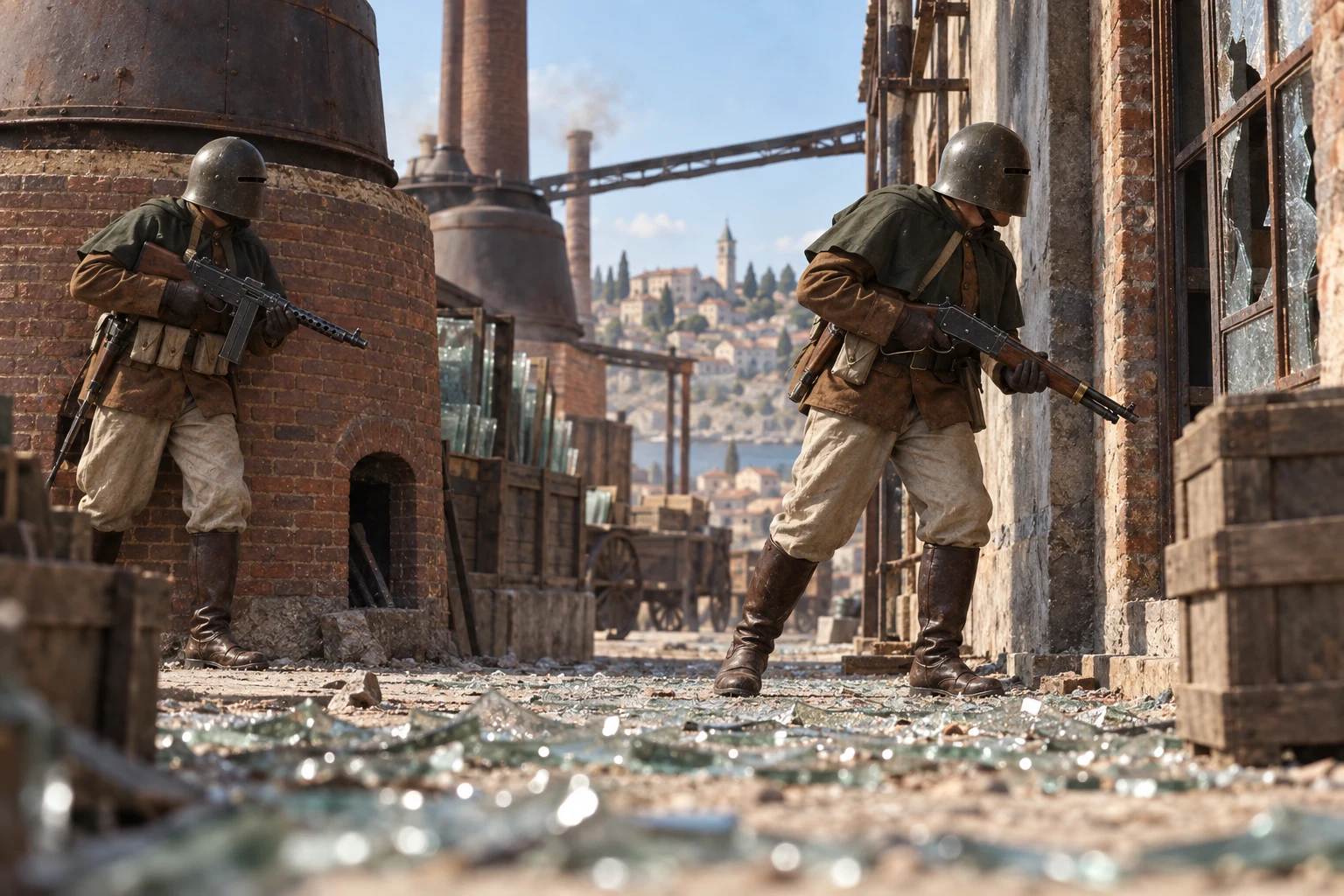
Fighting reached the Varen glassworks on June 22. Its furnace buildings had ceased production, but adjoining concrete stores offered strong shelter. Captain Nera Pell commanded the Athenoran company holding them. The floors were covered with fragments from prewar stock and shattered windows, making movement painful even without enemy fire. Soldiers wrapped cloth around the knees of their uniforms and cleared narrow passages for stretchers. Their preparations could not make the whole complex safe, but they reduced injuries caused by the building itself during repeated movements between positions.
Cirel infantry entered the furnace hall on June 24 and fought for the connection to the stores. Pell withdrew from one detached building after its roof caught fire. The enemy occupied it and then abandoned the upper floor when the same fire spread. Neither side gained a useful observation point from the exchange. Dast's report recorded a lost building without treating every square meter as equally valuable. She retained the stores and road passage, the functions for which the regiment had been assigned to the factory belt.
On June 28 Veld attacked north of the glassworks, seeking to turn the whole position. His troops took a row of workers' houses and threatened Sel's lateral road. Athenor's reserve battalion counterattacked after dark and recovered the western houses. The action restored movement but left civilians trapped in cellars nearer the enemy line. The following morning a local arrangement permitted their removal. Seventy-eight people crossed under supervision, carrying what they could. Three elderly residents remained until a second movement brought stretchers, a delay remembered with more anger than the military communiqués suggested.
July 1–15: The road is narrowed
Veld shifted his artillery effort toward Keren road in early July. Traffic continued, but damaged surfaces and repeated interruptions reduced capacity. Sel moved some stores farther inland and divided vehicle movements among several authorized local routes. The alternatives were slower and passed communities already supporting displaced families. Municipal authorities demanded notice before military traffic occupied their roads. Sel's staff established liaison posts to reduce conflict, learning that a route marked available on an army map could still be blocked by market traffic, damaged bridges, or an unannounced civilian evacuation.
The next infantry attack on July 7 gained the glassworks' northern yard. Pell's company withdrew into the concrete stores, leaving two isolated squads behind a collapsed wall. Sergeant Iven Dar led one squad through a service passage and returned with information about the other, whose wounded prevented immediate movement. A relief party reached them after darkness. Eleven men were recovered, while seven had died. The rescue did not recover the yard, but it preserved soldiers whose knowledge of the position could not be replaced by the next draft of recruits.
Sel considered a counteroffensive on July 11 and rejected it after reviewing the condition of her reserves. The fresh battalion listed in the corps return lacked two companies still completing movement from another district. Counting it as fully available would have committed the same promised men twice. She instead rotated the most exhausted glassworks defenders and reinforced the road junction. Veld also needed replacements, but his staff continued demanding a final attack before Allied receiving arrangements could absorb new cargoes scheduled later in the month.
July 16–31: Endurance at the same buildings
The final major assault began on July 16. Brevon infantry struck the road junction while Cirel troops renewed pressure on the stores. The junction defenders lost their outer trench but held a low embankment behind it. At the glassworks, attackers entered a storage room and fought Athenoran troops across an internal partition until fire forced both groups out. Pell was wounded during the withdrawal and evacuated. Her replacement inherited a company familiar with every wall and profoundly tired of being asked to defend them again.
By July 23 the offensive had narrowed to local pressure. Sel recovered the junction's outer trench but left the glassworks northern yard in Axis hands. She ended further attacks on July 31, holding the essential road and receiving system while accepting another damaged frontier. Athenor's engaged corps grouping recorded 1,687 killed, 4,021 wounded, and 591 captured. Brevon and Cirel recorded 2,208 killed, 5,146 wounded, and 384 captured. Civilian deaths in the battle district totaled 472, with many more households displaced for a second or third time.
The battle preserved Athenor's coastal position without producing a liberation elsewhere. Its survivors measured success through the road still carrying supplies and the continued existence of their units. Pell returned to the regiment months later on restricted duty, unable to lead an assault but able to train replacements in what the reports called factory fighting. She began with the simplest lesson: the name of a building did not explain its present condition. Every new company had to learn what remained standing, what still connected, and what previous battles had already destroyed.
Original illustrations for this source record
Original archive artwork and captions are preserved. Dates, labels and claims printed within inherited images belong to the previous edition; the revised text governs the current history.