The rupture before Keral
February 18–March 7, 1215 · Havera approaches, northern Volara · Allied forward grouping against Hukular's opening assault echelon
Inside Rauk's larger offensive
The rupture before Keral was the opening local struggle within Marshal Ilyan Rauk's February 18–April 19 offensive. Its formations and losses belong to that larger battle rather than to an additional campaign. Haveran General Elsen Rove directed the wider defense; Brigadier Mara Keld commanded 12,600 Haveran and Pavren troops in the forward Keral district. Hukular General Oren Vasken brought 27,400 men against it from the offensive's first assault echelon. His purpose was to open the approaches quickly enough for follow-on formations to pass through before Rove rebuilt the line.
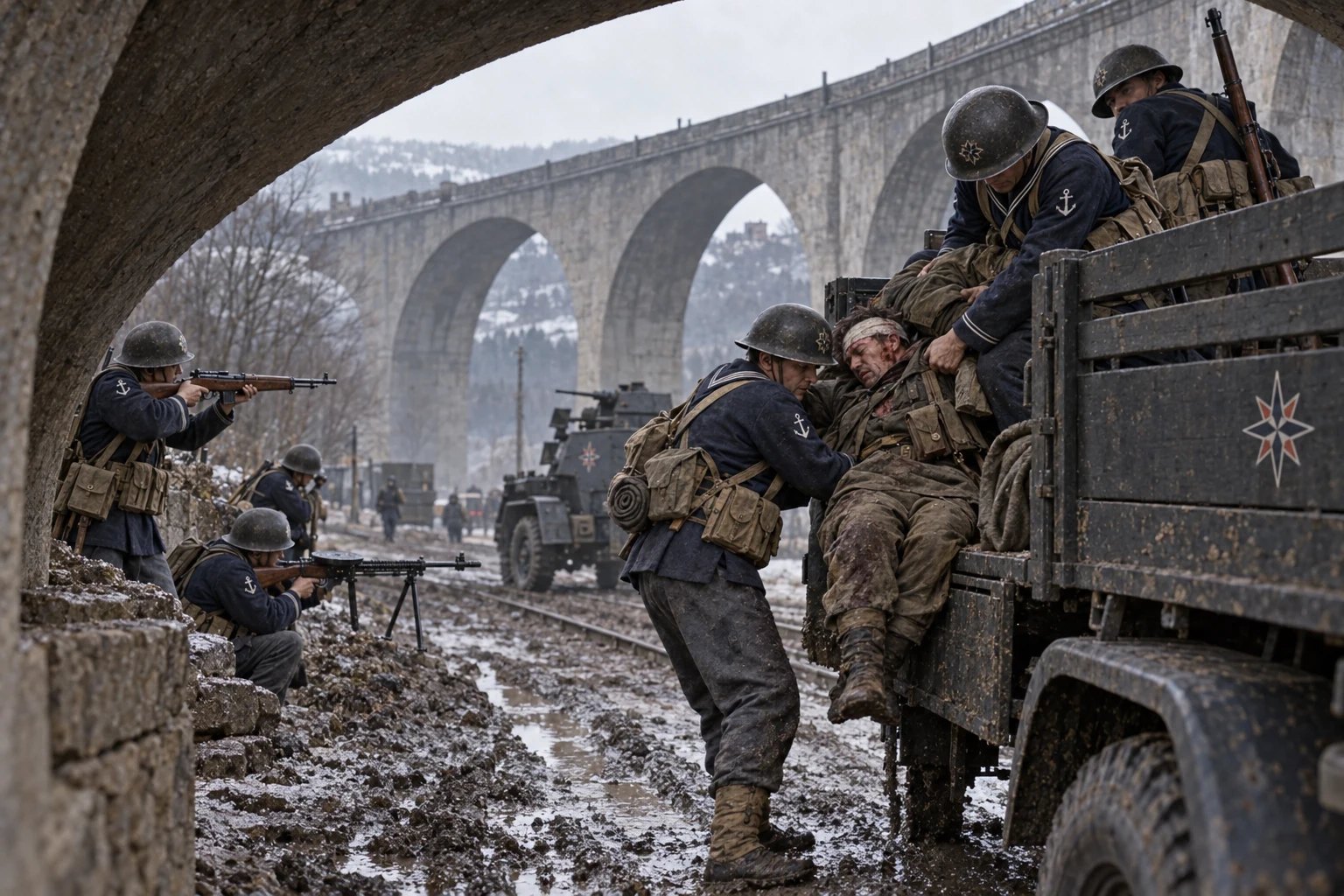
Keral's forward district contained a low ridge, three road villages, and a stone viaduct whose damaged structure mattered less than the assembly ground beside it. Allied units withdrawing from farther east would need that ground to reorganize. Keld had prepared several positions, but repairs differed in quality and communications depended on exposed lines. The first Hukular bombardment severed many of them. At dawn on February 18, officers knew their own shelters were being hit and could only infer what was happening to the neighboring units whose telephones had fallen silent.
The main assault struck the village of Leren East. Pavren Colonel Haren Vol, temporarily leading an assembled forward detachment before his later service around the capital, coordinated its defense there. He withdrew its surviving groups from the exposed village edge after artillery destroyed two strongpoints. The movement was locally sensible but widened a gap beside a Haveran battalion still holding its original line. Hukular infantry entered that gap before Keld received a reliable account of either position. By midday the first defensive belt had been penetrated.
February 19–23: The retreat becomes a traffic battle
Vasken pushed his leading regiments toward Keral on February 19. His advance encountered abandoned vehicles, prisoners, wounded men, and supporting formations using the same roads. Officers attempted to enforce priority by rank, producing contradictory instructions at a damaged bridge. The delay did not erase the tactical success, but it consumed the hours needed to turn it into a larger collapse. Keld used that interval to establish a rear-guard position near the viaduct assembly ground and separate arriving fragments into units that could receive orders again.
Lieutenant Nera Dast staffed one of the collection points. She asked arriving soldiers three questions: their unit, their last officer seen, and whether they possessed usable ammunition. The answers produced a more useful picture than the first reports of entire battalions destroyed. Some men had become separated after orderly withdrawals; others had escaped positions genuinely overrun. Dast grouped them under officers they recognized and sent the wounded to a separate aid point. The process did not restore lost strength, but it prevented confusion from masquerading as complete annihilation.
On February 22 Hukular infantry reached the viaduct district's eastern buildings. The structure itself could carry little useful traffic because earlier damage had weakened its deck. Fighting centered on the adjoining road and sheltered assembly space. Keld committed her remaining reserve battalion to the stone workers' houses below the viaduct. It stopped the first attack, then lost its commander to shellfire. Captain Irena Sel assumed command and maintained contact with neighboring troops by sending officers in person after the repaired telephone line failed again.
February 24–March 1: The workers' houses
Vasken attacked the workers' houses on February 24 after bringing artillery into the captured forward district. Shelling demolished several buildings and filled the road with stone. Allied defenders moved into surviving cellars and field positions behind the houses. Hukular infantry entered the eastern row but could not immediately clear the courtyards beyond it. The close fight divided into separate groups whose reports used house numbers no longer visible on shattered walls. A map showing intact streets became increasingly difficult to relate to the ground underfoot.
Vol's Pavren detachment reinforced Sel's battalion on February 26. Its men arrived hungry and without their original transport, yet retained enough organization to hold an assigned frontage. Vol stationed them beside the Haverans, preserving their organization instead of dispersing them as replacements. Their officers could therefore continue using familiar procedures while learning the new position. The decision preserved coherence and made cooperation visible. Soldiers who had spent a week hearing that allied units elsewhere were collapsing now saw another depleted formation arrive and remain dependable under fire.
Rove ordered a shorter line on February 28. Keld was to relinquish the eastern workers' houses while retaining the road behind the assembly ground. The withdrawal began under shelling and lost several loaded ambulances when a wall collapsed across their route. Medical personnel transferred patients to hand stretchers and carried them through adjacent gardens. Twenty-eight patients died before reaching the next aid station. Their loss appeared within the campaign's medical accounting, not as proof that every vehicle caught in the blockage had been destroyed with everyone aboard.
March 2–7: A rupture contained
The first March attacks gained more local ground but met a less dispersed Allied defense. Rove's formations occupied a shorter frontage with improved artillery support. Vasken still possessed offensive strength, yet his troops had spent it repeatedly opening the way rather than passing through an already secured gap. On March 4 a Hukular battalion penetrated a roadside orchard and threatened Keld's headquarters. A Haveran reserve company contained the advance until neighboring artillery forced the attackers to withdraw from the exposed edge. The headquarters moved afterward, but the line remained connected.
By March 7 the opening local phase had ended. Hukular held the original forward belt and much of the eastern Keral district. The Allies retained the assembly-road system needed for the next defense, though in damaged and reduced form. Keld's grouping recorded 1,163 killed, 2,871 wounded, and 1,024 captured. Vasken's assault echelon recorded 1,472 killed, 3,418 wounded, and 173 captured. These figures are subordinate to the larger Rauk offensive and must not be added again to any full campaign total.
The result was a genuine Hukular tactical success that failed to become the immediate operational decision Rauk expected. Keld's force could no longer defend its original ground, but Rove still commanded an army capable of resisting the next phase. Dast closed her temporary collection point and sent its final corrected lists to the rear. They contained fewer men than the prebattle rolls and more surviving units than the first panic reports suggested. Between those two truths lay the reason the offensive would continue for six more weeks instead of ending at Keral.
Original illustrations for this source record
Original archive artwork and captions are preserved. Dates, labels and claims printed within inherited images belong to the previous edition; the revised text governs the current history.