The Viar workshop defense
August 16–September 24, 1214 · Praxen industrial defense district, Viar · Praxen 11th Division and Erisian support against Rostan 44th Division
The machinery that kept returning
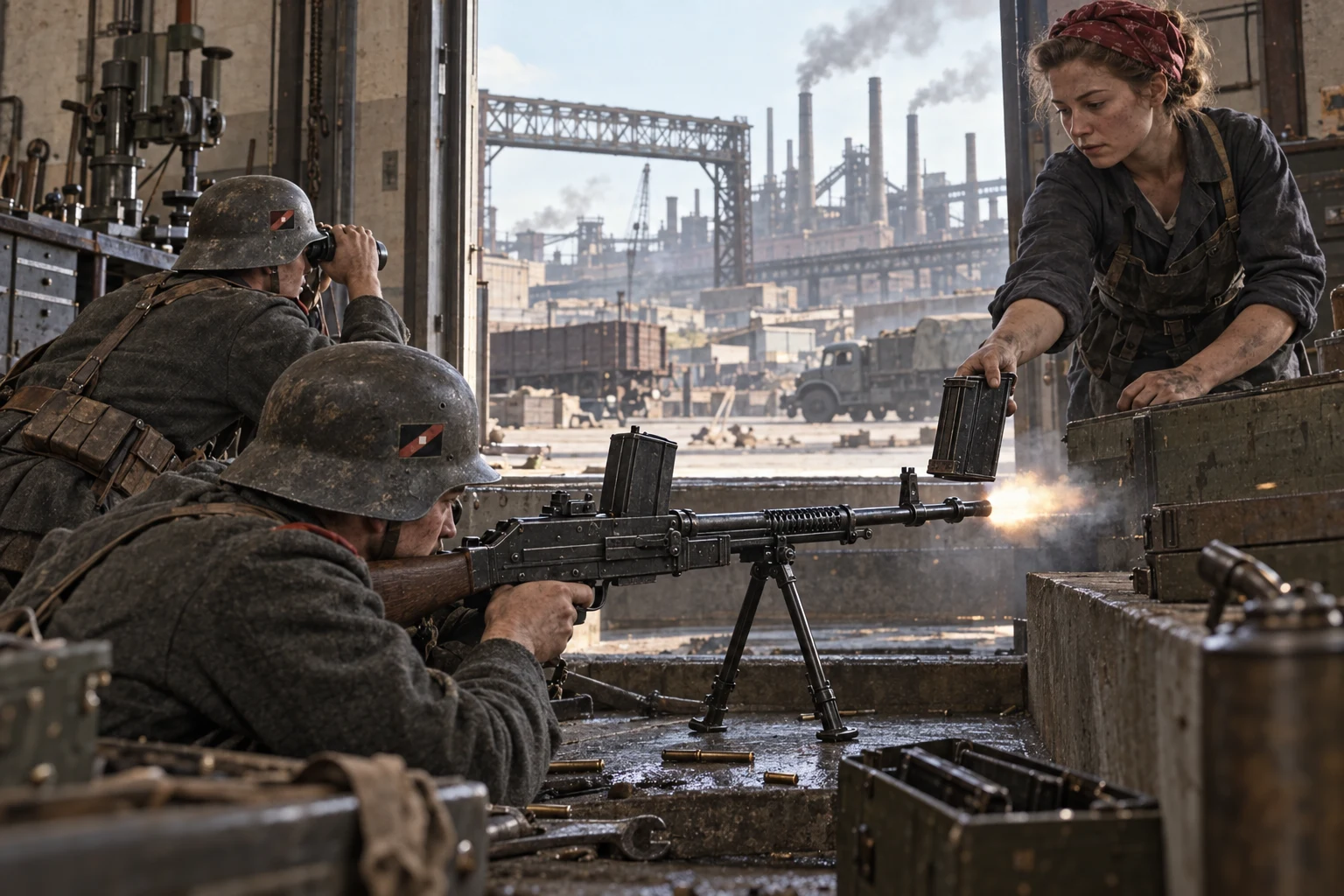
The workshops at Heren Vale repaired vehicles, field generators, and artillery equipment for Praxen's continuing defense. They stood behind the active front but close enough that an enemy advance could bring them under direct pressure. General Avena Korr directed Praxen's 11th Division, 16,800 strong in the district, having commanded its rebuilding after earlier losses along the eastern roads. Colonel Nera Mares commanded an Erisian support group of 3,240, including infantry and technical personnel. Rostan General Elan Vesk attacked with 25,600 men of the 44th Division and attachments.
Vesk's objective was to force the workshops out of service and take the road controlling their connection to the interior. He did not require every machine intact. The opening bombardment on August 16 struck the power distribution yard and workers' housing. Praxen's repair director, Irena Tel, ordered portable equipment removed while keeping the heavy machine hall working as long as electricity remained. The decision split her workforce between production and evacuation, reducing immediate output but preserving a capacity that would otherwise be lost if the attack reached the main buildings.
Korr defended an outer line of low ridges and railway service cuts. Her division had received replacements but lacked several experienced company commanders. She assigned veteran liaison officers to the newest battalions rather than concentrating all experienced personnel in one favored regiment. The arrangement spread competence and exhausted the veterans. Lieutenant Hara Venn spent her first week moving between three battalions, explaining the same local terrain and reporting the same shortages to officers who had arrived with different maps and expectations.
August 17–26: The service cuts
Rostan infantry captured the eastern service cut on August 17 and threatened the workshop road. Praxen's 33rd Regiment counterattacked the following day, recovering part of the cut but losing two company commanders. Fighting continued around maintenance huts whose shallow foundations offered little protection from shelling. Soldiers reinforced them with debris, creating shelters that looked substantial until direct hits broke them apart. Korr ordered the forward companies to occupy dispersed field positions rather than crowd into the remaining huts simply because those structures provided roofs.
Vesk shifted pressure northward on August 21 and seized an abandoned brickworks overlooking the road. The capture allowed observation of transport entering Heren Vale. Tel began moving machinery at night, but darkness introduced its own accidents. A heavy lathe slipped during loading and crushed a worker's leg. His companions nearly abandoned the machine until he insisted that the injured were not helped by wasting the effort already spent. The lathe reached a replacement workshop later that month; the worker survived after amputation and returned to administrative work the following year.
The Erisian infantry group attacked the brickworks on August 24 under Mares's command. It recovered the lower kilns but failed to take the upper drying sheds. Rostan defenders retained observation from the higher ground. Mares held the lower position, which reduced enemy access to the road without eliminating fire against it. The action showed why a battle could produce a useful partial result while leaving its headline objective unmet. Korr used the reduced pressure to accelerate evacuation of tools and specialist stores rather than immediately repeat the assault.
August 27–September 9: The working factory becomes a position
By August 27 shelling reached the main machine hall regularly enough that Tel suspended heavy work. The last generator repaired there departed on a truck already carrying workers' personal belongings. Infantry then occupied adjoining administrative buildings, while the hall itself remained largely empty except for machinery too heavy or damaged to move. The change in function required new orders: military use of the site could no longer be described as protection of continuing civilian production. Its industrial value now lay mostly in what had been carried away.
Rostan attacked the hall district on August 30. Praxen troops held the loading yard and western offices but withdrew from the eastern machine bay after fire spread beneath its roof. Sergeant Naren Del led a party back to recover two wounded soldiers and found them sheltered behind the base of a machine they had helped install before the war. Both survived. Their knowledge of the factory had guided the rescue, but familiar surroundings also made retreat harder to accept. Several defenders remained emotionally attached to a workplace whose practical function had already moved elsewhere.
Korr withdrew the main line beyond the eastern hall on September 3, preserving the road junction to the west. Vesk claimed the capture of the workshops, although the replacement repair organization was already operating in dispersed facilities beyond his reach. His tactical gain still mattered: Praxen lost buildings, heavy machinery, and production time. It did not achieve the permanent elimination of repair capacity imagined in his opening plan. The distinction became evident when equipment restored at the new facilities returned to the front later in September.
September 10–24: The junction defense
Vesk renewed his advance toward the western junction on September 10. The attack encountered Praxen units that had shortened their frontage and improved artillery coordination with Erisian observers. Leading Rostan companies gained a roadside depot but could not cross the open ground beyond it. Korr counterattacked on September 13 and recovered the depot's western buildings. She then halted, refusing to spend the division's reserve on an attempt to regain the damaged machine hall merely because its familiar name carried political importance.
The last major fighting occurred on September 19–20 around a rail overpass south of the junction. Rostan troops briefly held its eastern approach; Praxen defenders retained the western road and forced the attackers back from exposed positions. By September 24 the front stabilized. Rostan occupied the original workshops and brickworks heights, while Praxen held the junction and maintained a reduced repair service farther west. The defense therefore lost its original site while preserving much of the function the site had served.
Praxen's grouping recorded 1,407 killed, 3,388 wounded, and 682 captured; the Erisian group recorded 291 killed, 704 wounded, and 93 captured. Rostan recorded 2,116 killed, 4,932 wounded, and 317 captured. Civilian workers and residents suffered 389 deaths. Tel's replacement workshop reopened with fewer machines and longer queues. Above its entrance she placed the recovered Heren Vale sign, not to pretend the old district remained free, but to identify the institution whose workers and tools had survived its loss and continued serving the army.
Original illustrations for this source record
Original archive artwork and captions are preserved. Dates, labels and claims printed within inherited images belong to the previous edition; the revised text governs the current history.