The Gaften summer counterstroke
July 2–August 10, 1214 · Huqait–Handistan campaign system, Gaften · Regional Allied armies against Ruuyaq's expeditionary coalition
A limited promise in a cultivated district
The Gaften summer counterstroke sought usable roads and restored distribution, not a sweeping march to Ruuyaq's capital. Its connected actions took place within established Huqaiti and Handistani fronts, linked through authorized regional support rather than a direct Ruuyaq–Handistan border. General Hala Mer coordinated the Huqaiti attack around the Darim receiving belt with 18,600 troops. General Sera Nalm directed 16,400 Handistani troops in a parallel local recovery. Trenoan and Syran commitments supplied artillery, medical, and transport support already assigned to the regional system.
Ruuyaq General Nadir Sel commanded the principal opposing expeditionary group, with 42,300 immediately engaged troops distributed between the threatened districts and supporting partner formations. He had prepared positions around roads and water distribution points, expecting an Allied attack after the previous year's limited campaigning. His staff correctly identified the likely importance of those facilities but overestimated how much local civilian production could support the defense. Requisition had already reduced stored food and animal transport. The soldiers arrived at districts whose apparent resources existed more reliably in headquarters tables than in actual granaries.
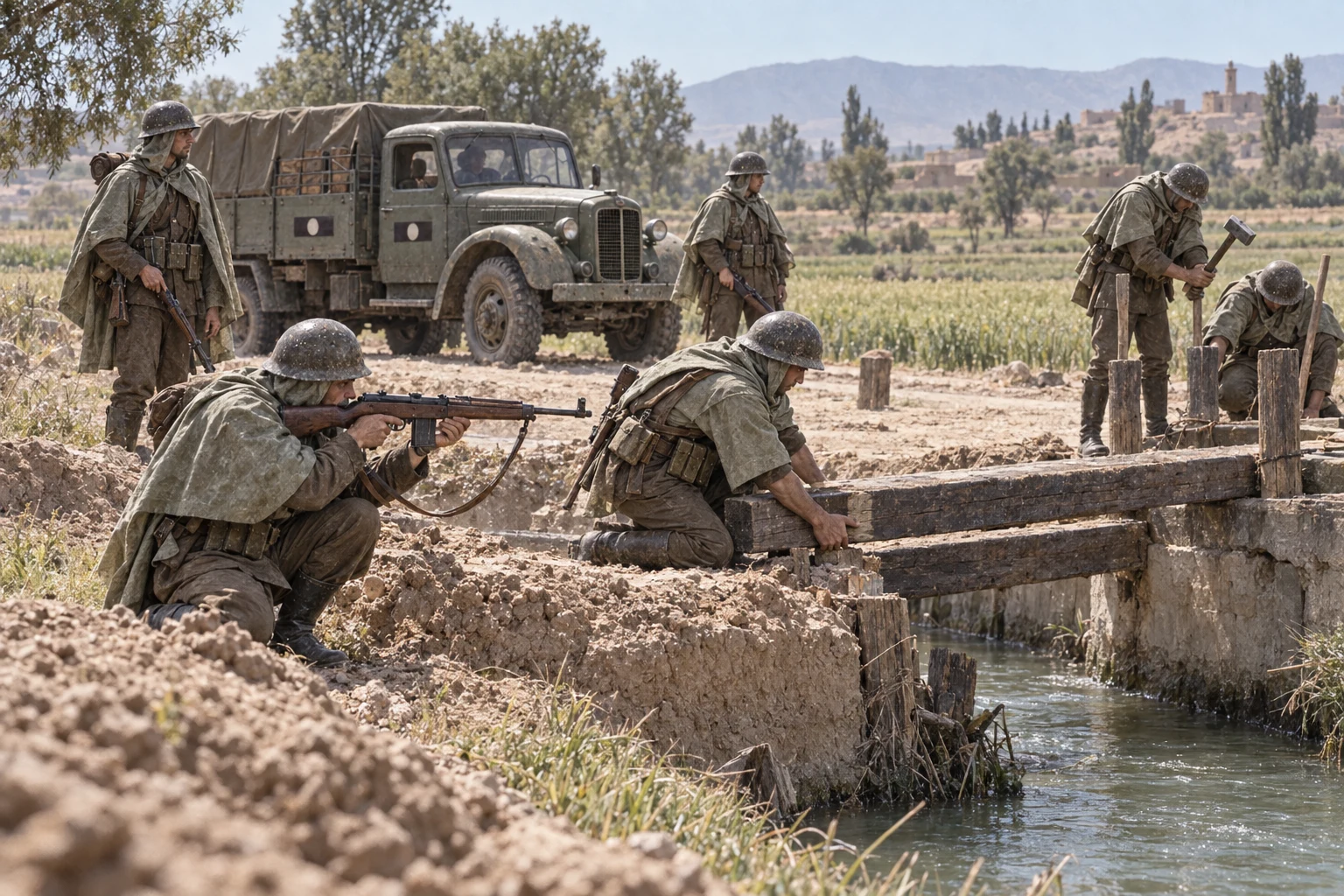
The Allied opening attack began on July 2 in the Huqaiti district of Laren Channels. Infantry advanced toward a road embankment overlooking cultivated plots and irrigation branches. Mer instructed commanders to preserve the distribution works where possible, but shelling damaged two control buildings before troops reached them. Engineer Lieutenant Rema Hal accompanied the following repair party and found water escaping into low fields. Capturing the ground had created an immediate civilian emergency that could not wait until the military plan declared its first phase complete.
July 3–12: The road and the channels
Huqaiti troops took the embankment on July 3 after a day of close fighting around its service culverts. A Ruuyaq counterattack recovered the southern section the next morning. The resulting line divided both the road and the water system. Hal's engineers restored one branch behind the Allied position while another remained beyond reach. Farmers asked whether they could cross to inspect their plots. Mer refused movement through the active battle area but established a supervised claim register so damaged crops and equipment would not disappear from later compensation simply because owners could not visit them.
In Handistan's sector, Nalm's attack recovered the outer road village of Haren on July 6. Its main buildings stood, but retreating defenders had removed food and vehicles. The first Allied troops distributed emergency rations, discovering that several households included people displaced from earlier fighting and absent from official population lists. Captain Lena Dorr requested additional civilian supplies rather than restrict distribution to registered residents. Her battalion's military allocation shrank for two days while the receiving staff corrected the count. The recovery of a village therefore increased immediate demand before producing any local support.
Sel counterattacked both sectors on July 10, seeking to exploit the Allies' growing responsibilities. In Laren Channels, his troops regained a pumping compound and threatened the embankment's northern end. Mer committed a reserve battalion to hold the adjoining road, stopping the advance without recovering the pumps. In Handistan, Nalm's defenders repelled an attack on Haren's western houses but suffered heavy losses among newly arrived replacements. Their platoon leaders had spent only days with them and struggled to restore order after several squads lost contact in smoke.
July 13–26: The advance becomes narrower
Mer revised the Huqaiti objective on July 13. Instead of taking the whole district, she sought a continuous road connection behind the recovered embankment. The revised attack passed through lower agricultural ground and required more engineering work than the original timetable allowed. Soldiers laid temporary surfaces and repaired damaged crossings while civilians waited to resume water distribution. Each military improvement had consequences for nearby fields. Hal insisted that engineers record which channels they diverted, allowing later repair crews to understand changes that otherwise would look like random destruction.
Nalm paused her Handistani advance after July 16 to relieve two exhausted battalions. Political representatives protested that the pause gave Ruuyaq time to strengthen its defenses. Nalm answered that the enemy already possessed positions and that exhausted infantry would not make those positions weaker by attacking them sooner. Her replacement battalions arrived with better strength but limited familiarity with the district. Surviving officers from the first phase accompanied them, extending their own service without requiring whole depleted battalions to remain continuously in the line.
The renewed attack on July 22 captured a road junction west of the principal Axis position. Sel withdrew from an exposed salient while retaining the stronger ground beyond it. Allied reports initially called the movement a rout. Prisoner statements and reconnaissance showed an organized withdrawal with functioning artillery support. Mer corrected the assessment before authorizing pursuit. The correction prevented the coalition from transforming a useful local gain into an advance against positions it had neither reconnoitered nor prepared to sustain.
July 27–August 10: Holding the recovery
Late July brought repeated small counterattacks and worsening shortages of transport animals and serviceable vehicles. The Allies held the recovered road but could not carry enough supplies forward for another broad phase without reducing civilian deliveries. Mer and Nalm agreed to consolidate. Their decision left the pumping compound and several cultivated districts under Axis control, a bitter result for families whose homes lay just beyond the new line. Military success had improved the wider receiving system while dividing local communities in ways that maps of gained territory concealed.
The final substantial attack occurred on August 4, when Ruuyaq troops struck the Huqaiti embankment after a concentrated bombardment. Defenders lost two forward posts and recovered one the following night. Mer declined an additional counterattack for the remaining post, whose observation value had diminished after the receiving road shifted. By August 10 the campaign had ended with limited Allied gains and an intact Ruuyaq coalition front. No regional capital had fallen, and the operation did not begin a premature general liberation of Gaften.
Huqait's engaged grouping recorded 1,276 killed, 3,102 wounded, and 398 captured; Handistan's recorded 1,143 killed, 2,864 wounded, and 467 captured. The opposing groups recorded 2,918 killed, 6,743 wounded, and 729 captured. Civilian deaths directly registered across the battle districts totaled 516. Hal's final survey listed three restored water branches and two still inaccessible. That incomplete inventory expressed the battle's result more accurately than a triumphant arrow: roads recovered, some harvests preserved, other families still displaced, and enough surviving armies on both sides to ensure the war continued.
Original illustrations for this source record
Original archive artwork and captions are preserved. Dates, labels and claims printed within inherited images belong to the previous edition; the revised text governs the current history.