The convoy that reached harbor
June 18–22, 1214 · Western Grand Isles receiving waters · Allied convoy W17 against Kelonese interception forces
Arrival was only the first stage
Convoy W17's leading ships reached the western Grand Isles on June 18, fulfilling the celebrated arrival recorded in the annual chronology. The battle continued around the trailing vessels, escorts, and unloading anchorages through June 22. Commodore Lena Dar of Motari commanded the convoy's naval escort: three light cruisers, eleven destroyers, and twelve smaller escort vessels contributed by participating island allies. Thirty-eight merchant and service ships carried food, medical supplies, replacement machinery, and military stores. Their cargoes had been matched to actual receiving capacity, an improvement that prevented arrival from creating an unmanageable queue.
Kelonese Rear Admiral Ren Saito directed the interception group, comprising two cruisers, nine destroyers, supporting reconnaissance aircraft, and submarines operating under separate patrol assignments. He intended to damage the convoy as it divided among authorized Allied receiving points. The division made unloading possible but reduced the protection available to each group. Dar had anticipated that danger and retained a mobile escort reserve rather than attaching every warship permanently to one merchant column. The arrangement would matter when the first attack struck ships still approaching the receiving waters.
At 08:17 on June 18, the Ranuvan freighter Morning Reed reported a suspected submarine contact astern. Its master, Eren Val, turned away from an observed disturbance while an escort investigated. The contact proved uncertain, but the maneuver separated two slower freighters from their immediate screen. Kelonese aircraft found them before the escort reformed. Bombs struck the second vessel, Amber Crossing, setting fire to deck cargo. Its crew extinguished the fire at the cost of abandoning several lifeboats and arrived that evening with four dead and twenty-three wounded.
June 19: The trailing group
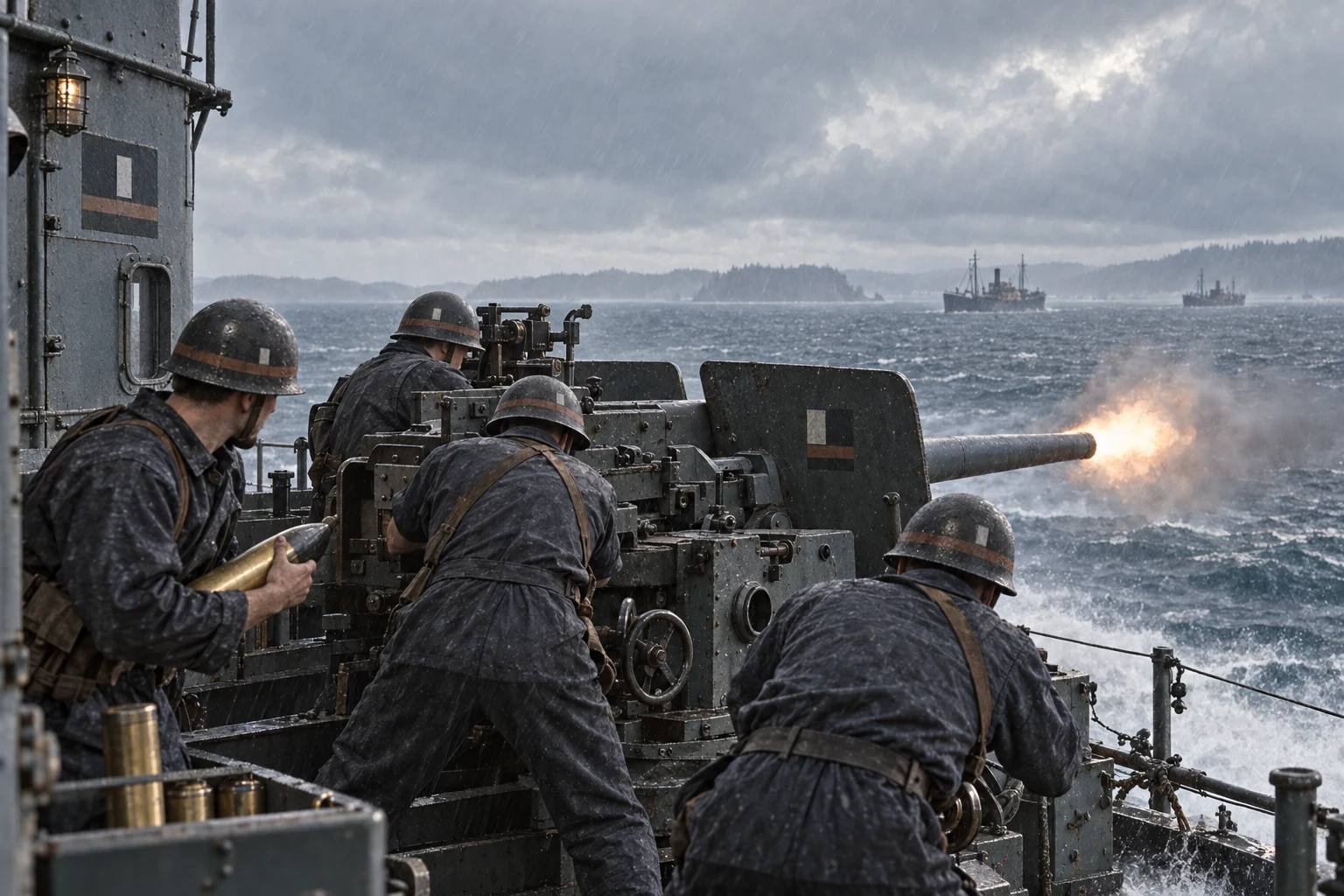
Saito's surface ships engaged the trailing group on June 19 under broken cloud. Dar sent the cruiser Motari Hope and four destroyers to reinforce it, retaining other escorts near the unloading vessels. Captain Nera Sel of Motari Hope identified the approaching cruisers through intermittent visibility and opened fire while merchant ships altered course toward sheltered receiving water. The exchange damaged both sides without producing a decisive surface engagement. A Kelonese shell struck the cruiser's forward handling room, killing its crew and temporarily silencing one gun position.
Below decks, Petty Officer Hara Den organized casualty movement through a passage narrowed by fallen fittings. The ship's medical team had prepared for wounds but not the sudden concentration of burned and smoke-affected men. Sailors from an unengaged gun crew assisted until their own position was called back into action. The division of labor changed with each phase of the battle. Motari Hope remained operational because damage-control parties contained the fire, not because the hit had been minor. Its captain reduced speed afterward and reported the limitation before accepting another pursuit order.
The merchant ship Green Current was less fortunate. Hit during the surface exchange, it began flooding through damaged machinery spaces. Captain Elan Mor abandoned it after attempts to stabilize the ship failed. Escorts rescued most of the crew, but forty-one people died, including passengers assigned to technical work ashore. The ship carried workshop equipment whose loss would delay repairs at several receiving facilities. Dar recorded the cargo loss immediately rather than permit the convoy's arrival announcement to imply that every planned machine had reached its destination.
June 20: The anchorage is attacked
Kelonese aircraft attacked the unloading area on June 20. The anchored ships were harder to maneuver but protected by local fighters and shore defenses. The freighter Pale Orchard suffered a direct hit and sank in shallow water beside its berth. Dock workers and sailors escaped across neighboring lighters, while some cargo remained recoverable above the waterline. The loss blocked part of the quay and required the receiving authority to revise its unloading sequence. Ships carrying perishable medical material were moved ahead of less urgent cargo, even where their original berths had been assigned elsewhere.
Onshore, Nurse Irena Toll supervised the transfer of medical crates from damaged packaging into usable storage. Several boxes had lost their labels, making their contents difficult to distribute safely. A Ranuvan pharmacist traveling with the convoy identified them and reconstructed the inventory. His presence saved supplies that might otherwise have been withheld or misdirected. The convoy's planning had deliberately included receiving specialists as well as cargo, recognizing that a crate unloaded at the quay did not automatically become assistance to the hospital named in its dispatch papers.
Dar declined to send her remaining mobile escorts after Saito's withdrawing surface force. Her immediate responsibility was the convoy and the ships still unloading. Pursuit might have produced an attractive naval success while leaving the receiving area exposed to another attack. The decision drew criticism from a destroyer commander who believed the enemy cruisers were badly damaged. Later reconnaissance confirmed damage to one cruiser but also showed that additional Kelonese ships remained within supporting distance. Dar's caution rested on incomplete information, yet preserved the force required for the next day.
June 21–22: Counting what arrived
A submarine attack on June 21 damaged the transport Clear Horizon as it approached its final unloading point. The ship remained afloat and reached sheltered water under escort. Its passengers included replacement medical personnel, several of whom treated wounded sailors during the passage. The vessel was eventually repaired, but its immediate cargo delivery was delayed. Such outcomes complicated simple loss tables: damaged ships could still deliver people, cargo might arrive later, and a vessel saved from sinking could remain unavailable for months.
By June 22 the convoy's surviving ships had reached their assigned receiving points or protected holding areas. Three merchant vessels had been sunk or written off, seven damaged, and two escorts seriously damaged. Eighty-four percent of the planned cargo tonnage was delivered within the battle period; additional recoverable cargo followed later. Allied military and merchant personnel recorded 263 killed and 418 wounded, with 31 initially missing later confirmed dead included in the final killed total. Kelonese forces lost 187 killed and 296 wounded, one destroyer sunk, and nineteen aircraft.
The operation succeeded because most essential cargo arrived and the receiving system remained capable of handling another convoy. It was neither bloodless nor a disguised Silvian intervention; every escort belonged to an active Allied belligerent. Green Current's lost machinery was reordered, Pale Orchard's accessible cargo salvaged, and Motari Hope entered repair. The public remembered the ships appearing offshore on June 18. Those who worked the convoy remembered the following four days, when arrival had to be converted into supplies ashore, crews recovered, and a route still usable after the celebration ended.
Original illustrations for this source record
Original archive artwork and captions are preserved. Dates, labels and claims printed within inherited images belong to the previous edition; the revised text governs the current history.